
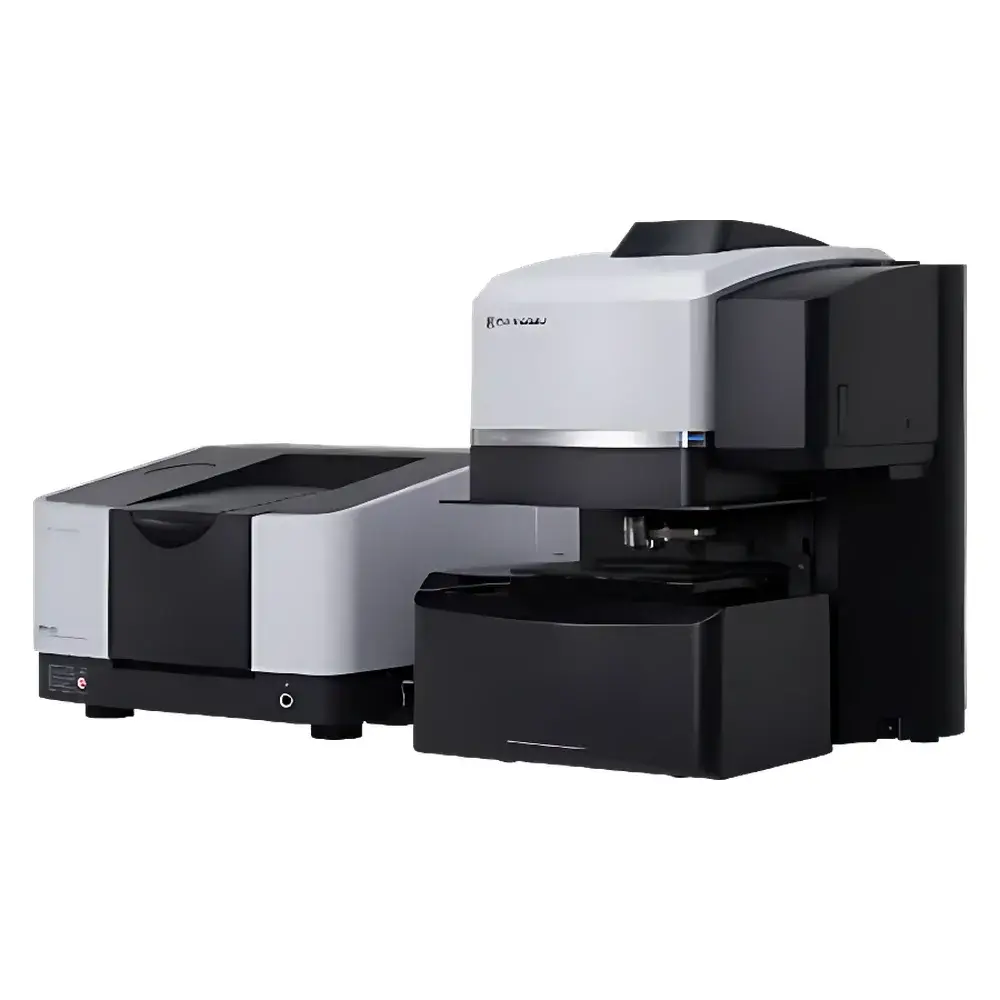
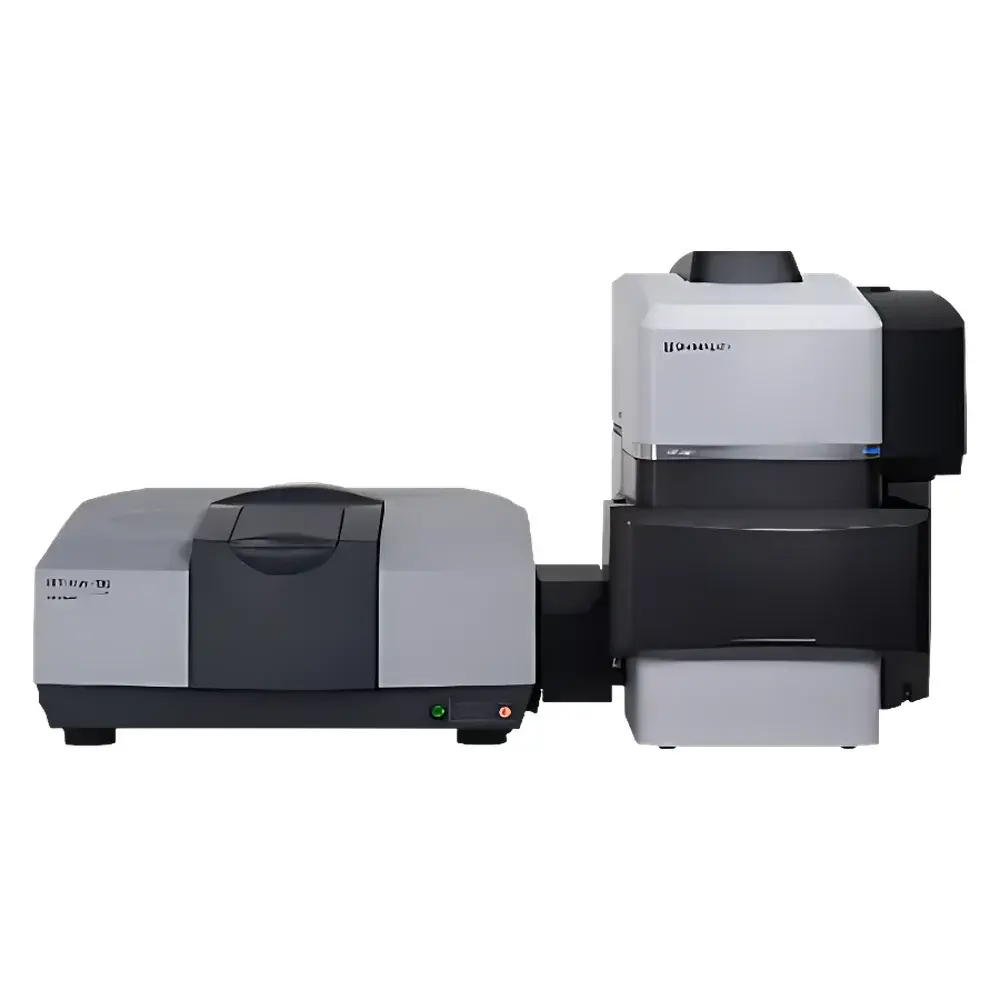
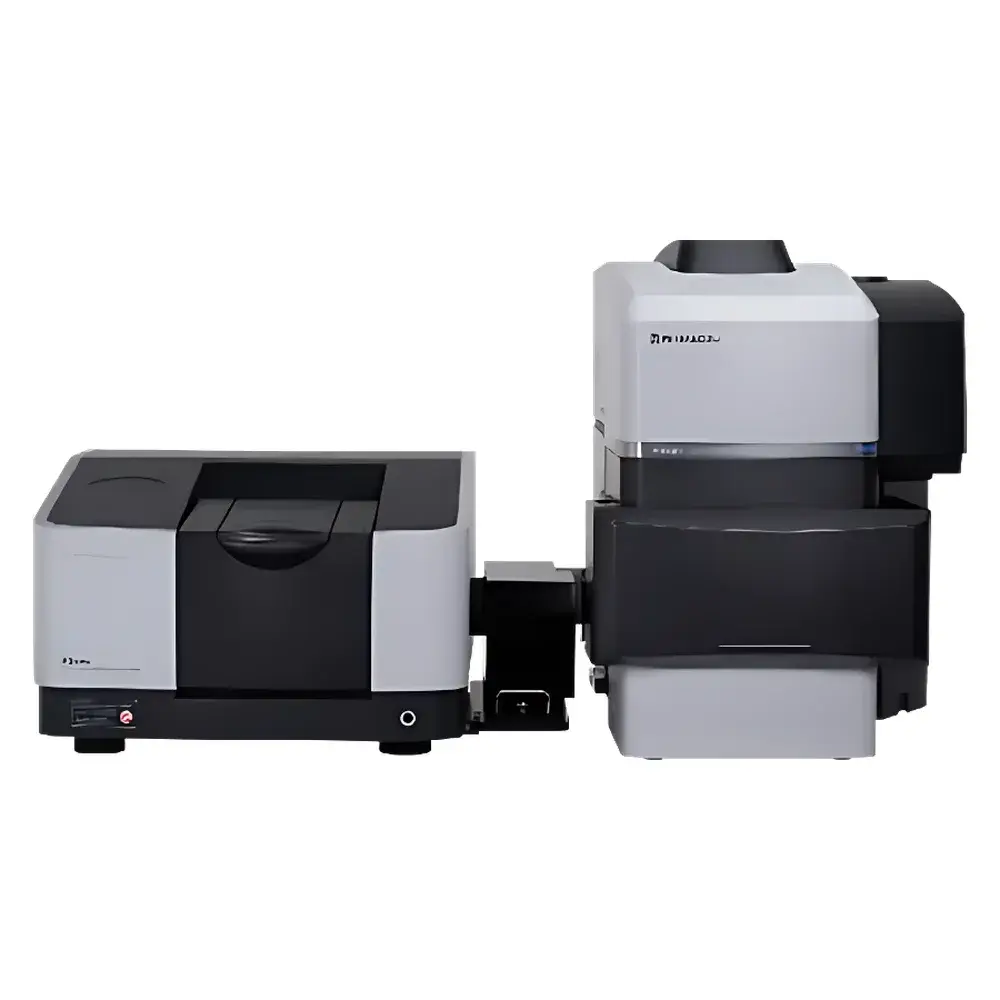
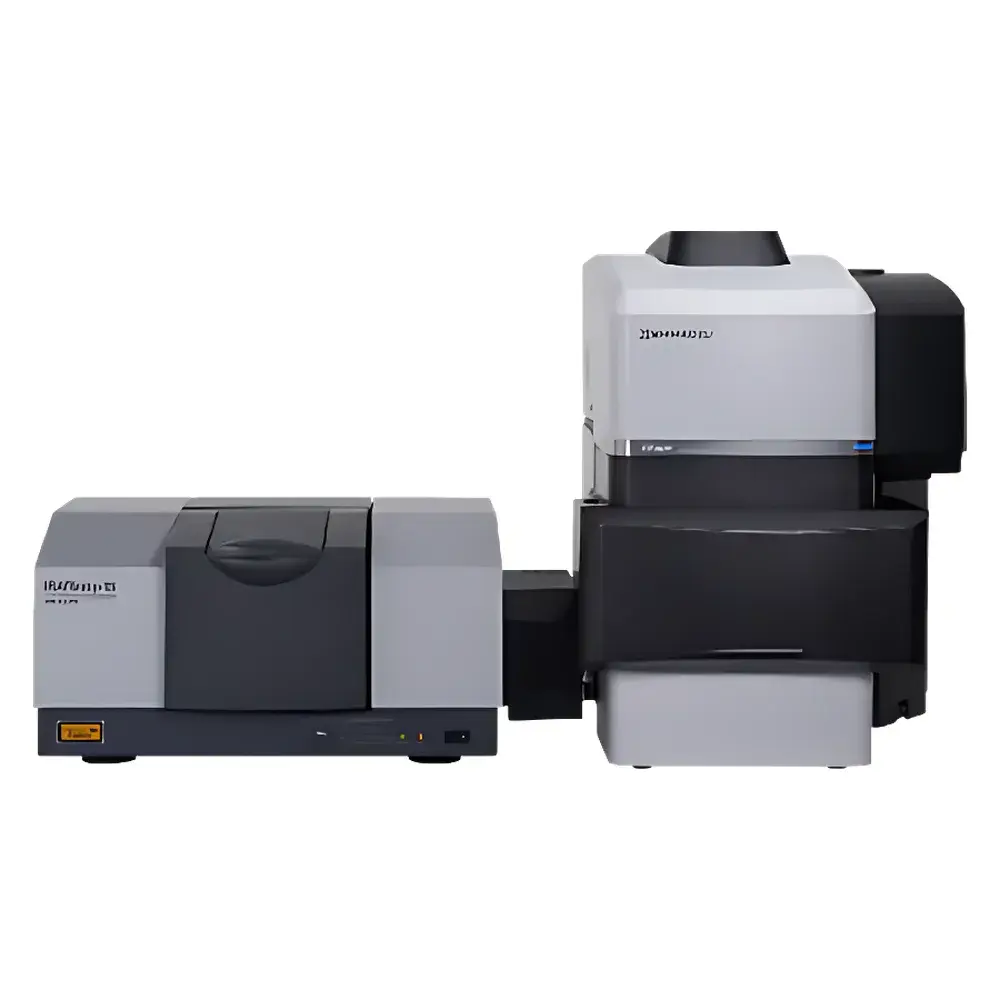
Shimadzu AIRsight Integrated Micro-FTIR and Micro-Raman Spectroscopy Microscope
| Brand | Shimadzu |
|---|---|
| Origin | Japan |
| Manufacturer Type | Original Equipment Manufacturer (OEM) |
| Product Category | Imported Instrument |
| Model | AIRsight |
| Instrument Type | Laboratory Benchtop System |
Overview
The Shimadzu AIRsight is an integrated micro-spectroscopy platform that unifies Fourier Transform Infrared (FTIR) microscopy and confocal Raman microscopy within a single optical path, mechanical stage, and unified software environment. Engineered for correlative molecular analysis at the microscale, it enables simultaneous acquisition of complementary vibrational spectra—FTIR for organic functional group identification (e.g., C=O, O–H, N–H stretches) and Raman for symmetric vibrations, crystalline lattice modes, and inorganic species (e.g., metal oxides, carbon allotropes, silicates)—from the exact same sample location without physical repositioning. This co-registered spectral acquisition eliminates spatial registration error, a critical limitation in sequential or hybrid setups requiring manual realignment. The system leverages a shared high-resolution visible-light microscope with motorized multi-objective turret and wide-field CMOS imaging, enabling precise morphological correlation between optical micrographs and spectral maps. As a fully integrated benchtop instrument, the AIRsight retains full standalone FTIR spectrometer functionality—supporting transmission, ATR, reflectance, and gas-phase measurements across solid, liquid, and gaseous samples—while extending analytical capability to sub-micron spatial resolution (down to ~1 µm lateral resolution in both IR and Raman modes) for micro-domain characterization.
Key Features
- Single-platform, single-software workflow for micro-FTIR and micro-Raman spectroscopy—no hardware switching or software toggling required.
- Co-registered spectral acquisition: infrared and Raman spectra collected from identical XY coordinates on the sample surface, ensuring pixel-perfect spatial correspondence for multimodal chemical mapping.
- Motorized multi-objective turret with position memory: supports interchangeable IR-optimized and Raman-optimized objectives (e.g., 15×, 30×, 75×), all calibrated to a common coordinate system for seamless mode transition.
- Integrated wide-field visible imaging: 5-megapixel CMOS camera provides real-time optical microscopy with overlay-capable annotation tools for ROI marking, size measurement, and contextual correlation with spectral data.
- Dual-beam FTIR spectrometer core: delivers high signal-to-noise ratio (SNR) and photometric accuracy per ASTM E1421 and ISO 18389, with standard MCT detector and optional liquid-nitrogen-cooled detectors for enhanced sensitivity.
- Multi-wavelength laser excitation: configurable 532 nm, 633 nm, and 785 nm lasers optimized for resonance enhancement, fluorescence suppression, and depth profiling across diverse material classes.
Sample Compatibility & Compliance
The AIRsight accommodates a broad range of sample formats—including thin sections, polished wafers, filter membranes, polymer films, biological tissue slices, and powder mounts—without requiring conductive coating or vacuum environments. Its open-stage design supports custom environmental cells (e.g., heating/cooling stages, humidity chambers, electrochemical cells) for in situ and operando studies. The system complies with ISO/IEC 17025 requirements for analytical instrument qualification and supports GLP/GMP workflows through audit-trail-enabled software logging (per FDA 21 CFR Part 11). All spectral acquisition parameters—including laser power, integration time, aperture size, and background correction protocols—are fully traceable and exportable in standardized formats (JCAMP-DX, HDF5, CSV) for regulatory submission.
Software & Data Management
Shimadzu’s LabSolutions IR/Raman software provides a unified interface for instrument control, spectral acquisition, multivariate analysis (PCA, cluster analysis, spectral subtraction), and hyperspectral imaging. Built-in chemometric libraries support automated peak identification against commercial and custom reference databases (e.g., SDBS, NIST, in-house libraries). Data processing modules include baseline correction (asymmetric least squares), smoothing (Savitzky-Golay), normalization (vector, min-max), and spectral deconvolution. All user actions—including method creation, calibration validation, and report generation—are logged with timestamps, operator ID, and parameter metadata. Raw and processed data files are stored in a hierarchical project structure compliant with FAIR (Findable, Accessible, Interoperable, Reusable) principles, facilitating integration with LIMS and ELN systems.
Applications
- Pharmaceutical polymorph identification and distribution mapping in tablet cross-sections.
- Micro-contaminant analysis in semiconductor wafers and packaging materials.
- Correlative analysis of biomineralization in bone and dental tissue—combining collagen (FTIR) and hydroxyapatite (Raman) signatures.
- Forensic fiber and paint chip analysis with simultaneous detection of organic dyes and inorganic pigments.
- Microplastic identification and aging assessment via carbonyl index (FTIR) and crystallinity mapping (Raman).
- 2D material characterization (e.g., graphene layer count, strain, doping) using G- and 2D-band Raman shifts coupled with functional group mapping via FTIR.
FAQ
Can the AIRsight perform true simultaneous IR and Raman acquisition?
No—the system acquires IR and Raman spectra sequentially but with sub-micron positional repeatability; the shared coordinate system ensures <0.5 µm registration accuracy between modalities.
Is ATR capability available for micro-FTIR mode?
Yes—micro-ATR accessories with diamond, germanium, or silicon crystals are supported, enabling surface-sensitive analysis of non-transparent or hydrated samples.
What is the minimum detectable sample mass for micro-Raman analysis?
Detection limits depend on laser wavelength and sample properties; typical nanogram-scale sensitivity is achievable for strongly scattering crystalline materials under optimized conditions.
Does the system support automated spectral imaging (mapping)?
Yes—both micro-FTIR and micro-Raman mapping are fully automated with programmable step sizes (down to 0.1 µm), dwell times, and spectral accumulation strategies.
Are third-party spectral libraries compatible with LabSolutions IR/Raman?
Yes—the software accepts JCAMP-DX formatted libraries and supports import/export of spectral metadata for interoperability with open-source chemometrics platforms (e.g., scikit-learn, Python-based spectral analysis tools).
Related Products






