
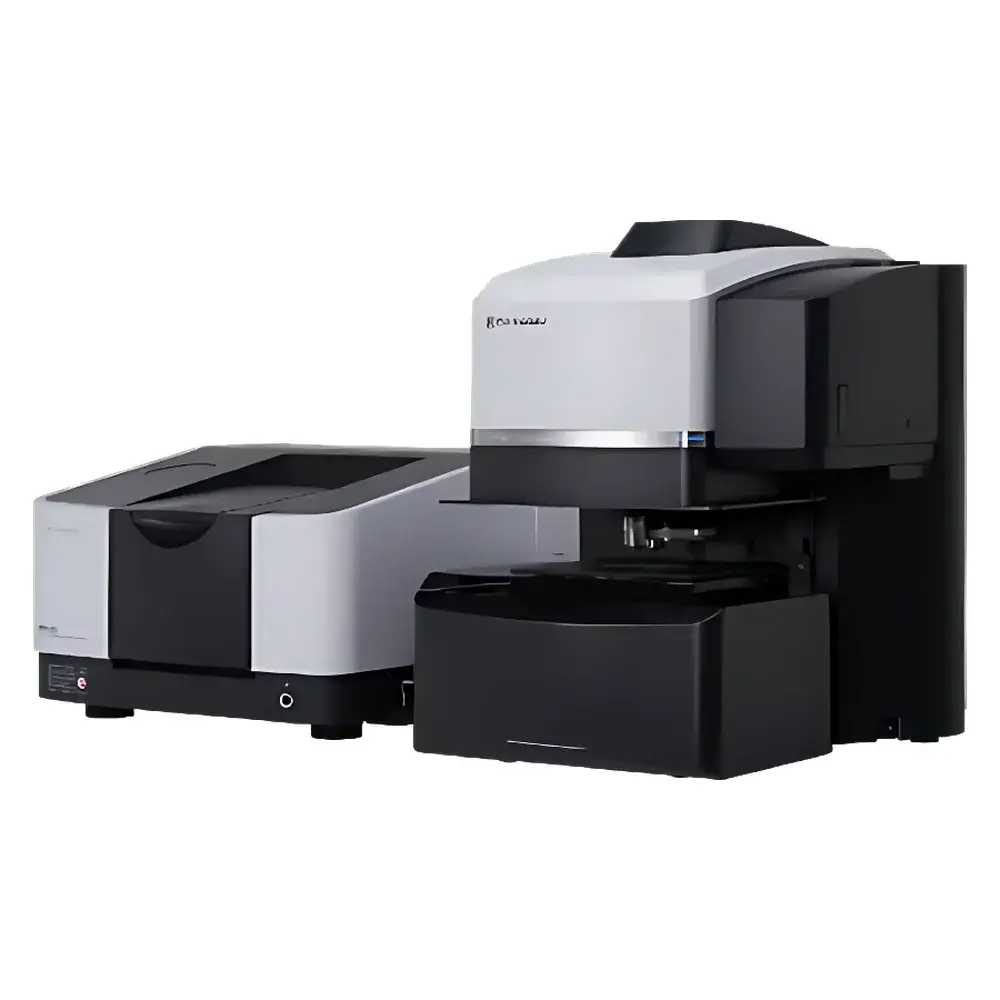
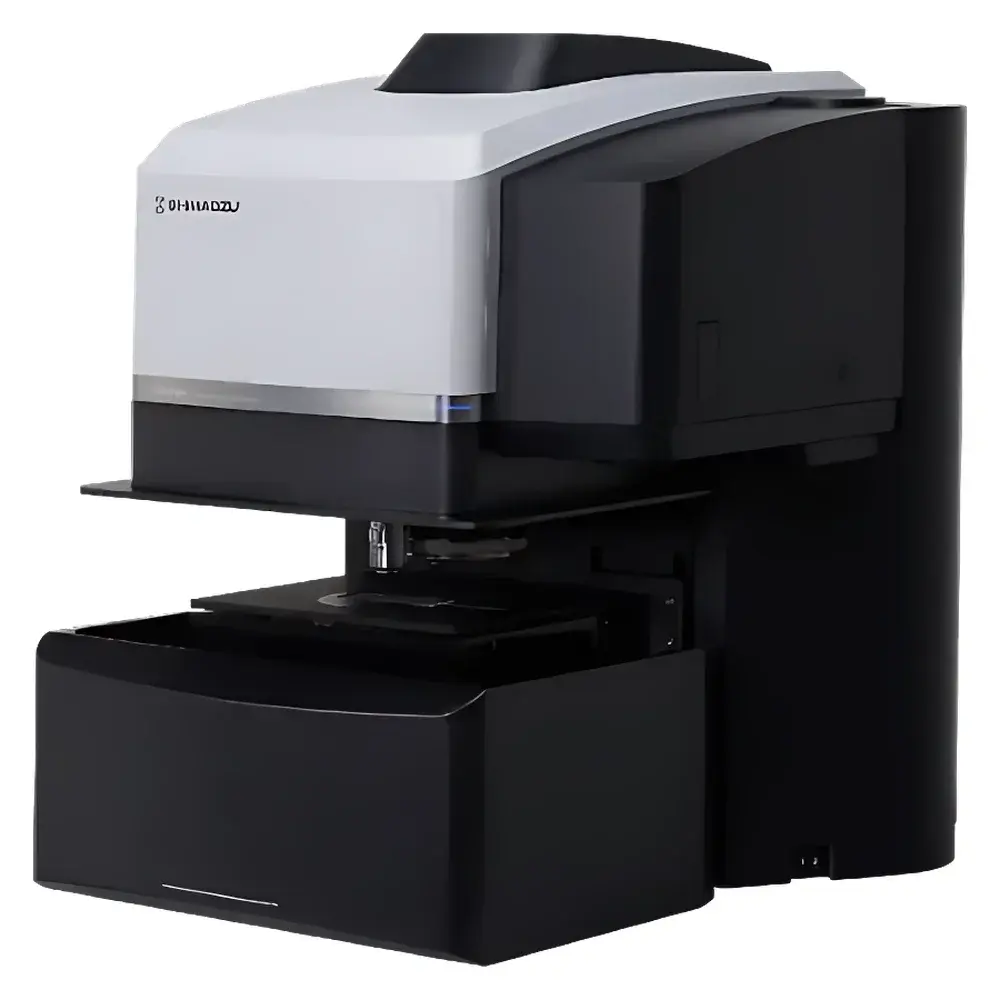
Shimadzu AIRsight Integrated Micro-FTIR and Micro-Raman Spectroscopy System
| Brand | Shimadzu |
|---|---|
| Origin | Japan |
| Manufacturer Type | Original Equipment Manufacturer (OEM) |
| Import Category | Imported Instrument |
| Model | AIRsight |
| Price Range | USD 270,000 – 405,000 |
Overview
The Shimadzu AIRsight is an integrated micro-FTIR and micro-Raman spectroscopy system engineered for correlative molecular characterization at the microscale. Unlike conventional sequential or hybrid setups requiring manual repositioning or software switching, the AIRsight unifies Fourier Transform Infrared (FTIR) microscopy and confocal laser Raman microscopy within a single optical platform—sharing one microscope body, one motorized multi-objective turret, one high-resolution visible-light imaging system, and one unified software environment. It operates on the principle of complementary vibrational spectroscopy: FTIR detects dipole-active vibrations (e.g., C=O, O–H, N–H stretches), while Raman spectroscopy probes polarizability changes (e.g., C≡C, S–S, symmetric ring modes), enabling comprehensive structural analysis of organic, inorganic, polymeric, and crystalline materials down to micron-scale domains. The system maintains full compliance with ISO 17025 analytical method validation requirements and supports traceable instrument performance verification per ASTM E1421 and ISO 18365 standards.
Key Features
- Single-platform correlative spectroscopy: Simultaneous micro-FTIR and micro-Raman acquisition from identical sample coordinates without physical relocation—eliminating spatial registration error and enabling sub-5 µm positional reproducibility.
- Shared optical architecture: Motorized multi-objective turret accommodates both IR-transmissive (e.g., CaF₂, BaF₂) and Raman-optimized (e.g., fused silica, apochromatic) objectives, with automatic coordinate mapping between modalities via integrated stage encoders and camera-based fiducial referencing.
- Large-field-of-view visible imaging: 5-megapixel CMOS camera with real-time focus-assisted navigation and automated scale calibration; supports overlay of spectral acquisition points onto morphological images for precise micro-area targeting.
- Dual-mode spectral acquisition engine: FTIR module utilizes a high-stability Michelson interferometer (1 cm⁻¹ resolution, 7500–370 cm⁻¹ range); Raman module integrates multiple excitation wavelengths (532 nm, 785 nm, optional 633 nm) with notch/edge filters, thermoelectrically cooled CCD detector, and confocal pinhole control (adjustable 10–100 µm).
- Full-system infrared capability: When detached from the microscope head, the base FTIR spectrometer functions independently for bulk solid, liquid, and gas-phase analysis—including transmission, ATR, DRIFT, and gas cell configurations—ensuring laboratory-wide utility beyond microanalysis.
Sample Compatibility & Compliance
The AIRsight accommodates diverse sample formats including polished solids, thin sections, powders, microtomed biological tissues, polymer films, semiconductor wafers, and encapsulated liquids. Its modular design complies with GLP/GMP documentation workflows, supporting audit trails, electronic signatures, and 21 CFR Part 11–compliant data integrity protocols through Shimadzu LabSolutions IR software. All spectral acquisitions meet ISO/IEC 17025 requirements for uncertainty estimation, with built-in reference standards (polystyrene film for FTIR, silicon wafer for Raman) and automated linearity/photometric accuracy checks. Optional environmental stages (heating/cooling, humidity control) enable in situ reaction monitoring under controlled atmospheres.
Software & Data Management
LabSolutions IR v6.x provides a unified interface for instrument control, spectral acquisition, multivariate analysis (PCA, cluster analysis, spectral subtraction), chemical imaging (false-color mapping), and report generation. Data files adhere to JCAMP-DX and ANDI/MSD formats for cross-platform compatibility. The software includes embedded spectral libraries (Sadtler, BioRad, Polymer), quantitative calibration tools (Beer–Lambert modeling, internal standard correction), and batch-processing modules for high-throughput mapping. All raw and processed data are stored in a relational database with time-stamped metadata, version-controlled processing history, and role-based access control—fully aligned with FDA and EMA data governance expectations.
Applications
- Pharmaceutical development: Polymorph identification in API microcrystals, coating uniformity assessment, and contaminant localization in tablet cross-sections.
- Materials science: Phase distribution analysis in composites, stress-induced Raman shifts in strained semiconductors, and degradation product mapping in aged polymers.
- Forensics: Fiber and paint chip discrimination via combined IR/Raman fingerprinting, with sub-10 µm spatial resolution for layer-by-layer interrogation.
- Life sciences: Label-free histopathology of unstained tissue sections, lipid/protein ratio quantification in single cells, and mineralization profiling in bone biopsies.
- Microelectronics: Residual stress evaluation in thin-film transistors, interfacial contamination detection at dielectric interfaces, and dopant distribution imaging in SiGe heterostructures.
FAQ
How does the AIRsight ensure spatial correlation between FTIR and Raman measurements?
Through hardware-synchronized stage positioning, calibrated objective lens centering, and real-time visible-image registration—enabling <1 µm coordinate transfer fidelity between modalities.
Can the system perform true simultaneous acquisition of FTIR and Raman spectra?
No—it acquires sequentially within the same field of view using shared coordinate referencing; however, total cycle time per location is typically <90 seconds, minimizing thermal drift effects.
Is external laser safety certification included?
Yes—the 532 nm and 785 nm laser sources comply with IEC 60825-1:2014 Class 3B requirements, with integrated interlocks, beam shutters, and certified operator training documentation.
What level of spectral resolution is achievable in micro-Raman mode?
Up to 2 cm⁻¹ (full width at half maximum) with 1800 grooves/mm grating and optimized slit settings—validated using the 520.7 cm⁻¹ Raman band of crystalline silicon.
Does the system support hyphenated techniques such as TGA-FTIR or GC-FTIR?
While the base AIRsight is not configured for hyphenation, its FTIR spectrometer module is fully compatible with Shimadzu’s TGA-50/50H and GCMS-QP2020 NX interfaces via standard analog/digital I/O and Ethernet control protocols.




