
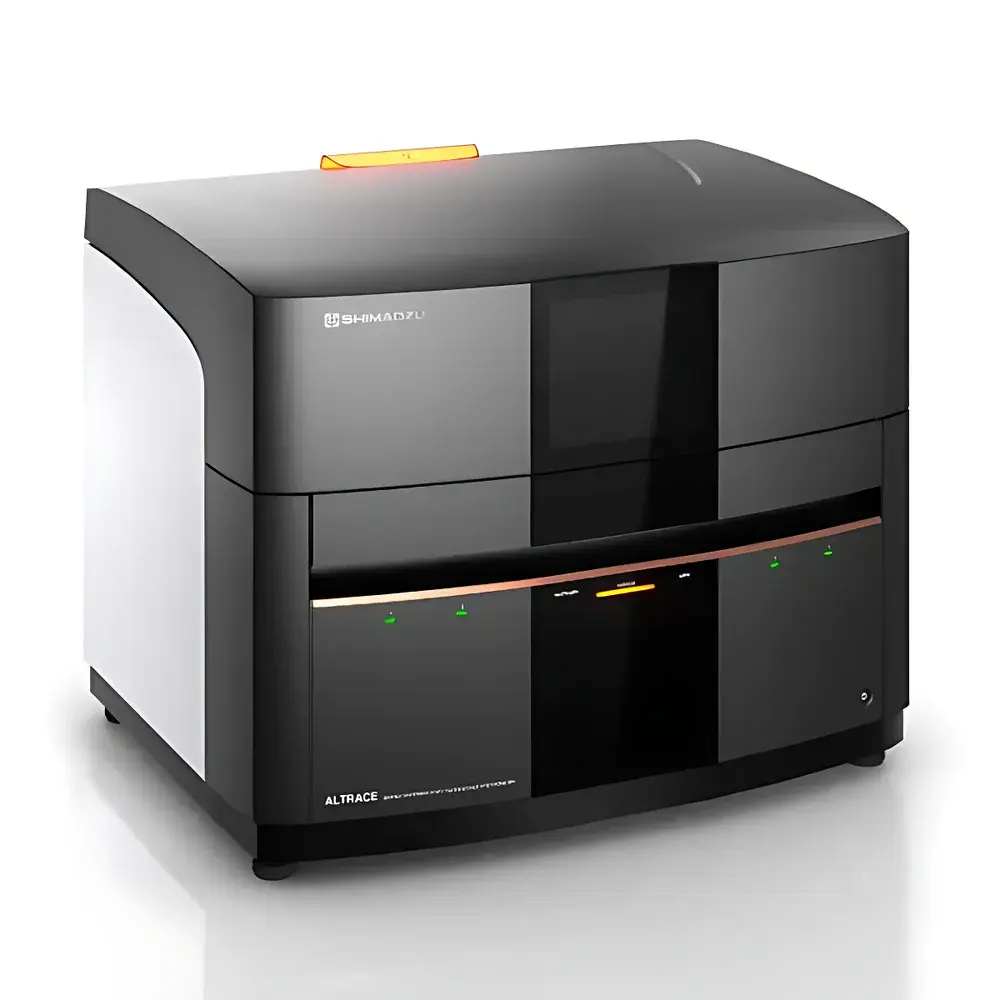
Shimadzu ALTRACE High-Sensitivity Energy Dispersive X-Ray Fluorescence Spectrometer
| Brand | Shimadzu |
|---|---|
| Origin | Japan |
| Manufacturer Type | Original Equipment Manufacturer (OEM) |
| Import Status | Imported |
| Model | ALTRACE |
| Configuration | Benchtop/Floor-standing |
| Instrument Type | Conventional ED-XRF |
| Application Scope | General-purpose |
| Elemental Range | Na (Z=11) to U (Z=92) |
| Quantification Range | 1 ppm – 99.99 wt% |
| Energy Resolution | <140 eV (Mn Kα) |
| Detector | Silicon Drift Detector (SDD) |
Overview
The Shimadzu ALTRACE is a high-sensitivity, benchtop/floor-standing energy dispersive X-ray fluorescence (ED-XRF) spectrometer engineered for precise, non-destructive elemental analysis across a broad range of sample matrices. Operating on the fundamental principle of X-ray fluorescence—where primary X-rays excite inner-shell electrons in sample atoms, resulting in characteristic secondary (fluorescent) X-ray emission—the ALTRACE leverages optimized optical geometry and Shimadzu’s proprietary high-speed pulse processing electronics to maximize photon collection efficiency and spectral fidelity. Its design prioritizes analytical flexibility without compromising detection capability: capable of quantifying elements from sodium (Z = 11) through uranium (Z = 92), it delivers robust performance for both trace-level screening and major-component quantification in a single measurement sequence. The instrument is particularly suited for laboratories requiring rapid, routine elemental profiling where minimal sample preparation, regulatory traceability, and long-term measurement stability are operational imperatives.
Key Features
- High-sensitivity detection enabled by a large-area silicon drift detector (SDD) with <140 eV energy resolution at Mn Kα—ensuring clear peak separation and accurate deconvolution of overlapping spectral lines.
- Optimized X-ray optics and excitation geometry that enhance signal-to-background ratio, supporting reliable detection down to sub-ppm levels for many elements in favorable matrices.
- Flexible configuration options: available in both benchtop and floor-standing variants to accommodate space-constrained labs or high-throughput environments requiring extended sample capacity.
- Automated 48-position sample changer with drawer-style tray insertion—enabling unattended operation and seamless mid-run sample addition without interrupting ongoing measurements.
- True multi-element capability: simultaneous quantitative analysis of up to 30+ elements per measurement, with calibrated response across the full Na–U range.
- No chemical dissolution, digestion, or dilution required for solid powders or homogeneous liquids—preserving sample integrity and eliminating acid handling risks and method-induced bias.
Sample Compatibility & Compliance
The ALTRACE accommodates a wide variety of sample forms—including pressed pellets, loose powders, filters, thin films, and stable liquid suspensions—without mandatory pre-treatment. Its sealed X-ray chamber and interlocked safety system comply with IEC 61010-1 and ISO 20885 for radiation safety in laboratory environments. Method development and validation workflows align with ISO 17025 requirements for testing laboratories; spectral data acquisition supports audit-ready metadata logging, including operator ID, timestamp, instrument parameters, and calibration history. While not inherently 21 CFR Part 11 compliant out-of-the-box, the optional software package provides electronic signature support, user access controls, and immutable audit trails—facilitating GLP/GMP-aligned deployment in regulated pharmaceutical, environmental, and materials QA/QC settings.
Software & Data Management
Controlled via Shimadzu’s dedicated ALTRACE Analysis Software, the system offers intuitive workflow-driven operation—from automated calibration and background subtraction to matrix-matched standardization and empirical coefficient correction. Quantitative modules include fundamental parameter (FP) and empirical calibration modes, with built-in libraries for common standards (e.g., NIST SRMs, JSS certified reference materials). All spectra and results are stored in vendor-neutral formats (e.g., .csv, .txt, .rdb) and support export to LIMS via ODBC or direct API integration. Raw spectral data retains full channel-by-channel intensity information, enabling retrospective reprocessing with updated calibrations or alternate deconvolution algorithms—critical for long-term data re-evaluation and method transfer.
Applications
- Rapid screening of RoHS-compliant electronics components for restricted substances (Pb, Cd, Hg, Cr⁶⁺, Br).
- Geochemical exploration and mining QA/QC—quantifying base metals (Cu, Zn, Ni), precious metals (Au, Ag), and pathfinder elements in soil and rock powders.
- Catalyst composition verification in petrochemical R&D, including Pt/Pd/Rh loading and promoter element distribution.
- Quality control of battery cathode materials (LiNiCoMnO₂, LiFePO₄), monitoring transition metal stoichiometry and impurity content (Fe, Al, Ca).
- Forensic glass and paint chip analysis using trace-element fingerprinting for provenance determination.
- Environmental monitoring of airborne particulate matter (PM₁₀/PM₂.₅) collected on filter media.
FAQ
Does the ALTRACE require vacuum or helium purge for light element analysis?
No—its optimized detector window and low-noise electronics enable reliable detection of sodium (Na) and magnesium (Mg) under atmospheric conditions, though argon purging may further improve sensitivity for Na in demanding applications.
Can the ALTRACE be used for depth-profiling or layered film analysis?
Not natively—ED-XRF is inherently bulk-sensitive with limited depth resolution (~micrometers to tens of micrometers depending on matrix density and excitation energy); complementary techniques such as TXRF or SEM-EDS are recommended for nanoscale stratigraphy.
Is method transfer between ALTRACE units supported?
Yes—calibration files, spectral libraries, and analysis protocols are fully portable across ALTRACE instruments of the same generation, provided detector gain and high-voltage settings are synchronized during installation.
What maintenance is required for sustained performance?
Annual detector cooling system inspection, periodic X-ray tube output verification using certified check standards, and routine cleaning of the sample chamber and collimator aperture are recommended per Shimadzu’s preventive maintenance schedule.






