
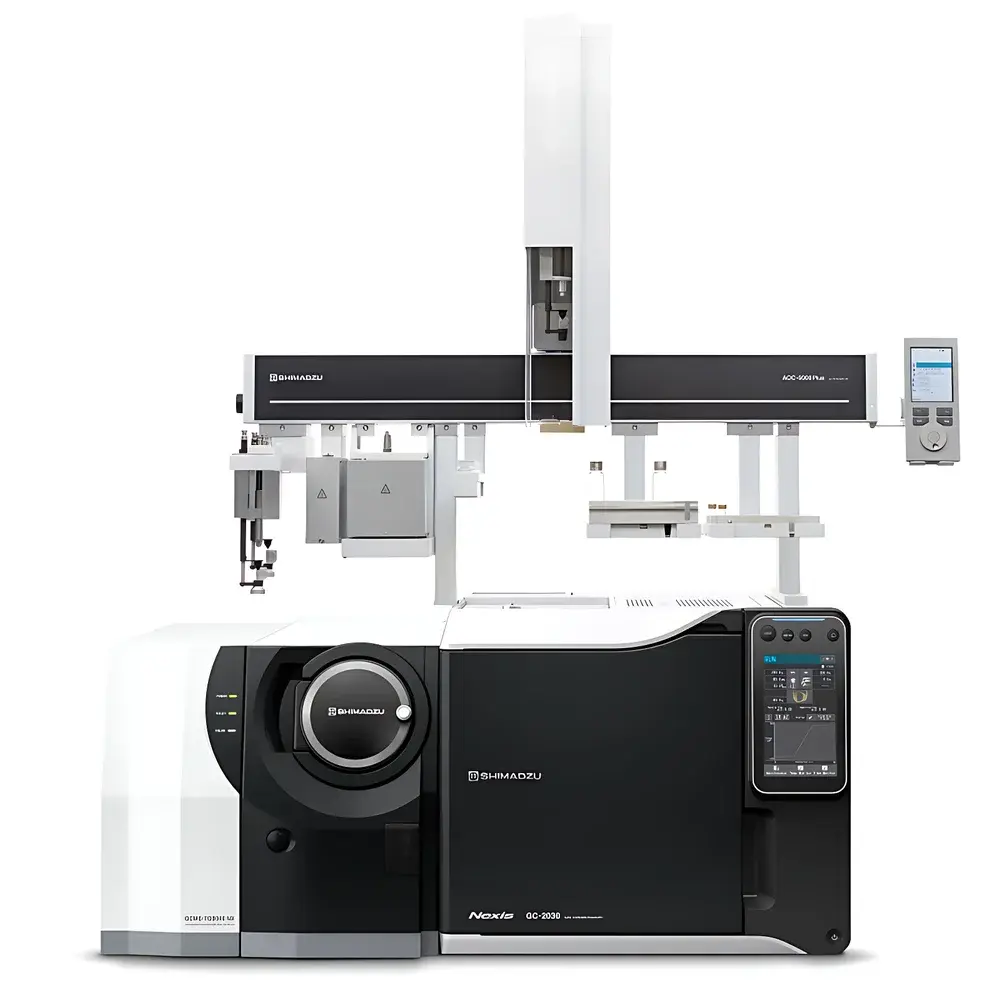
Shimadzu AOC-6000 Plus Multifunctional Autosampler
| Brand | Shimadzu |
|---|---|
| Origin | Switzerland |
| Manufacturer | Shimadzu Corporation |
| Product Type | Multifunctional Autosampler |
| Model | AOC-6000 Plus |
| Motion System | XYZ 3-axis robotic arm |
| Needle Wash | Internal & external wall cleaning |
| Repeat Injection Capability | Unlimited |
| Compatible Sample Introduction Modes | Liquid injection, headspace (HS), solid-phase microextraction (SPME), SPME Arrow, and ITEX-DHS |
| Software Integration | Native control via LabSolutions and GCMSsolution |
| Compliance | Designed for GLP/GMP environments with audit-trail-ready operation (21 CFR Part 11 compliant configuration available) |
| Sample Processing Functions | Automated standard curve preparation, internal standard addition, on-line derivatization, μSPE, and sequential method switching |
Overview
The Shimadzu AOC-6000 Plus Multifunctional Autosampler is an engineered solution for high-throughput, multi-modal sample introduction in gas chromatography (GC) and gas chromatography–mass spectrometry (GC-MS) laboratories. Built upon a precision XYZ 3-axis robotic architecture driven by high-resolution stepper motors, the AOC-6000 Plus supports concurrent implementation of liquid injection, static/dynamic headspace (HS), conventional SPME, SPME Arrow, and ITEX-DHS (Integrated Thermal Extraction–Dynamic Headspace) techniques — all within a single, unattended sequence. Its modular design enables seamless integration with Shimadzu’s Twin Line MS system, allowing dual-column, dual-method analysis without manual intervention or instrument downtime. Unlike legacy autosamplers limited to fixed-mode operation, the AOC-6000 Plus redefines analytical flexibility by embedding intelligent hardware coordination — including automatic needle exchange, thermal management, and real-time consumable tracking — into its core operational logic.
Key Features
- Triple-Mode Auto-Switching: Fully automated transition between liquid, headspace, and SPME/SPME Arrow/ITEX-DHS injection modes using dedicated, motorized needle carousels and position-calibrated tool changers.
- SPME Arrow & ITEX-DHS Support: Integrated hardware and firmware support for SPME Arrow fibers (enhanced mechanical robustness, 3–5× higher sorbent capacity vs. standard SPME) and ITEX-DHS cartridges (multi-cycle headspace enrichment followed by thermal desorption in a single injection event).
- Twin Line MS Synchronization: Native handshake protocol with Shimadzu’s Twin Line MS interface, enabling simultaneous acquisition from two independent GC columns under distinct methods (e.g., HS + SPME) within one run list — eliminating column changeovers and method reinitialization delays.
- Intelligent Consumables Management: RFID-enabled recognition of smart needles, SPME fibers, and SPME Arrow units; auto-reads temperature limits, cumulative usage cycles, last calibration date, and remaining service life — logged with timestamped audit trail.
- On-Board Sample Preparation: Programmable liquid handling functions including serial dilution, internal standard spiking, online derivatization (with optional heated reaction zone), and micro-solid-phase extraction (μSPE) using disposable tips or packed cartridges.
Sample Compatibility & Compliance
The AOC-6000 Plus accommodates vials (2–40 mL), SPME fiber holders, ITEX-DHS cartridges, and headspace crimp-top vials across ambient to 150 °C sample heating ranges. All fluidic pathways are chemically inert (PFA, fused silica, and stainless-steel components), ensuring compatibility with aggressive solvents (e.g., chlorinated hydrocarbons, strong acids/bases) and volatile analytes (e.g., BTEX, formaldehyde, sulfur compounds). The system meets ISO/IEC 17025 requirements for method validation and is configurable for full 21 CFR Part 11 compliance, including electronic signatures, user access controls, and immutable audit logs for GLP and regulated pharmaceutical/environmental testing.
Software & Data Management
Control and method development occur natively within Shimadzu’s LabSolutions and GCMSsolution platforms — no third-party drivers or middleware required. Method files embed not only injection parameters but also consumable ID binding, sample prep scripts, and error-handling routines (e.g., needle clog detection, vial cap puncture verification). All sequence logs, maintenance records, and consumable history are stored in SQLite-based local databases with optional export to LIMS via CSV or XML. Remote monitoring and diagnostic alerts are supported via Ethernet-connected status polling and SNMP traps.
Applications
The AOC-6000 Plus serves as a central hub for regulated and research-driven workflows: residual solvent analysis (ICH Q3C) using headspace-GC; trace-level environmental contaminants (EPA Method 8260D, 502.2) via SPME Arrow–GC–MS; forensic toxicology screening with automated derivatization and μSPE cleanup; flavor & fragrance profiling requiring rapid HS–SPME mode switching; and clinical biomarker quantification where internal standard addition and standard curve generation must be fully traceable. Its reproducibility (RSD < 0.8% for peak area across 100 injections) and cross-mode precision make it suitable for method transfer between QC and R&D labs.
FAQ
Can the AOC-6000 Plus operate independently of Shimadzu GC systems?
Yes — it supports standalone operation via front-panel touchscreen or remote command execution (SCPI over TCP/IP), though full SPME Arrow/ITEX-DHS functionality requires Shimadzu GC/GCMS hardware synchronization.
Is firmware update capability available remotely?
Firmware updates are delivered via Shimadzu’s official software update portal and installed through LabSolutions; remote push deployment is restricted to authorized service personnel under controlled network conditions.
Does the system support custom needle wash solvents?
Yes — up to three independent wash stations (primary, secondary, rinse) accept user-defined solvents with programmable dwell time, volume, and aspiration speed.
What is the maximum vial capacity per rack?
Standard racks hold 108 × 2-mL vials; optional high-density trays accommodate 144 positions; SPME/ITEX accessories reduce capacity to 72–96 depending on carrier geometry.
How is carryover mitigated during high-concentration sample analysis?
Carryover suppression employs multi-stage needle wash (internal flush + external rinse + bake-out at 250 °C), plus optional active needle purge gas flow and real-time pressure monitoring to verify seal integrity before each injection.




