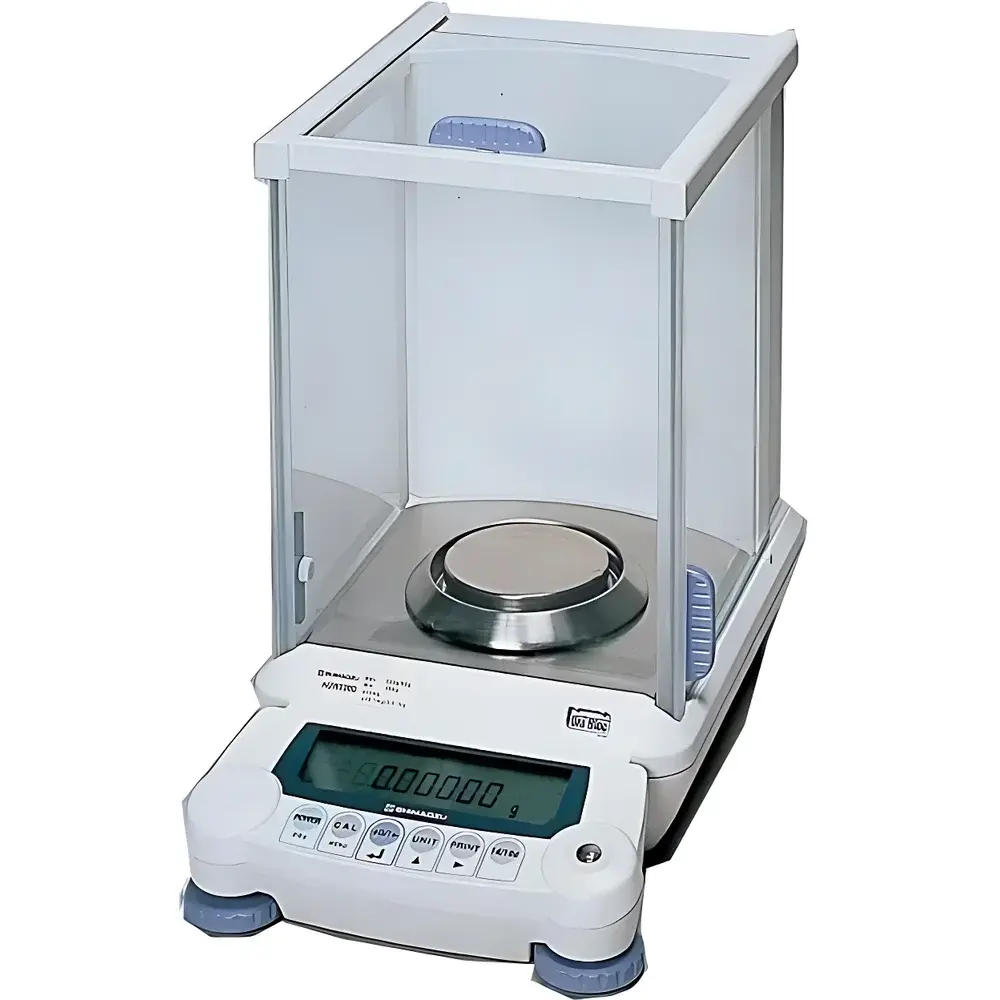
Shimadzu AUX220 Analytical Balance
| Brand | Shimadzu |
|---|---|
| Origin | Japan |
| Manufacturer Type | Original Equipment Manufacturer (OEM) |
| Product Category | Imported Instrument |
| Model | AUX220 |
| Instrument Type | Analytical Balance |
| Maximum Capacity | 220 g |
| Readability | 0.1 mg |
| Standard Deviation | ≤0.1 mg |
| Linearity Error | ±0.2 mg |
| Stabilization Time | 3 s |
| Internal Calibration | Yes |
| Operating Temperature Range | 5–40 °C |
| Sensitivity Drift (PSC OFF, 10–30 °C) | ±2 ppm/°C |
| Sensitivity Drift (PSC ON, 10–30 °C) | ±2 ppm/°C |
| Pan Diameter | 80 mm |
| Dimensions (W×D×H) | 220 × 330 × 310 mm |
| Weight | 7 kg |
| Power Consumption | 7 VA |
Overview
The Shimadzu AUX220 Analytical Balance is a high-precision mass measurement instrument engineered for laboratories requiring consistent repeatability, traceable calibration, and regulatory compliance in routine and critical weighing tasks. Based on electromagnetic force compensation (EMFC) technology, the AUX220 employs a monolithic modular sensor design—eliminating mechanical linkages and reducing susceptibility to thermal drift, vibration, and wear. This architecture delivers exceptional long-term stability and metrological integrity across daily use in QC, R&D, and GLP/GMP environments. With a maximum capacity of 220 g and readability of 0.1 mg, the balance meets the performance criteria defined in ISO 9001, ISO/IEC 17025, and USP for analytical weighing applications where uncertainty budgets must be rigorously controlled.
Key Features
- Monolithic Modular Sensor: Integrated single-body transducer ensures minimal hysteresis, superior linearity (<±0.2 mg), and resistance to mechanical stress—critical for high-frequency, multi-user lab workflows.
- Internal Automatic Calibration (IAC): Built-in calibration mass enables motor-driven, temperature-compensated recalibration at user-defined intervals or upon environmental trigger (e.g., ΔT ≥ 2 °C), supporting audit-ready documentation per FDA 21 CFR Part 11 requirements.
- Proportional Sensitivity Control (PSC): Active temperature compensation mode reduces sensitivity drift to ±2 ppm/°C within 10–30 °C ambient range—essential for labs lacking climate-controlled weighing rooms.
- GLP/GMP-Compliant Reporting: Onboard clock and event log generate timestamped calibration reports with operator ID, date/time, deviation values, and pass/fail status—fully exportable via RS-232 interface.
- Direct-View Interface (DVI): Real-time analog-style display mirrors digital readout, enabling rapid visual verification without cognitive load—particularly valuable during volumetric dilution or gravimetric standard preparation.
- Multi-Function Application Modes: Preloaded software modules support density determination (with auxiliary density kit), piece counting, percentage weighing, unit conversion (g, mg, oz, ct, etc.), and interval-triggered data logging.
Sample Compatibility & Compliance
The AUX220 accommodates standard laboratory sample vessels—including crucibles, weighing boats, and vials—on its 80 mm diameter stainless-steel pan. Its compact footprint (220 × 330 × 310 mm) and low power draw (7 VA) allow seamless integration into fume hoods, glove boxes, and ISO Class 5 clean benches. The instrument complies with international electromagnetic compatibility (EMC) standards IEC 61326-1 and safety standard IEC 61010-1. All firmware operations adhere to ISO/IEC 17025 clause 6.4.10 (software validation) and support full traceability under GLP and GMP frameworks. Calibration certificates are issued with NIST-traceable reference masses and include uncertainty budgets per EURAMET cg-18.
Software & Data Management
Data output is supported exclusively via RS-232 serial interface (no USB or Ethernet), ensuring deterministic timing and compatibility with legacy LIMS, ERP, and statistical process control (SPC) platforms. Interval-based output (programmable from 1–999 seconds) enables automated batch recording without host PC intervention. All exported records include header metadata: model number, serial ID, timestamp, net weight, tare value, stability flag, and calibration status. Audit trail functionality logs every calibration, zeroing, and parameter change—with immutable timestamps and operator identification when integrated with external access control systems. Firmware supports user-level privilege management (administrator/operator/guest) aligned with 21 CFR Part 11 electronic signature requirements.
Applications
- Gravimetric preparation of certified reference materials (CRMs) and internal standards in pharmaceutical QC labs.
- Weighing of active pharmaceutical ingredients (APIs) prior to tablet compression, adhering to USP minimum weight thresholds.
- Density determination of powders and granules using hydrostatic weighing protocols per ASTM D792.
- Inventory management via piece counting for catalysts, filters, or microfluidic components.
- Environmental monitoring labs performing filter weighing for PM2.5/PM10 analysis per EPA Method 201A.
- Academic research requiring high-reproducibility mass inputs for stoichiometric reaction modeling or isotopic ratio calibration.
FAQ
Does the AUX220 support external calibration with user-provided weights?
Yes—the balance accepts manual calibration using Class E2 or better weights traceable to national metrology institutes. Internal calibration remains available but is disabled during external procedure execution.
Is the RS-232 interface optically isolated?
No—RS-232 communication uses standard voltage-level signaling (±3 to ±15 V). For electrically noisy environments, use shielded twisted-pair cabling and ground-loop isolation adapters.
Can the AUX220 be operated inside a nitrogen-purged glove box?
Yes—provided ambient temperature remains within 5–40 °C and relative humidity does not exceed 80 % RH non-condensing. No modifications to housing or ventilation are required.
What is the recommended recalibration frequency under ISO/IEC 17025?
Calibration interval must be risk-assessed per clause 6.4.10; typical practice is daily zeroing + weekly full-range calibration, supplemented by documented intermediate checks using certified check weights.
Does the AUX220 meet OIML R76 requirements for trade use?
No—the AUX220 is classified as a Class I laboratory balance per OIML R76-1 Annex C and is not approved for commercial weighing or legal-for-trade applications.