
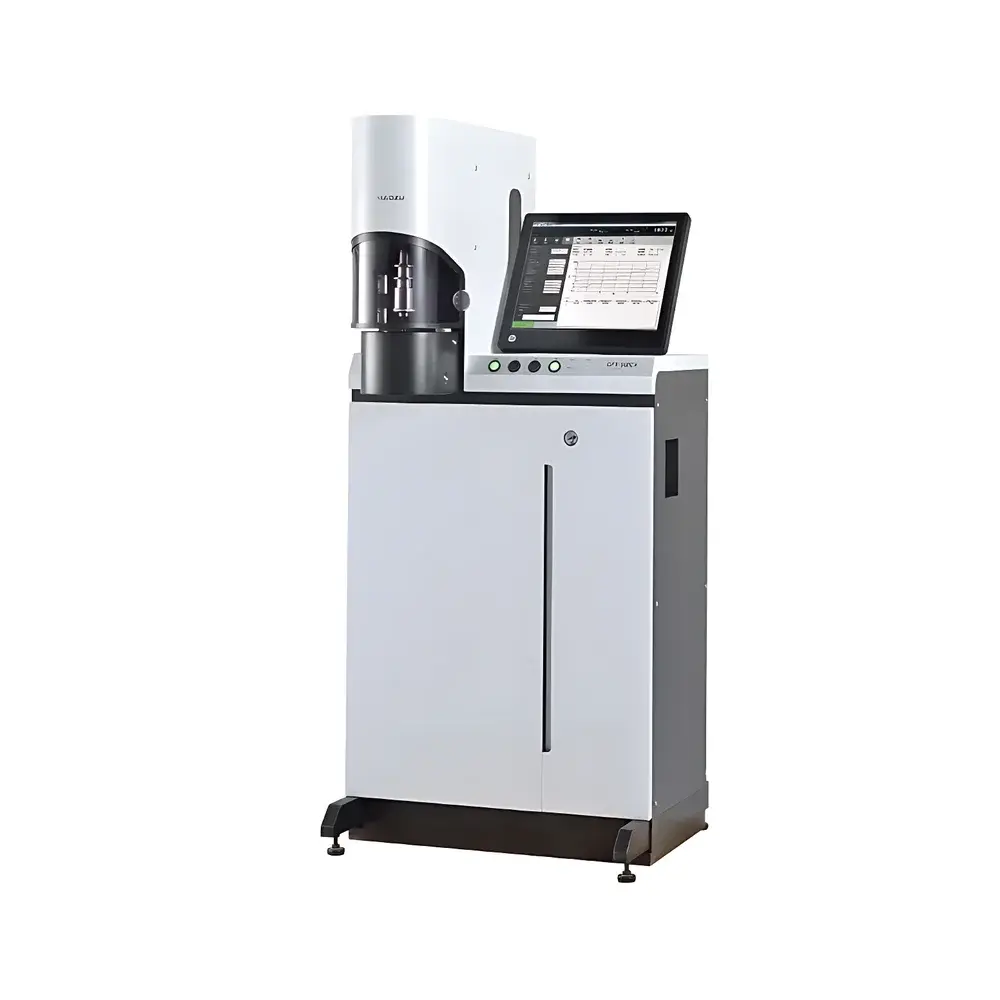
Shimadzu CFT-EX Series Capillary Rheometer
| Brand | Shimadzu |
|---|---|
| Origin | Japan |
| Manufacturer Type | Original Equipment Manufacturer (OEM) |
| Product Category | Imported Instrument |
| Model | CFT-EX Series |
| Instrument Type | Capillary Rheometer |
| Temperature Range | 20–400 °C |
| Temperature Control Accuracy | ±0.2 °C |
| Temperature Resolution | 0.1 °C |
| Displacement Range | 15 mm |
| Displacement Resolution | 0.01 mm |
| Sample Volume | Up to 1.5 cm³ |
| Viscosity Measurement Range | 1×10¹–1×10⁶ Pa·s (CFT-500EX) |
| Heating Method | Resistive Wire Heating |
| Loading Method | Dead-Weight Piston Drive |
| Test Modes | Isothermal and Temperature-Ramp (Rheological Softening Point) |
Overview
The Shimadzu CFT-EX Series Capillary Rheometer is a precision-engineered instrument designed for the quantitative characterization of melt flow behavior in thermoplastic and thermosetting polymers, elastomers, pastes, suspensions, and other viscoelastic materials under controlled thermal and mechanical conditions. Based on the fundamental principle of capillary rheometry—governed by the Mooney equation and Hagen–Poiseuille flow theory—the system measures shear stress and shear rate through pressure-driven extrusion of molten or softened material through a precisely dimensioned cylindrical die. This enables direct calculation of apparent viscosity, shear stress, shear rate, and extensional viscosity (with optional slit or converging die configurations). The CFT-EX series is widely deployed in R&D laboratories, process development units, and QC/QA environments where regulatory traceability, thermal stability, and reproducible extrusion kinetics are critical to material qualification and formulation optimization.
Key Features
- Two standardized test modes: isothermal flow analysis and temperature-ramp (ramp-rate programmable) for softening point determination and thermal transition profiling
- High-stability thermal chamber with resistive wire heating and integrated wind-shield enclosure, minimizing ambient convection effects and ensuring ±0.2 °C temperature control accuracy across the full 20–400 °C operating range
- Dead-weight piston loading mechanism providing constant-force extrusion—eliminating hydraulic or servo-driven variability and ensuring compliance with ASTM D3835 and ISO 11443 standards
- Real-time viscosity computation and display via Shimadzu’s dedicated CFT software, synchronized with displacement, pressure, and temperature acquisition at up to 100 Hz sampling rate
- High-resolution linear encoder (0.01 mm displacement resolution) coupled with calibrated load cells for precise piston travel and force quantification over 15 mm stroke length
- Modular die configuration support—including standard L/D = 10, 20, and 30 capillaries—enabling Bagley and Rabinowitsch corrections for entrance pressure loss and non-Newtonian wall slip compensation
Sample Compatibility & Compliance
The CFT-EX accommodates a broad spectrum of process-relevant materials, including but not limited to polyolefins, engineering thermoplastics (e.g., PEEK, PC, PA), crosslinking resins, toner powders, ceramic slips, food pastes (e.g., starch gels, chocolate masses), cosmetic emulsions, and pharmaceutical hot-melt extrusion (HME) formulations. Each test run utilizes ≤1.5 cm³ of sample, minimizing material consumption while maintaining representative bulk flow behavior. The instrument meets key international testing standards: ASTM D3835 (Standard Test Method for Determination of Apparent Viscosity of Thermoplastics Using Capillary Rheometers), ISO 11443 (Plastics — Determination of the Melt Mass-Flow Rate (MFR) and Melt Volume-Flow Rate (MVR) of Thermoplastics), and supports GLP-compliant audit trails when paired with Shimadzu LabSolutions software configured for 21 CFR Part 11 compliance.
Software & Data Management
The CFT-EX operates exclusively with Shimadzu’s proprietary CFT Analysis Software, which provides real-time graphical monitoring of viscosity vs. shear rate, pressure vs. time, and temperature ramp profiles. Raw data—including piston displacement, applied load, die pressure, and thermocouple readings—is stored in vendor-neutral CSV and XML formats. Advanced post-processing modules support automatic calculation of flow activation energy (via Arrhenius modeling), power-law index (n), consistency coefficient (K), and zero-shear viscosity extrapolation. Data export is compatible with third-party statistical platforms (e.g., JMP, Minitab) and LIMS integration via ODBC drivers. Audit trail functionality records user ID, method parameters, calibration events, and data modification history—fully aligned with GMP documentation requirements for regulated industries.
Applications
- Development and validation of polymer processing parameters for extrusion, injection molding, and blow molding
- Determination of rheological softening onset temperature (RSOT) and melt fracture thresholds in high-shear processes
- Quality control of toner particle dispersion stability and binder melt rheology in electrophotographic materials
- Characterization of ceramic green body extrudability and binder burnout behavior during sintering preparation
- Formulation screening of hot-melt adhesives and pharmaceutical excipients for hot-melt extrusion feasibility
- Texture and mouthfeel prediction in semi-solid food systems through shear-thinning index and yield stress estimation
FAQ
What types of materials are suitable for testing on the CFT-EX series?
Thermoplastic and thermosetting polymers, elastomers, toner powders, ceramic slips, food pastes, cosmetic gels, and pharmaceutical hot-melt extrusion formulations—with sufficient thermal stability between 20 °C and 400 °C.
Does the system support automated die cleaning or purge protocols?
No built-in auto-purge; however, the modular die design allows rapid manual replacement and solvent-based cleaning using recommended solvents (e.g., xylene for polyolefins, THF for acrylics) per Shimadzu’s maintenance guidelines.
Can the CFT-EX be integrated into an automated lab environment?
Yes—via RS-232 and Ethernet interfaces, it supports remote command execution, scheduled runs, and data streaming to central laboratory informatics systems compliant with ASTM E1384 and ISO/IEC 17025 data integrity frameworks.
Is calibration traceable to national standards?
Temperature calibration is traceable to JIS Z 8703 and NIST SRM reference materials; force calibration uses certified dead weights accredited to ISO/IEC 17025 by Shimadzu Metrology Center.
What safety features are included for high-temperature operation?
Dual-stage thermal cutoff, surface temperature monitoring of the barrel housing, interlocked wind-shield door sensor, and emergency stop circuit meeting IEC 61000-6-2 EMC and IEC 61010-1 safety standards.



