
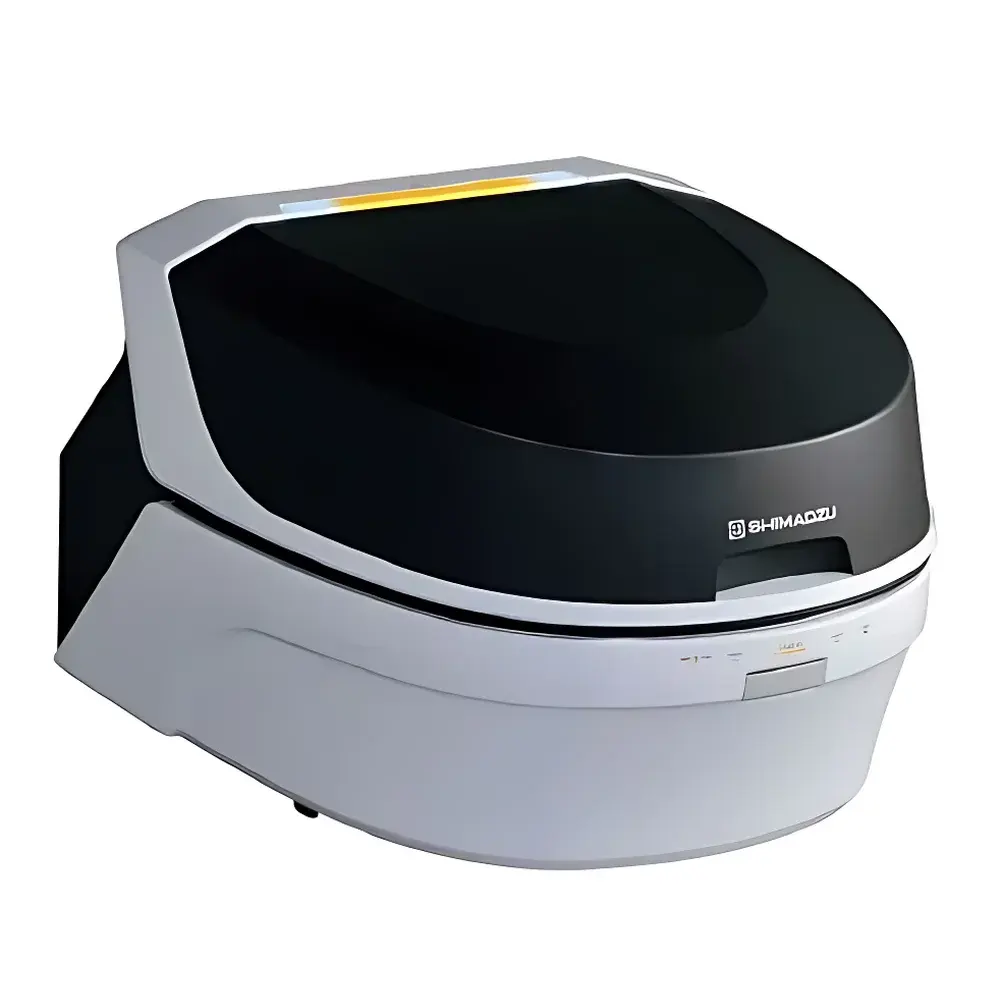
Shimadzu EDX-7200 Energy Dispersive X-Ray Fluorescence Spectrometer
| Brand | Shimadzu |
|---|---|
| Origin | Jiangsu, China |
| Manufacturer Type | Direct Manufacturer |
| Regional Classification | Domestic (PRC) |
| Model | EDX-7200 |
| Configuration | Benchtop or Floor-Standing |
| Instrument Type | Conventional ED-XRF |
| Application Scope | General-Purpose |
| Elemental Range | Na (Z=11) to U (Z=92) |
| Quantitative Concentration Range | 0.1 ppm – 100 wt% |
| Energy Resolution | ≤140 eV (Mn Kα) |
| Repeatability | ≤0.1% RSD (for major elements under standardized conditions) |
| Detector | High-Performance Silicon Drift Detector (SDD) |
Overview
The Shimadzu EDX-7200 is a benchtop or floor-standing energy dispersive X-ray fluorescence (ED-XRF) spectrometer engineered for high-speed, high-sensitivity elemental analysis of solid, powder, and liquid samples without chemical digestion or physical alteration. Based on the fundamental principle of X-ray fluorescence—where primary X-rays excite inner-shell electrons in sample atoms, resulting in characteristic secondary (fluorescent) X-ray emission—the EDX-7200 enables rapid, non-destructive qualitative and quantitative multi-element analysis across the periodic table from sodium (Na, Z=11) to uranium (U, Z=92). Its optimized optical path, high-efficiency SDD detector, and advanced pulse processing architecture deliver exceptional spectral resolution (≤140 eV at Mn Kα), low detection limits, and robust reproducibility (≤0.1% RSD for stable matrix standards), making it suitable for routine quality control, regulatory compliance screening (e.g., RoHS, WEEE, TSCA), and materials characterization in industrial laboratories.
Key Features
- Non-destructive analysis preserving original sample integrity—no dissolution, pressing, or coating required for solids, powders, or homogeneous liquids.
- Extended elemental coverage from Na to U with calibrated quantification across six orders of magnitude (0.1 ppm to 100 wt%).
- High-performance silicon drift detector (SDD) with large active area and Peltier cooling, enabling high count-rate capability and superior peak-to-background ratio.
- Enhanced sensitivity for light elements: optimized vacuum and helium purge pathways improve detection of phosphorus (P), sulfur (S), chlorine (Cl), and other low-Z elements critical for TSCA and halogen-free material compliance.
- Accelerated spectral acquisition and processing—up to 30× faster than prior-generation systems—enabled by real-time digital pulse processing and parallel multi-channel analysis.
- Integrated threshold-based algorithm for rapid pass/fail screening against regulatory thresholds (e.g., Pb < 1000 ppm, Cd < 100 ppm), reducing analysis time per sample in RoHS-compliant workflows.
- Upgraded helium gas management system with flow optimization, reducing helium consumption by up to 40% versus legacy configurations—lowering operational cost and environmental footprint.
- Moisture-resistant X-ray tube housing with enhanced thermal management, extending tube lifetime in high-humidity environments without performance degradation.
Sample Compatibility & Compliance
The EDX-7200 accommodates a broad range of sample forms—including irregular solids, pressed pellets, loose powders, thin films, and sealed liquid cells—via configurable sample chambers and optional accessories (e.g., vacuum chamber, helium purge kit, custom holders). It supports method development and validation in accordance with ISO 8258 (control charts), ISO 11885 (water analysis), ASTM E1621 (ED-XRF for RoHS screening), and IEC 62321-5 (determination of Cd, Pb, Hg, Cr(VI), Br in electrotechnical products). Full audit trail functionality, user-access-level controls, and electronic signature support align with GLP and GMP documentation requirements; data export formats (CSV, PDF, XML) facilitate integration into LIMS and comply with FDA 21 CFR Part 11 when deployed with validated software configurations.
Software & Data Management
Operating via Shimadzu’s proprietary QualiQuant™ software, the EDX-7200 provides intuitive workflow-driven interfaces for method setup, calibration (fundamental parameters, empirical, or standardless), spectral deconvolution, and report generation. The software includes pre-installed application packages for RoHS screening, alloy grade identification, mining geochemistry, and phosphorus/sulfur/tin-specific regulatory modules—including certified reference materials for Sn and P screening kits. All analytical data—including raw spectra, processed results, instrument parameters, and operator logs—are timestamped and stored in a secure local database with optional network backup. Export options include structured CSV for statistical analysis, PDF reports with embedded spectra, and XML files compatible with enterprise QA/QC platforms.
Applications
- Electronics manufacturing: Rapid screening of printed circuit boards, solder alloys (e.g., Sn–Ag–Cu), and component plating layers for restricted substances (Pb, Cd, Cr, Hg, Br, Cl, P).
- Metallurgy & foundry: Grade verification of aluminum, copper, and stainless steel alloys; trace element profiling (e.g., Fe, Ni, Co, Ti) in high-purity metals.
- Environmental testing labs: Analysis of soils, sediments, and fly ash for heavy metals (As, Se, Cd, Pb) and regulated halogens.
- Consumer goods compliance: Testing of plastics, paints, and textiles for restricted elements per CPSIA, EU REACH SVHC, and California Prop 65.
- Academic & R&D: Elemental mapping support (with optional motorized stage), phase association studies, and method transfer from research-grade to production QC environments.
FAQ
Does the EDX-7200 require external cooling water or liquid nitrogen?
No—it uses air-cooled electronics and a Peltier-cooled SDD detector, eliminating dependency on cryogenic coolants or chilled water systems.
Can the instrument perform standardless quantification reliably?
Yes—QualiQuant™ implements fundamental parameter (FP) algorithms with matrix correction, validated for homogeneous solids and liquids within defined density and homogeneity constraints.
Is vacuum operation mandatory for light element analysis?
Vacuum is recommended for optimal sensitivity below calcium (Z=20); however, helium purge mode enables reliable P, S, and Cl detection without full vacuum cycling.
What regulatory standards does the EDX-7200 support out-of-the-box?
Pre-configured methods comply with IEC 62321-5, ASTM E1621, JIS C 0950, and China’s GB/T 33352—covering RoHS, WEEE, and domestic hazardous substance control requirements.
How is instrument performance verified and maintained over time?
Built-in daily self-diagnostic routines, energy calibration using Mn Kα reference, and drift correction via internal radioactive check sources ensure long-term stability and traceable measurement consistency.
Related Products





