
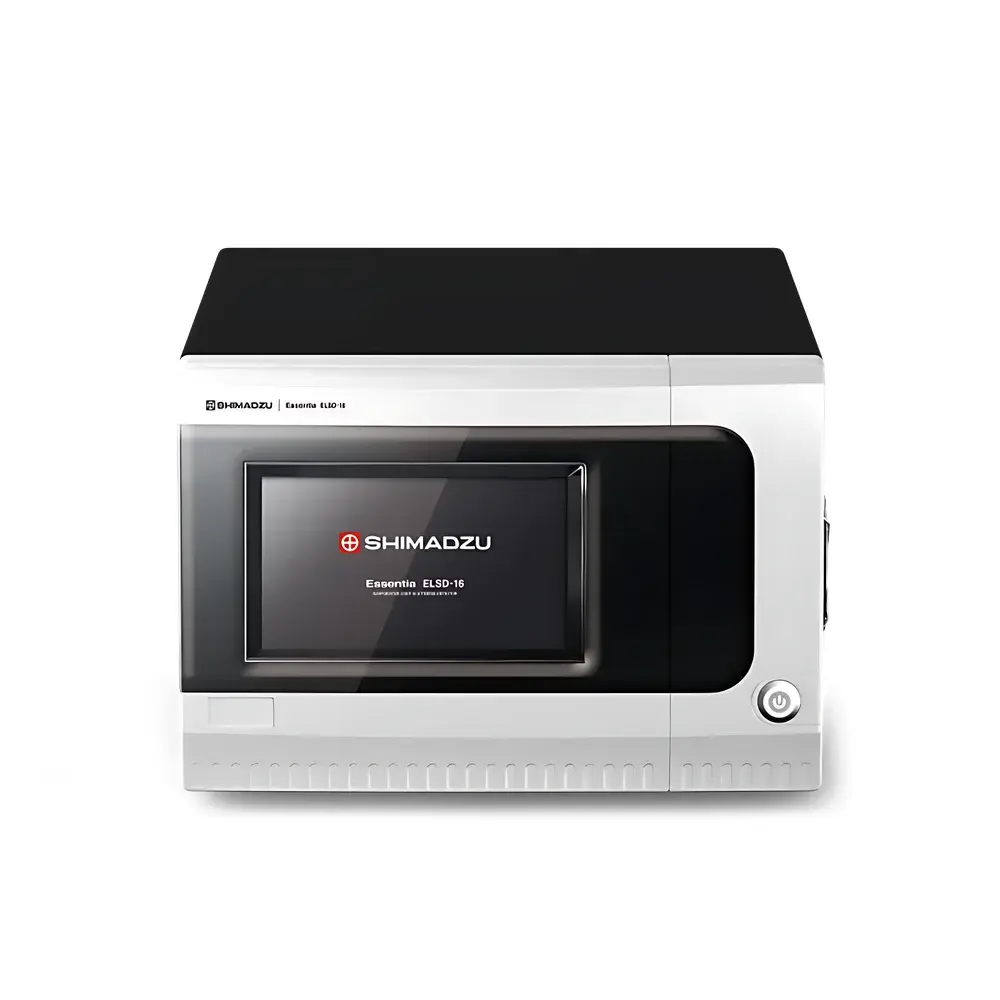
Shimadzu ELSD-16 Evaporative Light Scattering Detector
| Brand | Shimadzu |
|---|---|
| Origin | Jiangsu, China |
| Manufacturer Type | Original Equipment Manufacturer (OEM) |
| Product Category | Domestic |
| Model | Shimadzu ELSD-16 |
| Instrument Type | Evaporative Light Scattering Detector (ELSD) |
| Detection Principle | Low-Temperature Evaporation Mode |
| Light Source | Semiconductor Laser Diode |
| Baseline Noise | <0.05 mV (per Shimadzu internal specification) |
| Quantitative Repeatability | RSD₆ ≤ 3.0% |
| Minimum Detectable Concentration | ≤ 5.0 × 10⁻⁶ g/mL (cholesterol in methanol) |
| User Interface | 7-inch color touchscreen with real-time status monitoring and alarm logging |
| Compliance | Meets JJG 1512–2015 requirements for HPLC detector performance evaluation |
Overview
The Shimadzu ELSD-16 is a high-performance evaporative light scattering detector engineered for integration with liquid chromatography systems—including UHPLC, HPLC, and preparative LC platforms. It operates on the well-established ELSD principle: analyte-containing mobile phase is nebulized into fine, uniform droplets; solvent is removed under precisely controlled low-temperature evaporation conditions in a heated drift tube; non-volatile or semi-volatile solutes form dry particles that scatter laser light in a detection cell. This universal detection mechanism enables quantitative analysis of compounds lacking chromophores or fluorophores—such as carbohydrates, lipids, surfactants, polymers, and thermally labile natural products—without reliance on UV absorbance or derivatization. The ELSD-16 employs a stable semiconductor laser source and an optimized optical path design to deliver consistent signal generation across wide dynamic ranges, while its closed-loop gas flow and temperature control architecture ensures minimal baseline drift and high measurement reproducibility.
Key Features
- Ultra-low baseline noise (<0.05 mV), validated against JJG 1512–2015 national metrological verification criteria for HPLC detectors.
- Low-temperature evaporation mode preserves integrity of semi-volatile and thermally sensitive analytes—critical for applications in lipidomics, glycomics, and pharmaceutical excipient analysis.
- Narrow droplet size distribution achieved via precision pneumatic nebulization, enhancing particle formation consistency and signal linearity.
- Carrier gas sheath flow encapsulates solute particles entering the detection cell, minimizing wall deposition and cross-contamination—extending optical cell service life and improving long-term precision.
- Integrated 7-inch capacitive touchscreen interface supports real-time adjustment of drift tube temperature (range: ambient to 100 °C), nebulizer gas flow (0–3.0 L/min), and laser activation state.
- Comprehensive hardware-level safety interlocks: automatic gas shutoff upon overtemperature, overpressure, or flow deviation; alarm signals relayed to CBM-compatible controllers and LabSolutions software.
Sample Compatibility & Compliance
The ELSD-16 is compatible with common reversed-phase, normal-phase, and HILIC mobile phases—including volatile solvents (e.g., acetonitrile, methanol, ethyl acetate) and aqueous buffers containing ammonium acetate or formate. It is not suitable for non-volatile additives (e.g., phosphate buffers, SDS). Its detection response is mass-sensitive and largely independent of chemical structure, making it ideal for method development where UV-absorbing impurities interfere. From a regulatory standpoint, the instrument supports GLP/GMP workflows through full audit-trail capability when operated with LabSolutions Essentia software compliant with FDA 21 CFR Part 11 requirements. Hardware design adheres to IEC 61010-1 safety standards for laboratory electrical equipment, and electromagnetic compatibility meets EN 61326-1 Class A specifications.
Software & Data Management
The ELSD-16 interfaces natively with Shimadzu’s LabSolutions Essentia chromatography data system (CDS) via USB or Ethernet. Sequence-based operation allows automated startup/shutdown protocols—including post-run laser deactivation and gas line closure—to reduce consumable usage and extend component lifetime. All operational parameters (temperature setpoints, gas flow rates, alarm thresholds) are stored with acquisition metadata. Raw signal data (mV vs. time) is exported in ASCII or CDF format for third-party processing. System suitability tests—including noise, drift, and repeatability assessments—are preconfigured per pharmacopeial guidelines (e.g., USP , EP 2.2.46), facilitating routine QC validation.
Applications
- Quantification of non-UV-absorbing APIs and degradation products in stability-indicating methods.
- Analysis of phospholipids and triglycerides in biopharmaceutical formulations.
- Profiling of oligosaccharides and glycosaminoglycans in biologics characterization.
- Residual solvent and excipient quantitation in generic drug submissions.
- Quality control of surfactants and emulsifiers in cosmetics and food-grade products.
- Method transfer between UV and ELSD detection for orthogonal confirmation in regulatory filings.
FAQ
Is the ELSD-16 compatible with gradient elution methods?
Yes—the detector maintains stable baseline performance during solvent composition changes due to its robust thermal and flow control architecture.
What mobile phase additives are permissible?
Only volatile buffers (e.g., ammonium acetate/formate, triethylamine) at concentrations ≤20 mM; non-volatile salts must be avoided to prevent drift tube clogging.
Does the ELSD-16 support remote monitoring via network?
Yes—when connected via Ethernet and configured within LabSolutions Essentia, real-time status, alarms, and signal traces can be accessed from authorized client workstations.
How often does the optical cell require cleaning?
Under typical use with clean mobile phases, cleaning intervals exceed 2000 injections; the compact modular design allows rapid disassembly without tools.
Can ELSD-16 data be imported into third-party chemometric software?
Yes—ASCII and NetCDF export formats ensure seamless integration with MATLAB, Python (via pandas), and commercial multivariate analysis platforms.






