
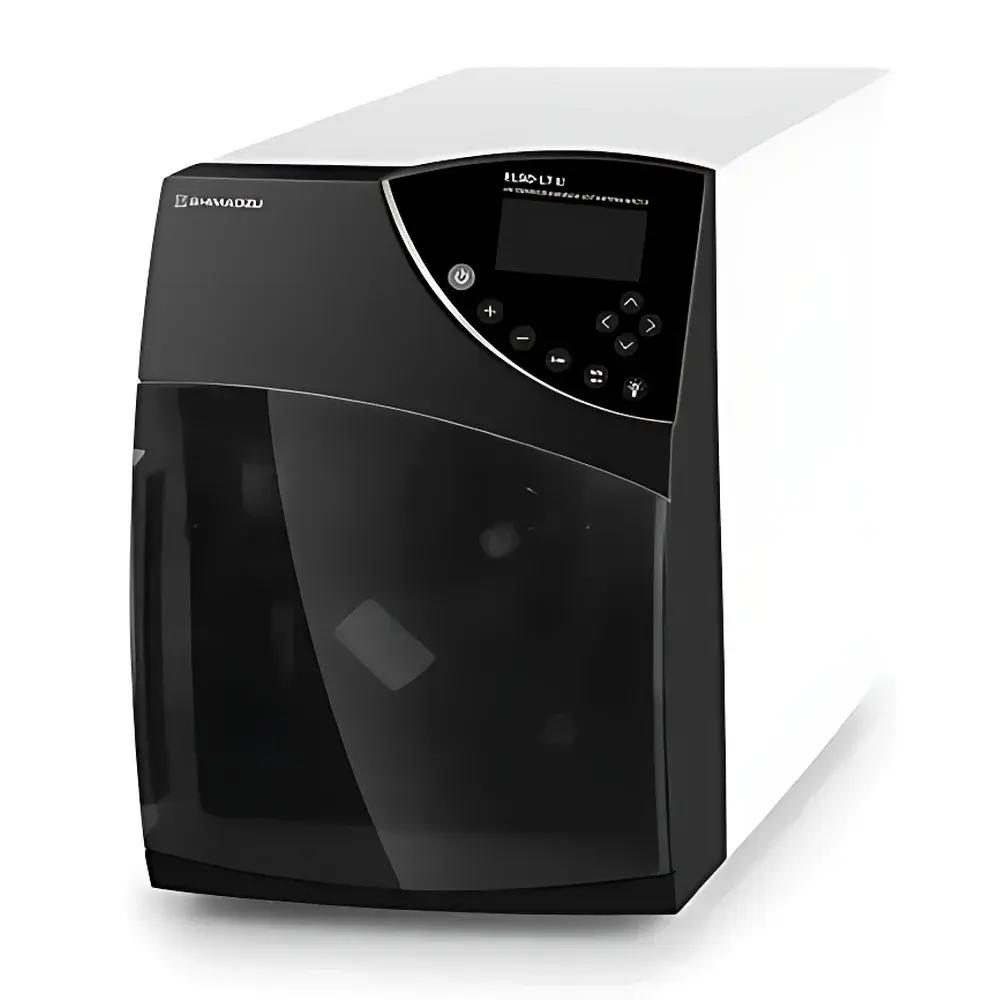
Shimadzu ELSD-LT III Evaporative Light Scattering Detector
| Brand | Shimadzu |
|---|---|
| Origin | Japan |
| Manufacturer | Shimadzu Corporation |
| Product Type | Imported Instrument |
| Model | ELSD-LT III |
| Detection Principle | Evaporative Light Scattering |
| Light Source | Laser Diode |
| Compatible Systems | Liquid Chromatography (HPLC/UHPLC), Supercritical Fluid Chromatography (SFC), Preparative LC |
| Sample Types | Non-volatile and Semi-volatile Compounds (e.g., carbohydrates, lipids, surfactants, synthetic polymers, glycosaminoglycans) |
| Compliance | Designed for GLP/GMP environments with audit-ready operational logs |
| Software Integration | Native compatibility with LabSolutions LCMS and optional 21 CFR Part 11-compliant data handling modules |
Overview
The Shimadzu ELSD-LT III is a high-performance evaporative light scattering detector engineered for universal, gradient-compatible detection in liquid chromatography systems. Unlike UV-Vis or refractive index detectors, the ELSD-LT III operates on the principle of nebulization, solvent evaporation, and laser-based light scattering measurement—enabling quantitative analysis of analytes lacking chromophores or exhibiting weak/short-wavelength UV absorption (e.g., below 195 nm). This makes it particularly suitable for carbohydrates, oligosaccharides, phospholipids, non-ionic surfactants, natural polymers, and glycosaminoglycans such as chondroitin sulfate sodium (CS-S). The detector’s core architecture integrates a photometrically stabilized laser diode, precision-controlled drift tube heating, and real-time pneumatic monitoring to ensure reproducible signal generation across wide concentration ranges without gain switching.
Key Features
- Laser-enhanced sensitivity: Equipped with a high-stability laser diode source, the ELSD-LT III delivers significantly improved signal-to-noise ratios compared to earlier ELSD generations—critical for trace-level detection of semi-volatile compounds under low-temperature evaporation conditions.
- Extended dynamic linear range: Achieves up to five orders of magnitude (10⁵) in linear response without manual gain adjustment—enabling simultaneous quantification of major and minor components in complex matrices, such as herbal extracts or biopolymer hydrolysates.
- Optimized nebulization and drift tube design: Features an advanced concentric nebulizer and thermally insulated drift tube that support efficient solvent removal at reduced operating temperatures (typically 30–100 °C), minimizing thermal degradation of labile analytes while maintaining robust response for both non-volatile and semi-volatile species.
- Focused detection geometry: Incorporates an auxiliary gas-assisted focusing mechanism that concentrates aerosol particles into a defined optical interrogation zone—enhancing scattering efficiency and improving detection limits by up to 3× relative to conventional ELSD configurations.
- Compact footprint & integrated diagnostics: With a height reduced to ~66% of its predecessor and a narrower chassis, the unit fits seamlessly atop standard HPLC or UHPLC stacks. Built-in pressure and temperature sensors continuously log nebulizer gas pressure and drift tube setpoint deviation; automatic shutdown activates upon detection of abnormal pressure decay or thermal instability.
Sample Compatibility & Compliance
The ELSD-LT III supports broad-spectrum compound classes including mono-/oligo-/polysaccharides, fatty acids, triglycerides, saponins, cyclodextrins, and sulfated polysaccharides. It is explicitly validated for use with reversed-phase, HILIC, and amino-bonded columns—including UHPLC-grade packings (e.g., 1.7–2.6 µm particles). Method development adheres to ICH Q2(R2) guidelines for detector qualification. When operated within Shimadzu’s LabSolutions LCMS platform with enabled electronic signatures and audit trail functions, the system meets FDA 21 CFR Part 11 requirements for regulated laboratories. Routine performance verification follows ASTM D7489-19 (Standard Practice for ELSD Use in Liquid Chromatography) and ISO 17025-aligned calibration protocols.
Software & Data Management
Native integration with LabSolutions LCMS v5.95+ provides full control over detector parameters (drift tube temperature, nebulizer gas flow, laser power modulation, and data acquisition rate), real-time baseline monitoring, and automated method validation workflows. All operational events—including temperature stabilization confirmation, gas pressure fluctuations, and error-triggered shutdowns—are timestamped and archived in instrument logs. Optional 21 CFR Part 11 add-ons enable role-based access control, electronic signatures, and immutable audit trails compliant with GLP and GMP documentation standards. Export formats include .csv, .txt, and .cdf (NetCDF), ensuring compatibility with third-party chemometric tools and LIMS platforms.
Applications
- UHPLC analysis of oligosaccharides: Resolves seven standard oligosaccharides in 25 min runtimes.
- Chondroitin sulfate quantification: Enables sensitive, reproducible detection of CS-S in ophthalmic formulations and nutraceuticals via RP-UHPLC gradients—delivering sharp peak symmetry and sub-µg/mL LODs without derivatization.
- SFC-ELSD coupling: Supports chiral separation of non-UV-absorbing pharmaceutical intermediates using CO₂-based mobile phases, leveraging the detector’s compatibility with volatile modifiers and rapid solvent removal kinetics.
- Preparative LC fraction monitoring: Integrated into fraction collection workflows to trigger cut decisions based on absolute mass response—not retention time alone—improving purity yield in natural product isolation.
FAQ
Is the ELSD-LT III compatible with gradient elution methods?
Yes. Unlike refractive index detectors, the ELSD-LT III is fully compatible with solvent gradient programs across HPLC, UHPLC, and SFC platforms.
What types of compounds cannot be detected effectively?
Highly volatile analytes (e.g., organic acids with bp <100 °C, low-MW alcohols, or residual solvents) are largely lost during nebulization and drift tube evaporation—limiting detectability.
Does it require special calibration standards?
No external calibration curve is mandatory for relative quantitation; however, for absolute quantification, response factors should be established using representative analyte standards under identical nebulization and evaporation conditions.
Can it be used with aqueous mobile phases containing high salt concentrations?
Yes—but high-buffer-content eluents may cause nozzle clogging over time; regular maintenance and use of inline filters (0.22 µm) are recommended.
How does it compare to CAD (Charged Aerosol Detection)?
While both are universal detectors, ELSD relies on optical scattering and exhibits lower baseline noise in low-flow regimes; CAD offers superior linearity but requires higher gas consumption and more complex electronics.
Related Products




