
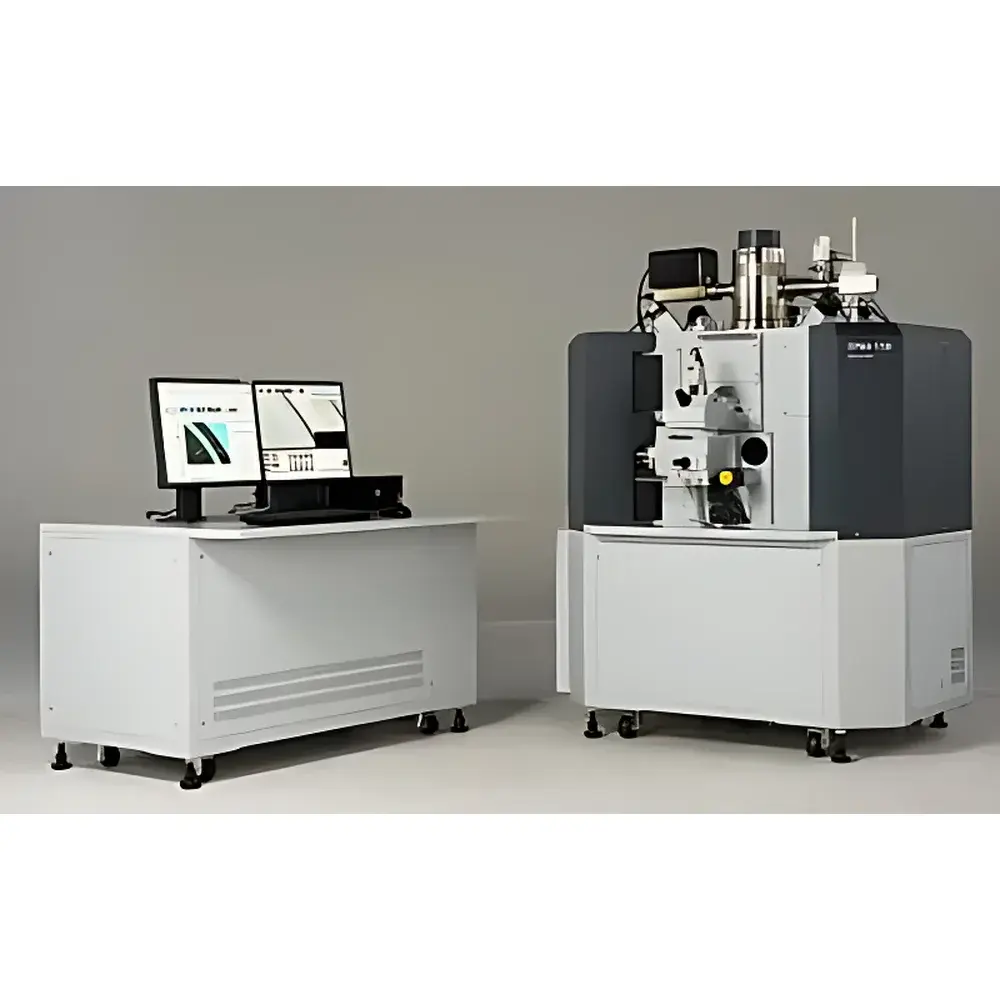
Shimadzu EPMA-1720 Series Electron Probe Microanalyzer
| Brand | Shimadzu |
|---|---|
| Origin | Japan |
| Manufacturer Type | Original Equipment Manufacturer (OEM) |
| Import Status | Imported |
| Model | EPMA-1720 Series |
| Pricing | Available upon Request |
Overview
The Shimadzu EPMA-1720 Series Electron Probe Microanalyzer is a high-performance, wavelength-dispersive X-ray microanalysis system engineered for quantitative elemental analysis and high-resolution compositional mapping at the micrometer scale. Operating on the principle of electron-induced X-ray emission, the instrument directs a finely focused electron beam (typically 0.1–1 µm diameter) onto a solid conductive or carbon-coated insulating sample surface. Incident electrons generate characteristic X-rays via inner-shell ionization; these X-rays are then diffracted by precisely oriented analyzing crystals in a Wavelength Dispersive Spectrometer (WDS), enabling energy-resolved detection with spectral resolution down to ~5–10 eV—significantly superior to Energy Dispersive Spectrometry (EDS). This fundamental advantage translates into enhanced peak-to-background ratios, improved detection limits (typically 10–100 ppm for most elements), and robust separation of overlapping X-ray lines (e.g., S Kα/Pb Mα, Ti Kβ/V Kα), making the EPMA-1720 series indispensable for rigorous geochemical, metallurgical, ceramic, and semiconductor failure analysis where trace-level quantification and matrix correction fidelity are critical.
Key Features
- High X-ray take-off angle of 52.5°: Optimized geometry maximizes solid-angle collection efficiency and signal-to-noise ratio, particularly for low-energy X-rays (e.g., B, C, N, O), without compromising spatial resolution.
- Motorized precision sample stage: Fully programmable XYZ motion with sub-micron repeatability and integrated tilt/rotation axes enables accurate positioning for multi-point analysis, line scans, and raster mapping across mm-scale regions.
- Automated beam alignment and spectrometer tuning: Integrated real-time feedback algorithms streamline setup of electron optics and crystal diffraction conditions, reducing operator dependency and ensuring consistent analytical performance across users and sessions.
- Dual-mode operation: Seamless switching between point analysis, line profiling, and area mapping—each with configurable dwell time, step size, and dwell per pixel—to support both rapid survey and high-precision quantification workflows.
- Robust vacuum architecture: Dual-pump system (rotary + turbomolecular) maintains <1×10⁻⁴ Pa operating pressure in the electron column and spectrometer chambers, ensuring stable beam current and minimizing hydrocarbon contamination during extended acquisitions.
Sample Compatibility & Compliance
The EPMA-1720 accommodates polished bulk specimens up to 30 mm in diameter and 25 mm in height, including conductive metals, semiconductors, oxides, silicates, and coated insulators (with optional carbon or Au/Pd sputter coating). Sample holders support standard 25 mm petrographic mounts and custom fixtures for irregular geometries. The system complies with IEC 61000-6-3 (EMC emissions) and IEC 61000-6-2 (immunity), and its hardware/software architecture supports GLP/GMP-aligned data integrity requirements—including full audit trail logging, user access controls, and electronic signature capability—facilitating compliance with FDA 21 CFR Part 11 when configured with validated software modules.
Software & Data Management
Control and analysis are unified within Shimadzu’s proprietary EPMA Navigator software suite, built on a modular, Windows-based platform compliant with ISO/IEC 17025 documentation standards. The interface provides intuitive workflow navigation—from SEM-like imaging and automated element identification (ZAF/φ(ρz) matrix corrections applied in real time) to quantitative mapping and statistical reporting. Batch processing tools enable parallel evaluation of multiple spectra or maps; raw data (intensity counts, background, peak positions) are stored in vendor-neutral formats (e.g., .csv, .tdf) alongside metadata (beam conditions, crystal type, detector voltage). A dedicated Data Browser application supports hierarchical project organization, spectral overlay comparison, and export to third-party visualization or statistical packages (e.g., Python Pandas, MATLAB).
Applications
- Quantitative mineral chemistry in petrology and ore deposit studies (e.g., olivine Fo content, garnet pyrope-almandine ratios)
- Phase identification and composition gradients in weld zones, heat-affected zones, and intermetallic layers
- Impurity segregation analysis in single-crystal turbine blade superalloys
- Thin-film stoichiometry verification (e.g., perovskite oxides, chalcogenides) with depth-resolved line scans
- Forensic metallurgy: inclusion composition, corrosion product layering, and solder joint interfacial reactions
- Archaeometric provenance studies of ceramics and glass using trace-element fingerprinting
FAQ
What is the typical detection limit for light elements (e.g., oxygen, carbon) on the EPMA-1720?
Detection limits for light elements depend on beam current, acquisition time, and matrix effects—but under optimized conditions (30 kV, 100 nA, 100 s counting), typical values range from 100–500 ppm for O Kα and 200–800 ppm for C Kα.
Can the EPMA-1720 perform simultaneous multi-element analysis?
Yes—up to five WDS spectrometers can be operated concurrently, each equipped with selectable analyzing crystals (e.g., LDE1, PET, TAP) to cover elements from Be to U in a single acquisition cycle.
Is the system compatible with EBSD integration?
While not factory-integrated, the EPMA-1720’s chamber design and stage kinematics support third-party EBSD detector installation and synchronized acquisition with appropriate mechanical and software interfacing.
How does the 52.5° take-off angle improve analytical sensitivity?
This geometry increases the effective solid angle of X-ray collection while minimizing absorption in the sample substrate and detector window—particularly beneficial for soft X-rays where attenuation losses dominate signal yield.
Does the software support standardized reference material calibration protocols?
Yes—EPMA Navigator includes preloaded calibration libraries for NIST SRMs, USGS glasses, and natural mineral standards, with customizable calibration curve generation and drift correction routines based on monitor standards.
Related Products




