
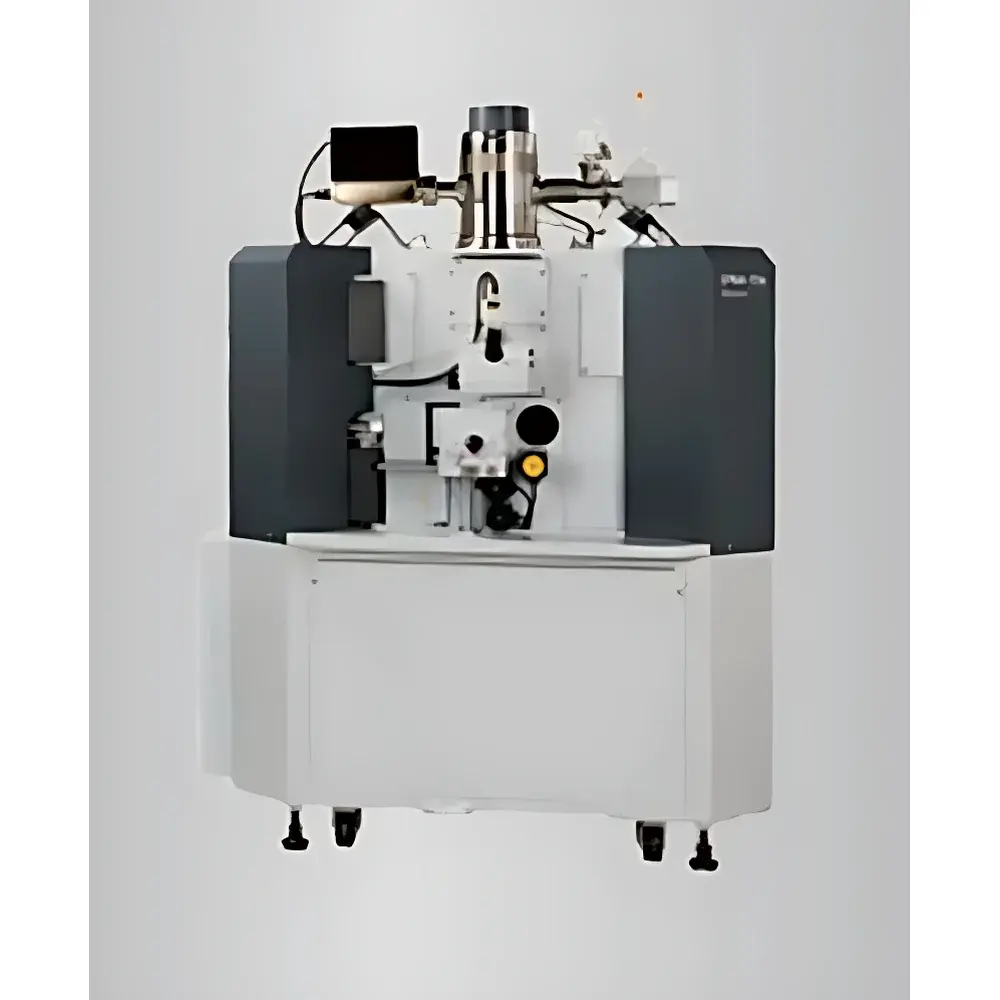
Shimadzu EPMA-1720 Series Electron Probe Microanalyzer
| Brand | Shimadzu |
|---|---|
| Origin | Japan |
| Model | EPMA-1720 |
| Analytical Range | Be (4) to U (92) |
| Electron Source | Tungsten (W) filament and Cerium Hexaboride (CeB₆) filament |
| Secondary Electron Image Resolution | 6 nm (W), 5 nm (CeB₆) |
| X-ray Take-off Angle | 52.5° |
| Spectrometer Type | Full-focusing Wavelength Dispersive Spectrometer (WDS) |
| Detector Configuration | High-sensitivity, high-resolution WDS system |
| Compliance | Designed for ISO/IEC 17025-compliant laboratories |
Overview
The Shimadzu EPMA-1720 Series Electron Probe Microanalyzer is a high-performance, wavelength-dispersive microanalytical instrument engineered for quantitative elemental analysis and high-resolution imaging at the micrometer to sub-micrometer scale. Operating on the principle of electron-excited X-ray emission, the EPMA-1720 directs a focused electron beam onto solid conductive or coated non-conductive samples, generating characteristic X-rays whose energies and wavelengths are uniquely associated with constituent elements. By coupling this excitation with full-focusing crystal spectrometers, the system achieves superior peak-to-background ratios, exceptional spectral resolution (<10 eV at Mn Kα), and detection limits in the range of 10–100 ppm—depending on element mass, matrix effects, and acquisition time. Unlike energy-dispersive systems (EDS), the EPMA-1720 prioritizes analytical accuracy over speed, making it the reference method for certified compositional mapping, phase identification, and standard-based quantification in metallurgy, geoscience, ceramics, and advanced materials R&D.
Key Features
- Optimized electron optics with dual electron source options: thermionic tungsten (W) filament for routine stability and cerium hexaboride (CeB₆) cathode for enhanced brightness and improved spatial resolution down to 5 nm in secondary electron imaging.
- Fixed 52.5° X-ray take-off angle—strategically selected to maximize X-ray collection efficiency while minimizing absorption losses in both sample and detector path, particularly critical for low-Z elements (e.g., C, N, O, F).
- Full-focusing WDS spectrometers utilizing curved, synthetic multilayer and natural single-crystal analyzers (e.g., LIF, PET, TAP) to deliver high peak intensity and minimal line broadening across the full Be–U elemental range.
- Integrated digital scanning and stage control enabling automated point analysis, line scans, area mapping, and multi-point quantitative workflows with reproducible positioning accuracy ≤±0.1 µm.
- Modular vacuum architecture with differential pumping stages ensuring stable 10⁻⁴ Pa base pressure in the column and 10⁻³ Pa in the sample chamber—compatible with air-sensitive and hydrated specimens via optional cryo-transfer or low-vacuum accessories.
Sample Compatibility & Compliance
The EPMA-1720 accommodates polished bulk solids (metals, minerals, oxides), thin sections (geological petrographic mounts), and coated insulators (carbon or Au/Pd sputtered). Sample dimensions support up to Ø30 mm × 25 mm height. All analytical protocols align with internationally recognized metrological frameworks: quantitative routines follow ISO 22309 (microanalysis of metallic materials) and ASTM E1508 (standard guide for quantitative WDS microanalysis); reporting structures comply with ISO/IEC 17025 requirements for uncertainty estimation and traceability. Instrument software logs full audit trails—including operator ID, parameter history, calibration timestamps, and raw spectrum metadata—to satisfy FDA 21 CFR Part 11 and GLP/GMP documentation mandates.
Software & Data Management
Shimadzu’s proprietary EPMA Analysis Suite provides a unified interface for acquisition, processing, and reporting. The platform supports ZAF and φ(ρz) matrix correction models, standardless semi-quantitative screening, and user-defined standard libraries. Real-time spectrum visualization, interactive peak deconvolution, and embedded stoichiometric calculation modules enable rapid phase characterization. Data export conforms to ASTM E1357 (ASCII-based spectrum format) and HDF5 for long-term archival. Networked deployment allows centralized license management, remote diagnostics, and integration with LIMS via OPC UA or custom API endpoints.
Applications
- Quantitative phase analysis in alloy development and failure investigation (e.g., segregation mapping of Ni-Cr-Mo superalloys).
- Precise cation site occupancy determination in layered oxide cathodes (e.g., LiCoO₂, NMC) for battery materials research.
- Trace-element zoning in igneous and metamorphic minerals (e.g., garnet, zircon) supporting petrogenetic modeling.
- Compositional depth profiling of diffusion couples and thin-film interfaces using calibrated electron-beam rastering.
- Reference-grade certification of CRM matrices (e.g., NIST SRM 2100 series) in national metrology institutes.
FAQ
What is the typical detection limit for light elements (e.g., oxygen, boron) on the EPMA-1720?
Detection limits vary by element and matrix but typically range from 50–200 ppm for B–F under optimized conditions (long counting times, high-current CeB₆ source, ultra-low-noise detectors).
Can the EPMA-1720 perform simultaneous multi-element WDS analysis?
Yes—up to five spectrometers can be configured for parallel acquisition, enabling real-time quantification of major and minor elements without sequential dwell time penalties.
Is automation supported for unattended overnight analysis?
Fully supported via batch script execution, auto-focus routines, and hardware interlocks; all sessions generate timestamped, tamper-evident log files compliant with 21 CFR Part 11.
How does the 52.5° take-off angle improve analytical performance compared to conventional 40° designs?
It increases effective solid angle of X-ray collection by ~35%, significantly enhancing signal-to-noise for low-energy X-rays and reducing absorption artifacts—particularly beneficial for accurate quantification of Na, Mg, Al, and Si in silicate matrices.
Does Shimadzu provide certified reference materials and calibration services?
Yes—Shimadzu offers traceable CRM sets (e.g., metal alloys, geological glasses) and on-site or factory-based calibration verification per ISO 17025, including drift monitoring and spectrometer alignment reports.




