
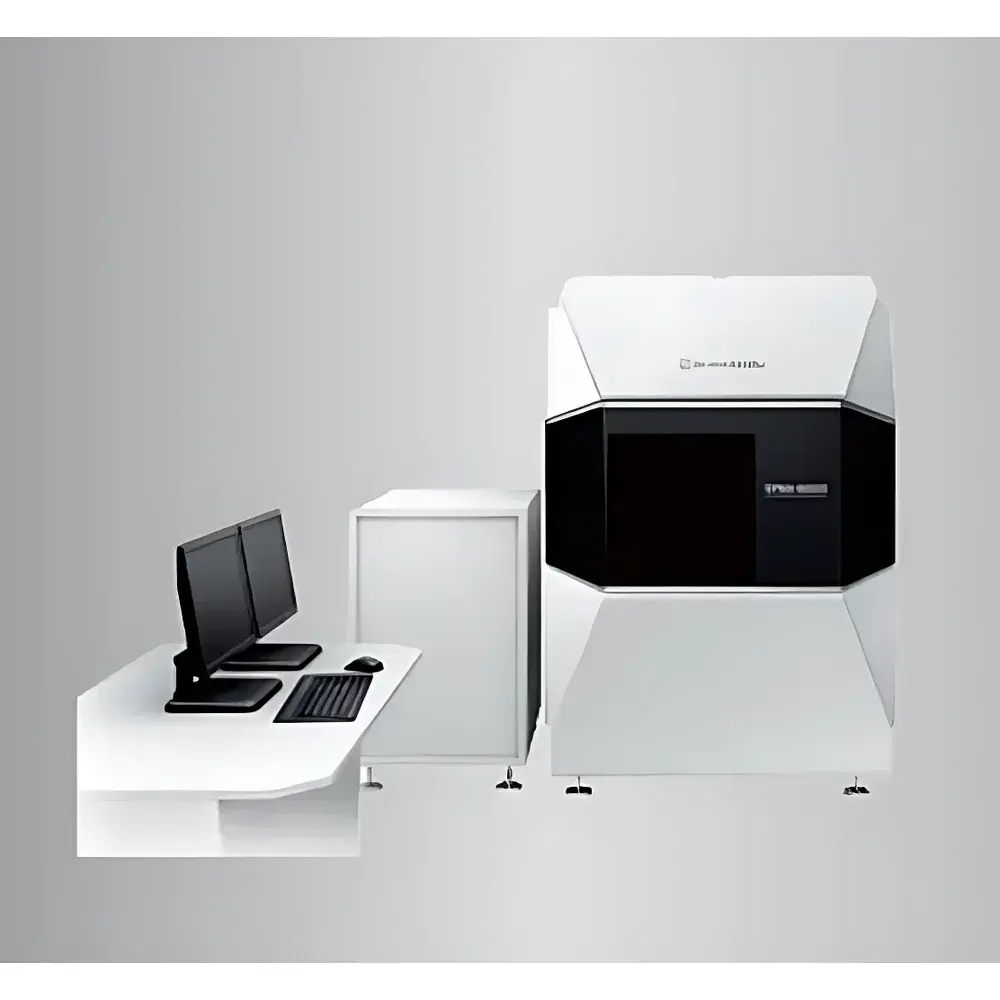
Shimadzu EPMA-8050G Field-Emission Electron Probe Microanalyzer
| Brand | Shimadzu |
|---|---|
| Origin | Japan |
| Model | EPMA-8050G |
| Beam Current Range | Up to 1 µA |
| Secondary Electron Resolution | 3 nm at 30 kV |
| X-ray Take-off Angle | 52.5° |
| X-ray Spectrometer | Five-channel, high-sensitivity, high-resolution WDS with full-focus crystals |
| X-ray Element Coverage | Be (4) to U (92) |
| Emission Source | High-brightness Schottky field-emission gun |
| Vacuum Architecture | Dual-stage orifice differential pumping system with ultra-high vacuum (UHV) electron gun chamber |
Overview
The Shimadzu EPMA-8050G is a high-performance field-emission electron probe microanalyzer engineered for quantitative elemental microanalysis at sub-micrometer spatial resolution. Based on the fundamental principles of wavelength-dispersive X-ray spectroscopy (WDS), the EPMA-8050G directs a finely focused, stable electron beam onto solid specimens to generate characteristic X-rays, which are then diffracted and resolved by precisely calibrated full-focus analyzing crystals. Unlike energy-dispersive spectrometry (EDS), WDS delivers superior peak-to-background ratios, detection limits in the range of 10–100 ppm (depending on element and matrix), and exceptional spectral resolution—critical for resolving overlapping X-ray lines (e.g., Ti Kβ / V Kα, S Kα / Pb Mα). The instrument’s field-emission electron optical architecture enables consistent analytical performance across beam currents from <1 nA to 1 µA—supporting both high-spatial-resolution imaging and high-precision bulk/trace quantification without hardware reconfiguration.
Key Features
- Schottky field-emission electron source: A thermally assisted, zirconium-oxide-coated tungsten emitter delivering high brightness (>1 × 10⁹ A/cm²·sr) and long-term current stability—enabling reproducible quantitative analysis at beam currents up to 1 µA while maintaining 3 nm secondary electron resolution at 30 kV.
- Dedicated EPMA electron optics: A simplified, low-aberration column design places the variable aperture lens at the objective lens plane—eliminating the need for interchangeable objective apertures and enabling optimal beam convergence across the full current range. This architecture ensures diffraction-limited probe formation independent of beam current setting.
- Dual-stage orifice differential vacuum system: Electron gun chamber, intermediate chamber, and analysis chamber are isolated via precision orifices. The minimal conductance between intermediate and analysis chambers restricts gas influx, preserving ultra-high vacuum (<1 × 10⁻⁸ Pa) in the electron gun region—essential for Schottky emitter longevity and emission stability.
- Five-channel WDS configuration: Equipped with five independently movable, 4-inch radius full-focus crystals (e.g., LIF, PET, TAP, OVO-50, MULTILAYER), each optimized for specific elemental ranges and resolution requirements. All spectrometers operate simultaneously under synchronized scan control.
- 52.5° X-ray take-off angle: Strategically optimized to maximize X-ray collection efficiency while minimizing absorption in both sample and detector window—enhancing signal-to-noise ratio for light elements (Be–F) and improving spatial resolution for heterogeneous phases.
Sample Compatibility & Compliance
The EPMA-8050G accommodates flat, polished, conductive or carbon-coated insulating samples up to 100 mm in diameter and 50 mm in height. Standard sample stages support precise XYZ translation, tilt (±45°), and rotation (360°), enabling multi-point analysis and crystallographic orientation mapping. The system complies with ISO 14725:2020 (Electron probe microanalysis — Quantitative analysis — Method of calibration and validation), ASTM E1508–22 (Standard Guide for Quantitative Analysis by WDS), and supports GLP/GMP traceability through audit-trail-enabled acquisition software. Optional integrated backscattered electron (BSE) and cathodoluminescence (CL) detectors extend phase identification and defect characterization capabilities.
Software & Data Management
Shimadzu’s proprietary EPMA Suite v5.x provides fully integrated instrument control, spectrum acquisition, matrix correction (ZAF/φ(ρz)), standardless quantification, and elemental mapping. All raw spectra, acquisition parameters, calibration files, and processing logs are stored in vendor-neutral HDF5 format with embedded metadata compliant with FAIR principles. Software supports 21 CFR Part 11-compliant electronic signatures, user-access-level permissions, and automated report generation with configurable templates aligned to ISO/IEC 17025 reporting requirements. Data export options include CSV, CDF, and Bruker ESPRIT-compatible formats for third-party post-processing.
Applications
The EPMA-8050G serves as a reference-grade platform in geoscience laboratories for mineral stoichiometry and zoning studies; in metallurgy for inclusion analysis, segregation mapping, and intermetallic phase characterization; in semiconductor R&D for dopant profiling and thin-film composition verification; and in nuclear materials research for actinide distribution and irradiation-induced phase evolution. Its ability to quantify light elements (e.g., B, C, N, O) alongside heavy metals within the same session—without switching detectors or vacuum modes—makes it indispensable for advanced ceramics, battery electrode materials, and catalyst development.
FAQ
What is the minimum detectable concentration for trace elements using the EPMA-8050G?
Detection limits depend on element atomic number, matrix absorption, and counting time—but typically range from 10 ppm for mid-Z elements (e.g., Fe, Ni) to ~100 ppm for light elements (e.g., O, F) under standard 100 s acquisition and 1 µA beam conditions.
Can the EPMA-8050G perform automated multi-point analysis across heterogeneous samples?
Yes—the stage and spectrometer motors are fully programmable via EPMA Suite; users can define grids, phase-based ROI masks, or coordinate lists for unattended batch analysis with auto-focus and beam alignment routines.
Is the Schottky emitter serviceable in-house, or does it require factory replacement?
Emitter replacement and alignment are performed by Shimadzu-certified field engineers; the UHV architecture precludes user-accessible emitter servicing to maintain vacuum integrity and emission stability.
Does the system support standards-based quantification with certified reference materials (CRMs)?
Yes—EPMA Suite includes libraries for NIST, USGS, MPI-DING, and JGSS CRMs, with built-in uncertainty propagation for ZAF corrections and matrix effects.
How is data integrity ensured during long-duration mapping sessions?
Real-time checksum validation, periodic acquisition log backups, and hardware-triggered emergency pause on vacuum excursion or power fluctuation ensure dataset continuity and compliance with ISO/IEC 17025 clause 7.5.2.







