
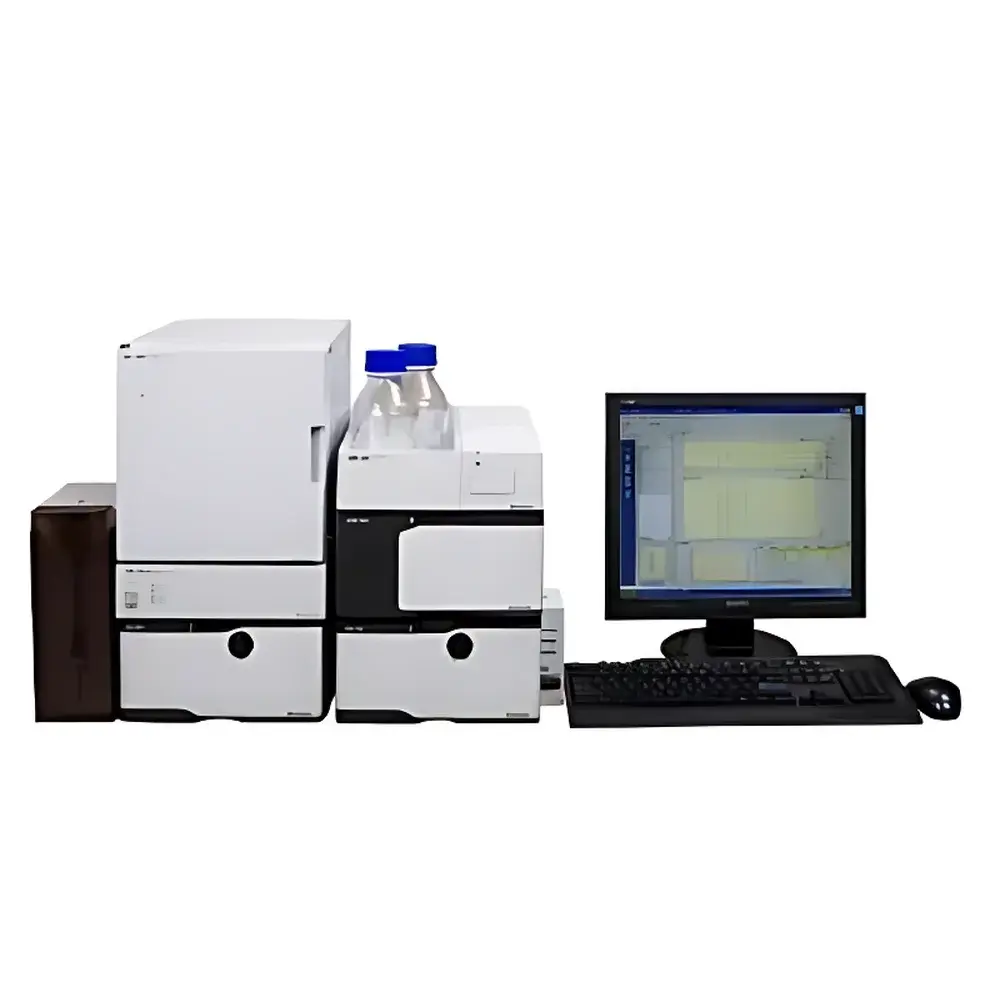
Shimadzu Essentia LC-15C High-Performance Liquid Chromatograph
| Brand | Shimadzu |
|---|---|
| Origin | Jiangsu, China |
| Manufacturer Type | Original Equipment Manufacturer (OEM) |
| Product Origin | Domestic (China) |
| Model | Essentia LC-15C |
| Pricing | Available Upon Request |
Overview
The Shimadzu Essentia LC-15C is a robust, entry-level high-performance liquid chromatograph engineered for routine analytical laboratories requiring reliability, operational simplicity, and compliance-ready performance. Built upon the proven architecture of Shimadzu’s flagship Prominence LC-20A platform, the Essentia LC-15C delivers consistent gradient elution, precise flow control, and stable baseline detection—core requirements for quantitative and qualitative analysis in pharmaceutical quality control, food safety testing, environmental contaminant screening, and industrial chemical characterization. Its modular design implements standard HPLC principles: solvent delivery via dual-plunger reciprocating pumps, sample introduction through a fixed-loop or programmable autosampler, analyte separation on packed reversed-phase or specialized columns within a thermostatically controlled compartment, and UV-Vis absorbance detection using a dual-wavelength photodiode array-based optical system. The system operates under isocratic or linear gradient conditions, supporting method transfer from research-grade instruments without compromising reproducibility.
Key Features
- LC-15C Solvent Delivery Unit: Features an enhanced dual-piston pump with floating plunger support mechanism, extending seal and piston lifetime while maintaining flow accuracy ±0.2% RSD and pressure pulsation <0.1 MPa at 1.0 mL/min.
- SPD-15C UV-Vis Dual-Wavelength Detector: Offers simultaneous dual-channel monitoring at user-selectable wavelengths (190–700 nm), wide linear dynamic range (>2.5 AU), and four acquisition modes—dual-wavelength detection, ratio chromatography, wavelength-programmed scanning, and stop-flow spectral acquisition.
- SIL-10AF Autosampler: Provides 100-position vial capacity (2 mL), injection volume range 0.1–100 µL with <0.3% RSD repeatability, integrated needle wash station, and programmable pre-injection functions including dilution, derivatization reagent addition, and mixing sequences.
- CTO-15C Column Oven & Solvent Tray: Integrates column heating (ambient to 85 °C, ±0.1 °C stability) with a compact solvent reservoir tray accommodating three 1000 mL or four 500 mL bottles; optional manual injector mounting minimizes extra-column volume and improves peak shape fidelity.
- System Integration: Fully compatible with Shimadzu LabSolutions LC software for instrument control, data acquisition, peak integration, calibration curve generation, and audit-trail-enabled reporting aligned with GLP/GMP workflows.
Sample Compatibility & Compliance
The Essentia LC-15C supports a broad range of sample matrices—including aqueous extracts, organic solvent-solubilized compounds, hydrolyzed biological fluids, and filtered environmental water samples—when paired with appropriate column chemistries (e.g., C18, phenyl-hexyl, HILIC, or ion-exchange). It meets essential regulatory expectations for routine QC environments: hardware design conforms to IEC 61010-1 safety standards; detector optics comply with ISO 17025 traceability guidelines for photometric response; and software operation supports 21 CFR Part 11-compliant user authentication, electronic signatures, and immutable audit trails when deployed with LabSolutions CS (Compliance Support) configuration. Method validation parameters—including precision, linearity, LOD/LOQ, and robustness—can be rigorously assessed per ICH Q2(R2) and USP guidelines.
Software & Data Management
Controlled exclusively via Shimadzu LabSolutions LC software, the Essentia LC-15C enables method development, sequence definition, real-time chromatogram visualization, and post-run processing using industry-standard algorithms for baseline correction, peak deconvolution, and retention time alignment. Raw data files (.lcd) are stored in vendor-neutral formats compatible with third-party review tools. The software supports automated report generation with customizable templates, PDF export with embedded metadata, and secure database archiving. Optional LabSolutions CS adds role-based access control, change history logging, and electronic record integrity safeguards required for FDA-inspected facilities.
Applications
- Pharmaceuticals: Assay and impurity profiling of active pharmaceutical ingredients (APIs) per USP monographs; dissolution testing; stability-indicating method validation.
- Food & Beverage: Pesticide residue quantification (e.g., organophosphates, carbamates); mycotoxin analysis (aflatoxins, ochratoxin A); vitamin and preservative content verification.
- Environmental: Detection of PAHs, PCBs, and endocrine-disrupting compounds in wastewater and soil extracts per EPA Methods 8330B and 8082A.
- Chemical Manufacturing: Monomer purity assessment, catalyst residue screening, and polymer additive quantification in raw materials and finished products.
FAQ
Is the Essentia LC-15C compliant with 21 CFR Part 11?
Yes—when configured with LabSolutions CS software, it supports electronic signature enforcement, audit trail generation, and user permission management as required for regulated environments.
Can the SPD-15C perform spectral scanning during a run?
No—it does not support real-time full-spectrum acquisition; however, it allows stop-flow spectral scanning for peak identification and library matching.
What is the maximum operating pressure of the LC-15C pump?
The system is rated for continuous operation up to 40 MPa (400 bar), suitable for most sub-2 µm particle-packed columns and UHPLC-compatible methods.
Does the SIL-10AF support cold storage of samples?
No—the autosampler operates at ambient temperature; for temperature-sensitive samples, external refrigerated racks or third-party cooled trays must be integrated.
Is method transfer from Prominence LC-20A straightforward?
Yes—identical pump dynamics, detector optical path, and software command structure enable direct parameter migration and minimal revalidation effort.





