
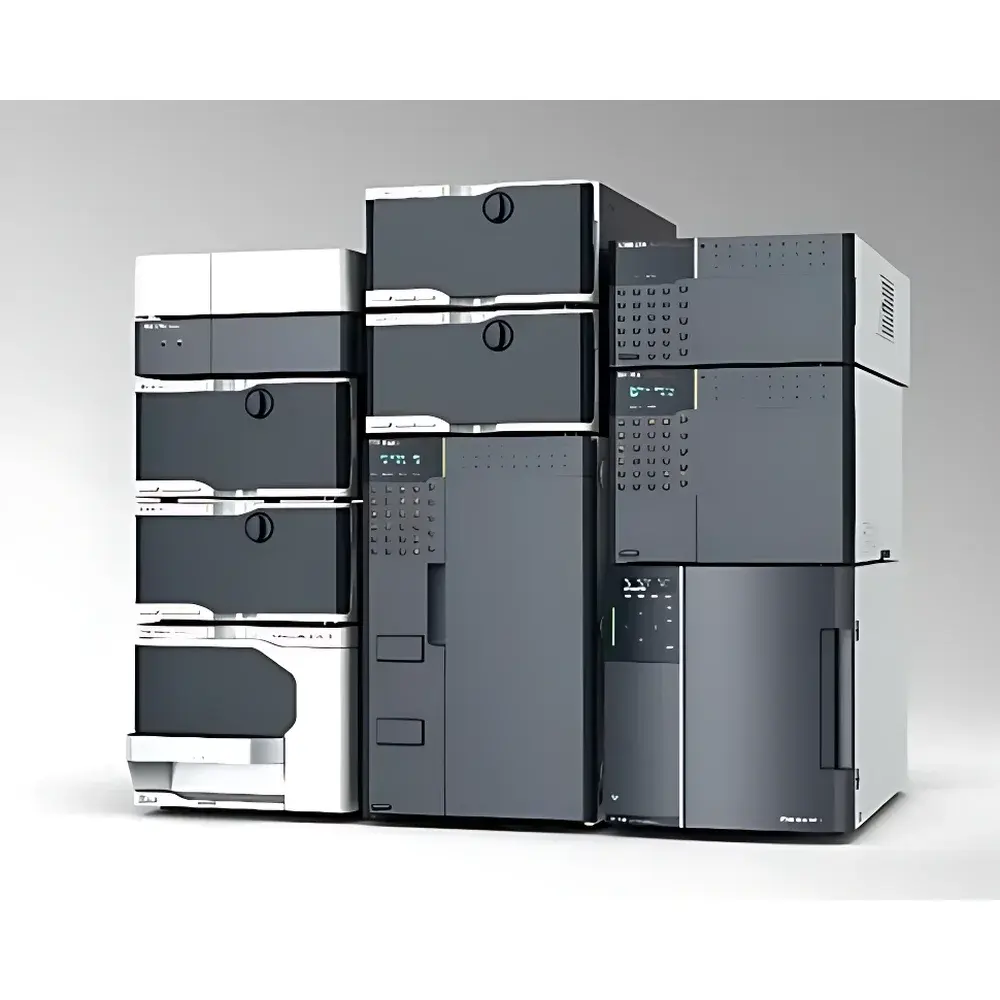
Shimadzu Essentia LC-16 Carbamate Post-Column Derivatization System
| Brand | Shimadzu |
|---|---|
| Origin | Jiangsu, China |
| Manufacturer Type | Original Equipment Manufacturer (OEM) |
| Product Category | Domestic Instrument |
| Model | Essentia LC-16 Carbamate Post-Column Derivatization System |
| Price Range | USD 28,000 – 70,000 |
| Instrument Type | Conventional High-Performance Liquid Chromatograph (HPLC) |
| Application | Dedicated Analytical System for Carbamate Pesticide Residues |
| Flow Rate Range | 0.001–10.00 mL/min |
| Maximum Pressure | 40 MPa |
| Flow Accuracy | ≤0.06% RSD or ≤0.02 min SD |
| Autosampler Capacity | 108 positions |
| Injection Volume Range | 0.1–100 µL |
| Column Oven Temperature Range | (Ambient + 10 °C) to 150 °C |
| Fluorescence Detector Wavelength Range | Excitation (Ex): 200–750 nm |
| Emission (Em) | 200–750 nm |
| Data Acquisition Rate | 100 Hz |
Overview
The Shimadzu Essentia LC-16 Carbamate Post-Column Derivatization System is a purpose-built, integrated HPLC platform engineered for the quantitative determination of carbamate pesticide residues in complex environmental and food matrices. It operates on the principle of post-column alkaline hydrolysis followed by o-phthalaldehyde (OPA)-mediated fluorescence derivatization—enabling selective, sensitive, and robust detection of trace-level carbamates such as carbaryl, carbofuran, methomyl, aldicarb, and propoxur. Unlike generic HPLC systems, this configuration incorporates tightly synchronized fluidic control, precisely regulated thermal zones, and chemically stable reaction pathways to ensure stoichiometric conversion and reproducible fluorophore formation. The system’s architecture reflects over three decades of Shimadzu’s method development experience aligned with major regulatory protocols—including GB, NY/T, SN/T, HJ, and GB/T standards—making it suitable for routine compliance testing in accredited food safety, environmental monitoring, and agricultural quality control laboratories.
Key Features
- Integrated triple-pump fluidics: Independent high-precision pumps for mobile phase delivery, hydrolysis reagent (0.05 mol/L NaOH), and OPA derivatization reagent—each calibrated to maintain ≤0.06% RSD flow accuracy across 0.001–10.00 mL/min range.
- Dual-zone thermostatic reactor module: Separately controlled hydrolysis chamber (up to 100 °C) and derivatization chamber (42 °C), both featuring PID-driven temperature stability (±0.3 °C) and real-time thermal feedback loops.
- Fluorescence detector with thermally stabilized flow cell: Excitation/emission wavelengths programmable from 200–750 nm; optimized at Ex 330 nm / Em 465 nm for OPA-carbamate adducts; data acquisition at 100 Hz ensures peak fidelity under gradient conditions.
- Autosampler with 108-position capacity and 0.1–100 µL variable injection: Equipped with needle wash, seal flush, and pressure-sensing syringe actuation to minimize carryover and ensure injection precision.
- Comprehensive hardware-level safety architecture: Triple-protection system for the reaction module—including overtemperature cutoff, liquid leak detection via capacitive sensors, and volatile organic compound (VOC) sensing for alkaline vapor leakage—fully compliant with IEC 61010-1 for laboratory instrumentation safety.
Sample Compatibility & Compliance
The system is validated for solid, semi-solid, and aqueous samples following standardized extraction procedures (e.g., QuEChERS, SPE, or solvent partitioning). It meets performance criteria outlined in GB 23200.112–2018 (9 carbamates in plant commodities), GB 23200.105–2016 (carbaryl in meat), NY/T 761–2008 (multi-residue analysis), SN/T 1017.7–2014 (cereal exports), HJ 960–2018 (soil/sediment), HJ 1025–2019 (solid waste), and GB/T 5750.9–2006 (drinking water). All operational parameters—including dwell volume, gradient delay, column backpressure, and detector response linearity—are traceable to NIST-traceable reference standards. The system supports GLP-compliant audit trails when operated under Shimadzu LabSolutions software with 21 CFR Part 11–enabled user authentication and electronic signature modules.
Software & Data Management
LabSolutions CS v5.97 (Carbamate Edition) provides full graphical workflow supervision—from method setup and real-time pump/temperature status display to live fluorescence signal overlay and automated peak integration. Preloaded method packages include calibration curves, gradient tables, and QC checklists per GB/HJ/NY/T standards. All derivatization timing parameters (hydrolysis dwell, mixing coil residence, OPA reaction delay) are adjustable with sub-second resolution. Raw data files (.lcd) are stored with embedded metadata (instrument ID, operator, timestamp, audit log hash), enabling seamless LIMS integration and long-term archival per ISO/IEC 17025 requirements. Batch processing supports automatic report generation in PDF/XLS formats with configurable templates aligned to CNAS or FDA submission guidelines.
Applications
This system delivers validated performance in multi-matrix residue analysis: quantification of carbaryl and carbofuran in rice, wheat, and apple homogenates; screening of methomyl in leafy vegetables using accelerated solvent extraction; determination of aldicarb sulfoxide in soil leachates; and confirmation of propoxur in drinking water after solid-phase extraction. Its linear dynamic range (R² ≥ 0.9995, n = 5) and LODs < 0.5 µg/kg (in fortified blank matrices) meet EU MRL and US EPA tolerance thresholds. The modular design also permits adaptation for non-carbamate analytes requiring post-column hydrolysis—such as certain organophosphate oxons or hydrazide-containing pharmaceuticals—subject to method revalidation.
FAQ
What regulatory standards does this system support out-of-the-box?
GB 23200.112–2018, GB 23200.105–2016, NY/T 761–2008, SN/T 1017.7–2014, HJ 960–2018, HJ 1025–2019, and GB/T 5750.9–2006.
Can the system be used for non-carbamate applications?
Yes—its modular fluidic architecture and programmable thermal zones allow method adaptation for other hydrolyzable or derivatizable analytes, provided full validation is performed per ISO/IEC 17025.
Is the fluorescence detector compatible with other derivatization chemistries?
Yes—the excitation/emission range (200–750 nm) supports alternative reagents such as naphthalene-2,3-dicarboxaldehyde (NDA) or 4-fluoro-7-nitro-2,1,3-benzoxadiazole (NBD-F), subject to optical filter configuration.
How is data integrity ensured during long unattended runs?
LabSolutions CS implements continuous checksum logging, instrument state snapshots every 30 seconds, and automatic recovery from power interruption without data loss.
Does the system support remote monitoring and diagnostics?
Yes—via Shimadzu’s optional LabSolutions Remote Access Module, enabling secure web-based status viewing, method upload, and diagnostic log retrieval through TLS 1.2–encrypted connections.
Related Products





