
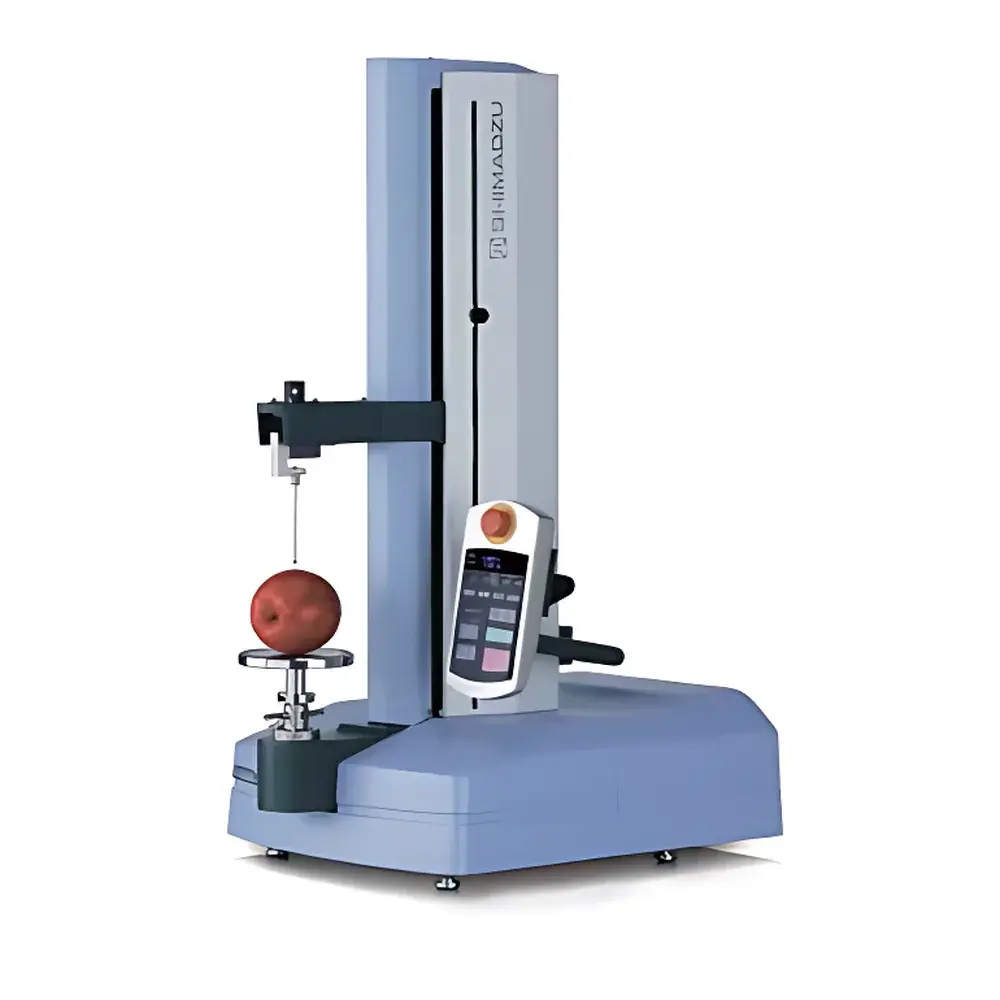
Shimadzu EZ Test Texture Analyzer
| Brand | Shimadzu |
|---|---|
| Origin | Japan |
| Manufacturer Type | Original Equipment Manufacturer (OEM) |
| Origin Category | Imported Instrument |
| Model | EZ Test |
| Price Range | USD 14,000 – 42,000 |
Overview
The Shimadzu EZ Test Texture Analyzer is a high-precision, single-column universal testing system engineered for objective mechanical property characterization of food and soft biomaterials. Based on controlled-force and controlled-displacement compression/tension methodology—compliant with fundamental principles of material science and rheomechanics—the instrument quantifies time-dependent deformation responses under standardized probe–sample interactions. It operates within the framework of texture profile analysis (TPA), adhering to internationally recognized test geometries defined in ASTM STP 1357 and ISO 11357-3 for thermoplastic and viscoelastic food matrices. Designed for reproducible force resolution down to 0.01 N and displacement accuracy within ±0.01 mm, the EZ Test delivers traceable, GLP-compliant physical measurements essential for R&D validation, QC release testing, and sensory correlation studies.
Key Features
- Robust single-column electromechanical architecture with integrated load cell (capacity range: 5 N to 500 N, selectable by configuration) and precision ball-screw drive system
- Programmable test sequences supporting up to 10 independent motion segments per method—enabling multi-cycle TPA, relaxation, creep, and hysteresis protocols
- Modular probe interface compatible with ISO-standardized fixtures: cylindrical probes (2–25 mm diameter), Warner–Bratzler blades, Kramer shear cells, tensile grips, extrusion dies, and custom-designed sample holders
- Real-time force–displacement data acquisition at ≥1,000 Hz sampling rate, ensuring fidelity in transient event capture (e.g., fracture onset, yield point, adhesion break)
- IP54-rated enclosure with ergonomic benchtop footprint (W × D × H: 360 × 420 × 620 mm), optimized for shared laboratory environments and production-floor deployment
- Thermal-stable aluminum alloy frame and anti-vibration base plate to minimize environmental interference during low-force measurements
Sample Compatibility & Compliance
The EZ Test accommodates heterogeneous food matrices across 12 functional categories—including cereals (puffed corn, oat flakes), fruits & vegetables (apple parenchyma, cucumber pericarp), bakery products (crumb structure in baguettes, biscuit layer delamination), meat analogs and comminuted proteins (emulsion stability in sausages, myofibrillar network integrity in surimi), dairy gels (casein micelle aggregation in yogurt, fat globule network rupture in butter), hydrocolloid systems (agarose hysteresis, pectin syneresis), starch-based pastes (rice noodle tensile strength, dumpling skin extensibility), viscous dispersions (peanut butter spreadability, honey flow resistance), confectionery (chocolate snap force, gum base elasticity), and botanical extracts (herbal tablet friability, dried root compressibility). All test methods align with AOAC 988.11 (fruit firmness), USP (mechanical testing of dosage forms), and ISO 11036 (texture analysis terminology), supporting audit readiness for FDA 21 CFR Part 11–enabled workflows when paired with optional electronic signature modules.
Software & Data Management
Operating via Shimadzu’s proprietary TR-Soft v3.x platform, the EZ Test provides ISO/IEC 17025-aligned data governance: automated metadata tagging (operator ID, timestamp, environmental conditions), encrypted raw binary storage (.tdf format), and export to CSV, Excel, or XML for LIMS integration. The software includes pre-validated method templates for TPA, puncture, extrusion, and tensile testing; customizable pass/fail thresholds with statistical process control (SPC) charts; and built-in calculation engines for derived parameters—hardness (peak force, N), fracturability (slope discontinuity index), cohesiveness (area ratio of first vs. second compression cycle), springiness (recovery distance/time), chewiness (hardness × cohesiveness × springiness), and adhesiveness (negative work area). Audit trails log all user actions, parameter edits, and calibration events, satisfying GLP/GMP documentation requirements.
Applications
The EZ Test serves as a primary instrumentation platform for texture-driven quality assurance in food innovation pipelines—from upstream ingredient functionality screening (e.g., gluten viscoelasticity modulation during flour blending) to downstream shelf-life monitoring (e.g., moisture-induced softening kinetics in extruded snacks). It supports formulation optimization (fat replacement efficacy in low-calorie cheeses), process validation (blanching time impact on green bean crispness), regulatory dossier preparation (texture consistency in infant formula powders), and cross-modal sensory mapping (correlating instrumental hardness with panel-perceived “bite resistance” using partial least squares regression). Its validated use extends to non-food domains including pharmaceutical tablet hardness profiling, cosmetic gel rheology, and agricultural post-harvest maturity assessment.
FAQ
What standards does the EZ Test comply with for food texture testing?
It supports methodologies referenced in ASTM STP 1357, ISO 11036, AOAC 988.11, and USP , with configurable test parameters aligned to each standard’s procedural definitions.
Can the EZ Test perform both compression and tension tests on the same sample?
Yes—its bidirectional motor and programmable sequence logic allow synchronized compression–tension cycles within a single run, critical for simulating mastication mechanics.
Is calibration traceable to national metrology institutes?
Load cell calibration certificates are issued with NIST-traceable references; annual recalibration services include uncertainty budgets compliant with ISO/IEC 17025.
How is data integrity maintained during long-term stability studies?
TR-Soft enforces write-once archival mode, digital signatures for report finalization, and automatic backup to network drives with version-controlled revision history.
What probe selection guidance is available for novel food matrices?
Shimadzu provides application notes with probe geometry rationale (e.g., flat-ended vs. spherical probes for surface homogeneity assessment) and peer-reviewed case studies covering >200 food types.
Related Products




