
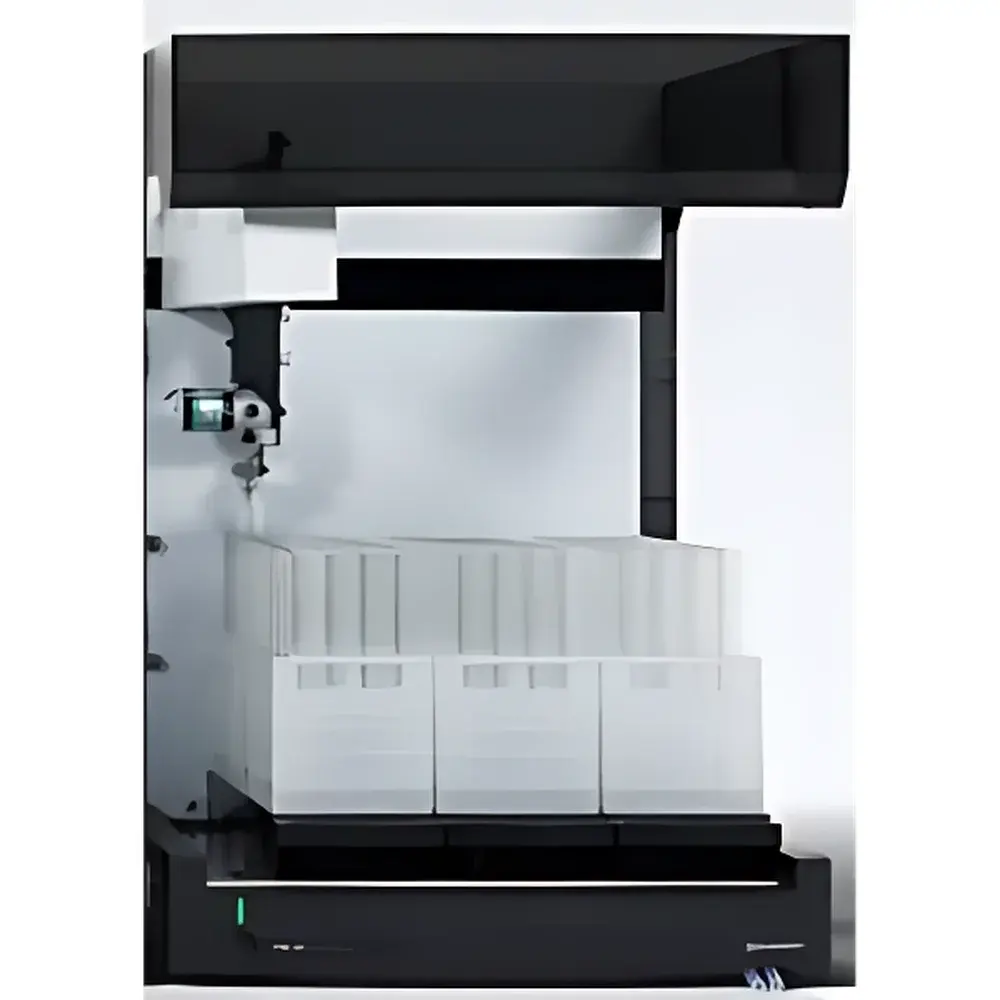
Shimadzu FRC-40 SF Analytical Fraction Collector
| Brand | Shimadzu |
|---|---|
| Origin | Japan |
| Manufacturer | Shimadzu Corporation |
| Product Type | Liquid-phase analytical fraction collector |
| Model | FRC-40 SF |
| Application Compatibility | Compatible with Nexera UC Supercritical Fluid Chromatography (SFC) systems |
| Core Technology | μ Lotus Stream compact gas–liquid separator |
Overview
The Shimadzu FRC-40 SF Analytical Fraction Collector is an engineered solution designed for high-precision, low-volume fractionation in analytical-scale supercritical fluid chromatography (SFC) and liquid chromatography (LC) workflows. Unlike preparative fraction collectors optimized for milligram-to-gram recovery, the FRC-40 SF operates at the analytical interface—where reproducibility, minimal carryover, and sub-microliter timing accuracy are critical. Its integration with the Nexera UC SFC platform enables automated, peak-triggered collection of target analytes directly from complex matrices, leveraging real-time UV/Vis or MS signal input. The system employs a proprietary μ Lotus Stream gas–liquid separator to ensure stable phase handling during CO₂-based mobile phase transitions, minimizing pressure fluctuations and improving baseline stability during fraction elution. This architecture supports retention time alignment between detection and collection events—essential for method transfer from analytical screening to downstream structural characterization (e.g., NMR, HRMS).
Key Features
- High-efficiency sample recovery: Optimized tubing path geometry and low-dead-volume valves reduce sample loss, achieving >95% recovery for 10–100 µL injections under standard SFC conditions.
- Analytical-flow compatibility: Accepts flow rates from 0.1 to 5 mL/min—compatible with both narrow-bore (2.1 mm ID) and standard (4.6 mm ID) analytical columns.
- Microplate-ready collection: Direct dispensing into 96-well microplates (V-bottom or flat-bottom), PCR tubes, or custom vials via programmable XYZ positioning; minimum fraction volume: 10 µL.
- Multi-method preparation support: Stores up to 100 user-defined collection methods—including time-based, peak-threshold, and multi-window trigger logic—with independent delay time compensation per method.
- Preparative simulation mode: Simulates preparative-scale gradient profiles using analytical data to estimate fraction purity and yield prior to scale-up—reducing trial-and-error in purification development.
- Automated peak detection setup: Uses baseline noise estimation and derivative thresholding to auto-generate retention time windows and amplitude criteria based on injected standards.
- Dynamic delay time calculation: Compensates for system dwell volume (detector-to-collector transport lag) by measuring actual peak apex shift across flow rates and column configurations—applied in real time during acquisition.
- Overflow prevention logic: Monitors collected volume per well via integrated flowmeter feedback and halts dispensing if capacity thresholds are exceeded—preventing cross-well contamination.
- Cross-contamination suppression: Features dual-stage needle wash (organic solvent + aqueous rinse), active purge cycles between fractions, and inert PEEK/MP31 tubing throughout fluidic paths.
- Residual sample recovery: Includes post-collection aspiration protocol to retrieve residual liquid from transfer lines and injection valve ports—critical for high-value natural product isolates or synthetic intermediates.
Sample Compatibility & Compliance
The FRC-40 SF accommodates a broad range of sample types including chiral pharmaceuticals, natural product extracts, polymer oligomers, and metabolite standards. It complies with ISO/IEC 17025 requirements for calibration traceability and supports GLP-compliant operation through audit-trail-enabled software logging (user actions, method parameters, timestamps, and instrument status). When operated within a validated Nexera UC SFC system, it meets relevant sections of USP and ICH Q2(R2) for chromatographic method robustness testing. All wetted materials conform to USP Class VI biocompatibility standards.
Software & Data Management
Controlled via LabSolutions LC/GC software (v5.95 or later), the FRC-40 SF integrates natively with Shimadzu’s instrument network architecture. Software features include full 21 CFR Part 11 compliance with electronic signatures, role-based access control, and immutable audit trails covering method creation, execution, and export. Fraction metadata—including retention time, UV spectra, peak area, and collection coordinates—is embedded in .cdf files and exportable to LIMS via ASTM E1384-compliant XML schema. Batch processing tools allow retrospective reprocessing of collection logic across historical runs without re-injection.
Applications
- Chiral purity assessment and enantiomer isolation in early-stage API development
- Targeted isolation of bioactive compounds from plant extracts for dereplication studies
- Metabolite trapping and enrichment prior to high-resolution mass spectrometry
- Method scouting for orthogonal separation techniques (e.g., SFC → LC–MS/MS)
- Stability-indicating fractionation of degradants in forced degradation studies
- Automated library generation for high-throughput screening assays
FAQ
What is the minimum detectable delay time correction resolution?
The system calculates delay times with 0.1-second resolution, calibrated against physical dwell volume measurements using step-gradient validation protocols.
Can the FRC-40 SF be used with HPLC systems outside the Nexera UC platform?
Yes—via analog TTL trigger input or Ethernet-based remote command (Shimadzu GC/LC Control Protocol), though μ Lotus Stream optimization is exclusive to SFC applications.
Is hardware modification required to switch between 96-well plates and individual vials?
No—tool-free tray exchange is supported; interchangeable plate holders and vial racks are included as standard accessories.
How is carryover quantified during qualification?
Carryover is assessed per ICH Q5C guidance using a high-concentration standard followed by blank injection; typical results are ≤0.01% for consecutive injections of 100 µg/mL caffeine in methanol.
Does the system support scheduled maintenance alerts?
Yes—software monitors actuator cycle counts, wash solvent levels, and valve performance metrics, triggering configurable notifications aligned with Shimadzu’s PM schedule (every 6 months or 500 hours, whichever occurs first).




