
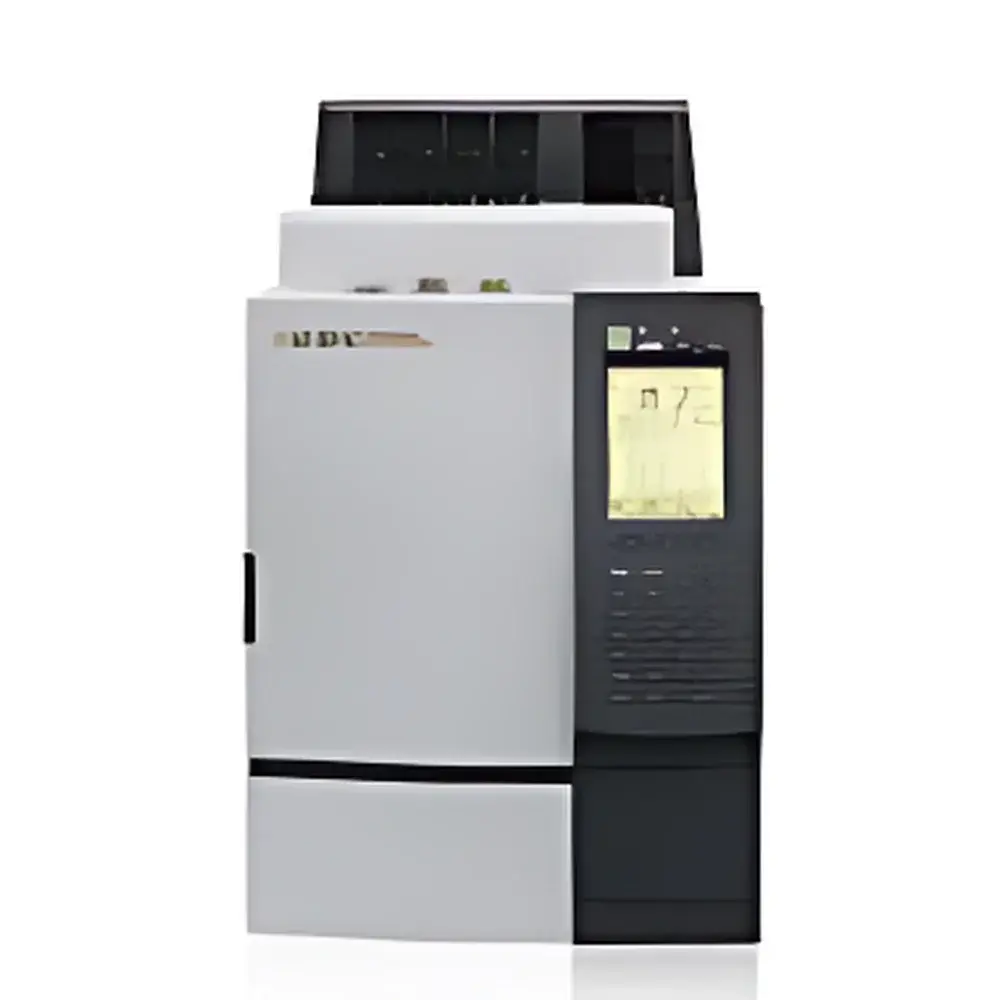
Shimadzu GC-2014C Gas Chromatograph System
| Brand | Shimadzu |
|---|---|
| Origin | Imported (Manufactured in Suzhou, China under Shimadzu Global Quality Standards) |
| Manufacturer Type | Original Equipment Manufacturer (OEM) |
| Instrument Type | Laboratory Gas Chromatograph |
| Application Scope | General-Purpose Analysis |
| Oven Temperature Range | Ambient +10 °C to 400 °C |
| Maximum Ramp Rate | 250 °C/min |
| Cooling Rate | From 300 °C to 50 °C in <6 min |
| Carrier Gas Flow Control Range | 0–1200 mL/min (7 programmable segments) |
| Carrier Gas Pressure Control Range | 0–970 kPa (7 programmable segments) |
| Injector Maximum Operating Temperature | 420 °C |
| Injector Pressure Setting Range | 0–970 kPa |
| Injector Total Flow Setting Range | 0–1200 mL/min |
Overview
The Shimadzu GC-2014C is a high-performance, general-purpose gas chromatograph engineered for precision, reliability, and operational flexibility in regulated and research laboratory environments. Built at Shimadzu’s ISO 9001-certified Suzhou manufacturing facility—part of the company’s global analytical instrumentation network—the GC-2014C integrates core thermal and pneumatic control architectures from the legacy GC-14 series with the intuitive user interface and workflow efficiency of the GC-2014 platform. Its analytical principle relies on capillary or packed column separation coupled with selective detection, where volatile and semi-volatile compounds are vaporized, partitioned across a stationary phase under precisely controlled temperature and carrier gas dynamics, and quantified via detector-specific response mechanisms. Designed for compliance-critical applications—including environmental monitoring (EPA Method 8021B, 8260), food safety testing (AOAC, ISO 17025), petrochemical profiling (ASTM D3606, D5503), and residual pesticide analysis (EU SANTE/11312/2021)—the system supports method transfer, routine QC, and method development workflows without compromise.
Key Features
- Thermally stable oven with expanded internal dimensions (280 × 260 × 170 mm), facilitating rapid column installation, maintenance, and compatibility with 40 mm-thread glass columns from GC-7 through GC-16 series.
- Advanced electronic pressure and flow control (AFC) module—identical to that used in GC-2010 and GC-2014 platforms—enabling three distinct carrier gas delivery modes: constant pressure, constant flow, and Shimadzu’s proprietary constant linear velocity (CLV) mode, which improves retention time reproducibility (<0.02 min RSD) and peak area precision (<1.5% RSD).
- High-speed thermal management: 250 °C/min maximum ramp rate and sub-6-minute cooling from 300 °C to 50 °C ensure shortened cycle times and enhanced throughput in multi-method sequences.
- Modular architecture supporting up to three independent injection units and four detectors simultaneously—enabling dual- or triple-detector configurations for compound confirmation, selectivity enhancement, or parallel analysis streams.
- Full Chinese-language LCD interface with real-time graphical monitoring of injector, oven, and detector status; context-sensitive help system and guided setup wizard reduce operator training requirements and minimize configuration errors.
- Integrated self-diagnostic routines—including leak detection, valve actuation verification, and detector baseline stability checks—support proactive maintenance and GLP-compliant instrument qualification (IQ/OQ/PQ).
Sample Compatibility & Compliance
The GC-2014C accommodates a broad range of sample matrices—including aqueous extracts, organic solvent solutions, headspace vapors, and thermal desorption tubes—via its configurable inlet systems. Compatible inlet options include the DINJ-2014 dual-packed injector (for simultaneous FID/TCD analysis), SPL-2014 split/splitless injector (with high-pressure capability and carrier gas-saving mode), and optional PTV or cold-on-column units. All detectors meet international sensitivity and linearity standards: FID-2014 delivers <3 pg C/sec detection limit for n-decane (ASTM D3606); TCD-2014 features semi-diffusion cell design with automatic filament protection; ECD-2014 achieves <0.005 pg/mL for γ-HCH (ISO 10382); FPD-2014 and FTD-2014 variants support trace-level sulfur, phosphorus, and nitrogen compound quantification per EPA 508/525 protocols. The system conforms to IEC 61000-4 electromagnetic compatibility standards and supports full audit trail functionality required under FDA 21 CFR Part 11, EU Annex 11, and JPAL GLP guidelines.
Software & Data Management
GCsolution Lite—a fully localized Chinese workstation—provides complete instrument control, data acquisition, peak integration, calibration curve generation, and report export (PDF, CSV, XML). It implements role-based user access control, electronic signatures, and immutable audit trails—including timestamped records of method changes, sequence modifications, and raw data reprocessing events. Data integrity safeguards include automatic backup, checksum validation, and secure database encryption compliant with ISO/IEC 27001 practices. Optional GCsolution Pro extends capabilities to spectral deconvolution (for co-eluting peaks), automated method optimization, and integration with LIMS via ASTM E1384 or HL7 interfaces. All software modules undergo annual verification against NIST-traceable reference standards.
Applications
The GC-2014C serves as a foundational analytical platform across regulated and academic laboratories. In environmental labs, it performs VOC analysis in drinking water (EPA 524.4), PCB congener profiling in soil (EPA 8082), and BTEX quantification in air samples. Food testing laboratories utilize its dual-FID/TCD configuration for fatty acid methyl ester (FAME) profiling and ethanol determination in beverages (AOAC 971.12). Petrochemical users apply CLV mode to achieve robust retention indexing across wide-boiling-point hydrocarbon cuts (ASTM D5186). Residue labs deploy ECD-2014/FTD-2014C combinations for multiresidue pesticide screening in fruits and vegetables, meeting EU MRL thresholds with validated LOQs ≤0.01 mg/kg. Its modular scalability also supports method development for emerging contaminants—including PFAS precursors and microplastic pyrolysis markers—without hardware replacement.
FAQ
Is the GC-2014C compliant with FDA 21 CFR Part 11 requirements?
Yes—GCsolution Lite includes electronic signature support, audit trail logging, and data integrity controls aligned with Part 11 Subpart B specifications.
Can the GC-2014C operate with both packed and capillary columns?
Yes—its universal inlet design and pressure/flow programming accommodate 40 mm-thread glass packed columns and fused-silica capillaries up to 0.53 mm ID.
What is the maximum operating temperature for the FPD-2014 detector?
The FPD-2014 has an upper temperature limit of 350 °C, enabling high-temperature sulfur/phosphorus analysis without detector degradation.
Does the system support remote monitoring and control?
When deployed on a local network with GCsolution Lite installed on a Windows PC, real-time status viewing and method editing are supported via TCP/IP communication.
Are consumables and service parts globally available?
All critical components—including AFC valves, detector nozzles, and septa—are stocked by Shimadzu’s regional distribution centers in North America, EMEA, and APAC, with standard lead times under 5 business days.




