
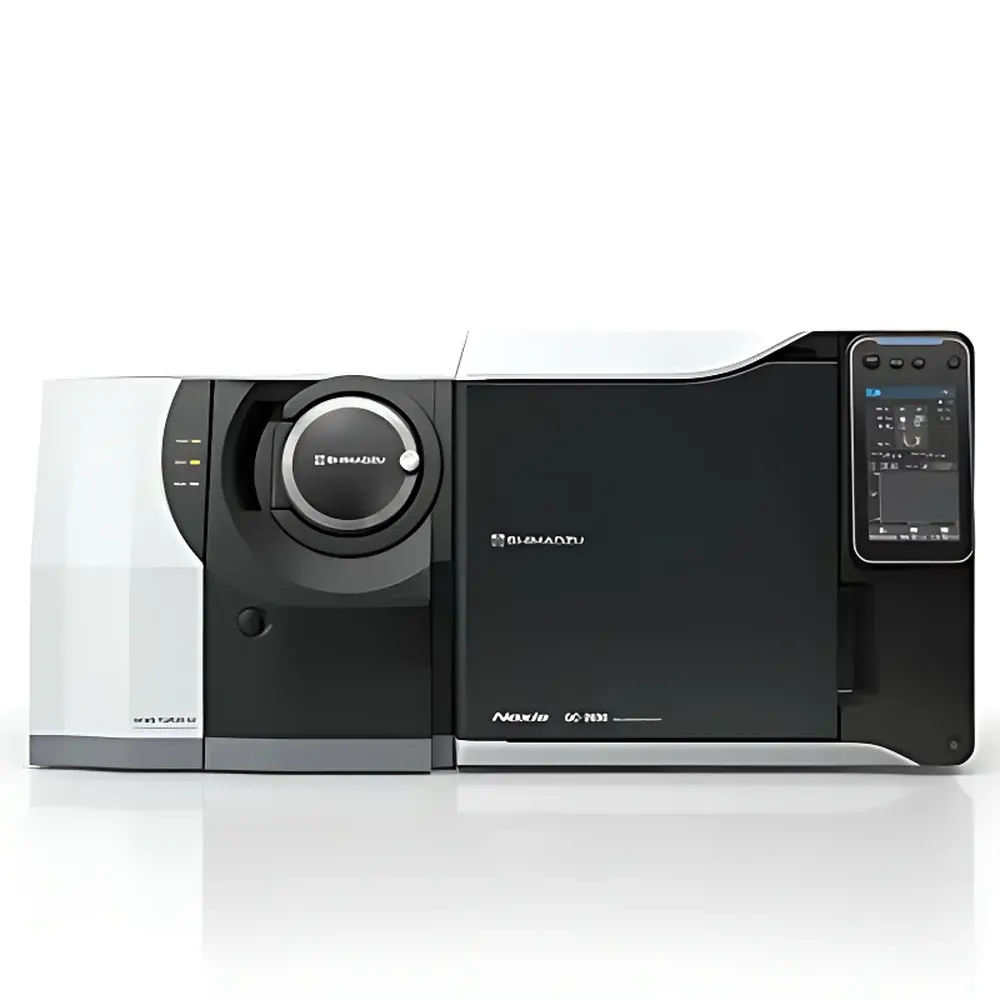
Shimadzu GCMS-TQ8040 NX Triple Quadrupole Gas Chromatography Mass Spectrometer
| Brand | Shimadzu |
|---|---|
| Origin | Jiangsu, China |
| Manufacturer Type | Original Equipment Manufacturer (OEM) |
| Regional Classification | Domestic Instrument |
| Model | GCMS-TQ8040 NX |
| Price Range | USD 210,000 – 280,000 |
| Instrument Type | Triple Quadrupole Mass Spectrometer |
| GC Configuration | Conventional Capillary GC Coupling |
| Mass Range | m/z 2–1090 |
| Resolution | 0.4–3.0 Da (Full Width at Half Maximum, FWHM) |
| Sensitivity | >18,000:1 (Signal-to-Noise Ratio, S/N, for 1 pg OFN in MRM mode) |
| Scan Speed | Up to 20,000 u/s |
Overview
The Shimadzu GCMS-TQ8040 NX is a high-performance triple quadrupole gas chromatography mass spectrometer engineered for robust, quantitative trace analysis in regulated and research-intensive environments. It operates on the principle of tandem mass spectrometry (MS/MS) via three quadrupole stages: Q1 (mass selection), Q2 (collision-induced dissociation cell), and Q3 (mass analysis). This architecture enables highly selective multiple reaction monitoring (MRM), significantly reducing chemical noise and enhancing detection specificity for target analytes in complex matrices—such as environmental extracts, food residues, clinical biofluids, and forensic samples. Designed for seamless integration with Shimadzu’s Nexis GC-2030 or legacy GC-2010 series, the system delivers reproducible retention time alignment, precise temperature-controlled transfer line coupling, and real-time synchronization between chromatographic elution and MS/MS event scheduling.
Key Features
- Smart MRM Technology: Automates method development by intelligently selecting optimal precursor→product ion transitions, collision energies, and dwell times based on compound class libraries and empirical tuning data—reducing manual optimization time by up to 70%.
- High-Throughput Acquisition: Supports up to 32,768 MRM channels per acquisition cycle, enabling comprehensive multi-analyte quantitation without sacrificing dwell time or sensitivity—ideal for large-scale residue screening and biomarker panels.
- Advanced Ion Source Design: Features a high-efficiency electron ionization (EI) source with optimized filament geometry and heated ion optics, delivering stable ion currents over extended run times and improved signal reproducibility across thermal gradients.
- ASSP (Active Scan Speed Protocol): Dynamically adjusts scan speed and detector gain during acquisition to maintain consistent sensitivity across wide mass ranges and variable peak widths—critical for co-eluting compounds and gradient GC methods.
- Simultaneous Scan/MRM Mode: Acquires full-scan spectra and MRM transitions within the same injection, supporting both retrospective library searching (e.g., NIST, Wiley) and high-confidence quantitation without reanalysis.
- Robust Collision Cell (Q2): Utilizes pressurized argon or nitrogen gas with optimized RF/DC fields to ensure efficient fragmentation and minimal neutral loss—enhancing selectivity for structurally similar isomers and metabolites.
Sample Compatibility & Compliance
The GCMS-TQ8040 NX accommodates standard 0.25–0.53 mm ID capillary columns (e.g., DB-5ms, Rxi-5Sil MS, VF-17ms) and interfaces with split/splitless, PTV, and cold-on-column injectors. It supports derivatized and underivatized volatile/semi-volatile organics—including pesticides, PAHs, PCBs, phthalates, steroids, and mycotoxins—across aqueous, organic, and solid-phase extracted (SPE) sample types. The system complies with instrumental requirements outlined in ASTM D5845, EPA Methods 8270/1613/1631, ISO 17025:2017 (as part of accredited laboratory workflows), and supports audit-trail-enabled operation per FDA 21 CFR Part 11 when deployed with LabSolutions LCMS software v5.95 or later under validated configurations.
Software & Data Management
Controlled via Shimadzu LabSolutions LCMS software, the GCMS-TQ8040 NX provides integrated instrument control, automated calibration (tune report generation), peak integration, and batch processing with customizable report templates. The software includes built-in spectral deconvolution (AIA/ANDI-compliant), retention time locking (RTL), and internal standard normalization workflows. All raw data files adhere to ANDI/NetCDF format for third-party compatibility (e.g., Compound Discoverer, SimLynx, TargetLynx). Audit trails record user actions, parameter changes, and sequence modifications with timestamped, non-erasable entries—enabling GLP/GMP-aligned data integrity and regulatory submission readiness.
Applications
- Regulatory pesticide residue testing in fruits, vegetables, and grains (EU MRLs, USDA PDP)
- Environmental monitoring of persistent organic pollutants (POPs) in soil, sediment, and wastewater
- Clinical toxicology screening for drugs of abuse and therapeutic drug monitoring (TDM)
- Food safety verification of veterinary drug residues and process contaminants (e.g., acrylamide, furans)
- Forensic identification of ignitable liquids and explosive residues per ASTM E1618/E2329
- Metabolomics profiling using targeted MRM panels for endogenous small molecules (e.g., amino acids, fatty acids, oxylipins)
FAQ
Does the GCMS-TQ8040 NX support method transfer from other Shimadzu GC-MS systems?
Yes—via LabSolutions’ Method Migration Assistant, which auto-adapts GC temperature programs, MS parameters, and MRM transitions from legacy GCMS-QP2010 Ultra or GCMS-TQ8030 platforms with minimal recalibration.
Is the system compatible with third-party GC controllers or autosamplers?
It supports industry-standard RS-232 and Ethernet-based communication protocols (Shimadzu GC Control API); however, full synchronization of GC events (e.g., valve switching, backflush) requires native Nexis GC-2030 or GC-2010 Plus hardware.
What maintenance intervals are recommended for routine operation?
Ion source cleaning every 2–4 weeks (depending on sample load), quadrupole tuning every 3 months, and vacuum system inspection (turbo pump oil level, foreline trap) every 6 months—per Shimadzu PM Guide Rev. 4.2.
Can the GCMS-TQ8040 NX perform qualitative identification alongside quantitation?
Yes—through simultaneous Scan/MRM acquisition, where full-scan data enable NIST library matching (match factor ≥800) while MRM data provide pg-level quantitation with ≤5% RSD across 5-day validation runs.
Is remote monitoring and diagnostics supported?
LabSolutions Remote Monitor allows secure web-based access to real-time status, error logs, and scheduled maintenance alerts via TLS 1.2–encrypted connection—compatible with corporate IT security policies.
Related Products






