
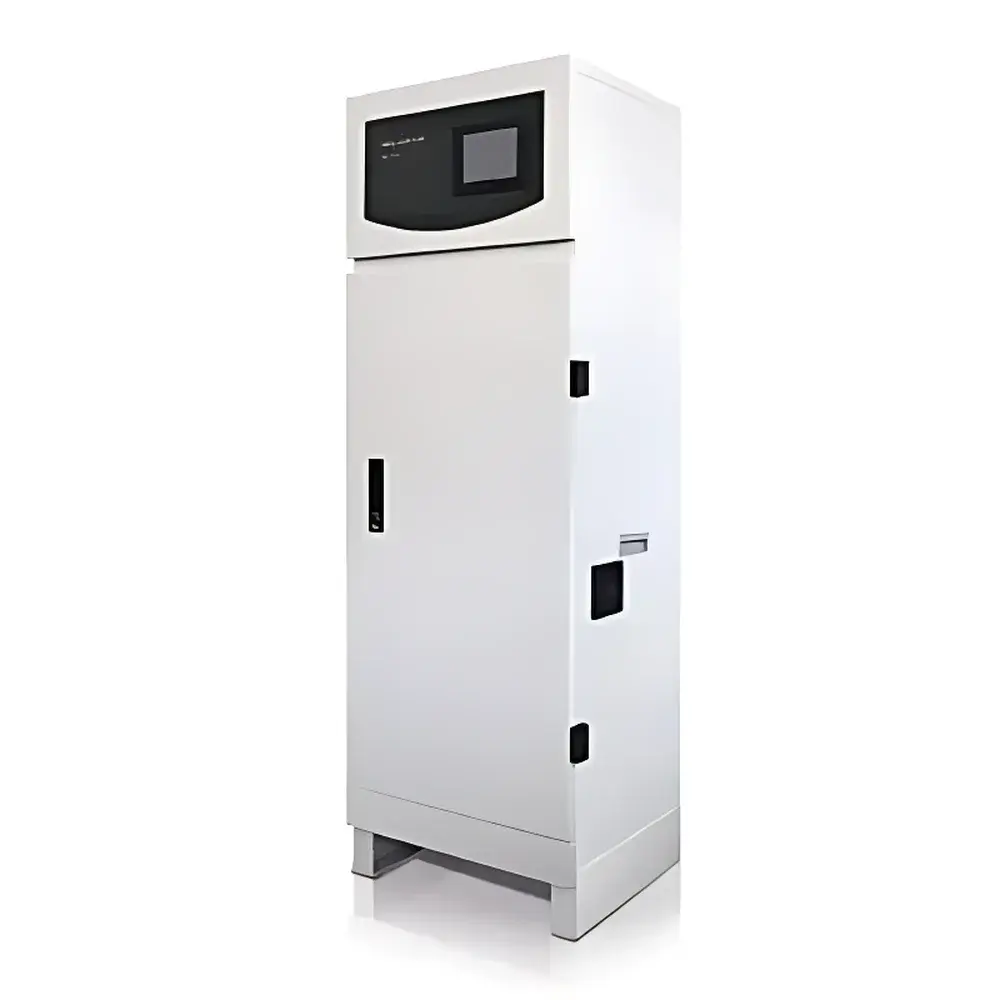
Shimadzu HMA-4200 Series Online Heavy Metal Analyzers (Cr(VI), Total Cr, Total Cu, Total Ni)
| Brand | Shimadzu |
|---|---|
| Origin | Jiangsu, China |
| Manufacturer Type | Original Equipment Manufacturer (OEM) |
| Product Line | HMA-4200 Series |
| Measurement Principles | Colorimetric Spectrophotometry per ISO 11969 / GB/T 7467–1987 (for Cr(VI)), ISO 11045 / GB/T 7475–1987 (for Total Cr, Cu, Ni) |
| Detection Range | 0–2 mg/L (Cr(VI), Total Cr), 0–3.5 mg/L (Total Cu), 0–10 mg/L (Total Ni) |
| Accuracy | ≤±5% FS |
| Repeatability | ≤±5% RSD |
| Linearity Error | ≤±5% FS |
| Span Drift | ≤±5% over 24 h |
| Zero Drift | ≤±3% (Cr(VI), Total Ni), ≤±5% (Total Cu) |
| Minimum Measurement Cycle | 20 min (Cr(VI)), 50 min (Total Cr, Cu, Ni) |
| Calibration Mode | Manual or Automatic (with standard solution dispensing module) |
| Output Interface | RS-232 serial port and isolated 4–20 mA analog output |
| MTBF | ≥1440 h |
| Power Supply | 220 VAC ±10%, 50 Hz ±5% |
| Dimensions (H×W×D) | 1550 × 500 × 420 mm |
| Enclosure Rating | IP54 (indoor installation) |
| Compliance | Designed to support ISO/IEC 17025-compliant QA/QC workflows |
Overview
The Shimadzu HMA-4200 Series Online Heavy Metal Analyzers are fully automated, benchtop-mounted spectrophotometric analyzers engineered for continuous, unattended monitoring of regulated heavy metal species in aqueous environmental and industrial effluent streams. Each model in the series—HMA-4200CR6 (hexavalent chromium), HMA-4200TCR (total chromium), HMA-4200TCU (total copper), and HMA-4200TNI (total nickel)—implements standardized colorimetric detection principles aligned with internationally recognized methods: ISO 11969 and GB/T 7467–1987 for Cr(VI); ISO 11045 and GB/T 7475–1987 for total metal determination following acid digestion and complexation. The system employs a segmented flow analysis (SFA) architecture with precise reagent metering, thermal-controlled reaction cuvettes, and dual-beam photometric detection at optimized wavelengths (e.g., 540 nm for Cr(VI)-diphenylcarbazide complex). This design ensures high reproducibility under variable matrix conditions typical of surface water, electroplating wastewater, municipal influent/effluent, and industrial discharge points.
Key Features
- Auto-recovery after power interruption: Upon restoration of AC supply, the analyzer executes a full purge sequence to evacuate residual sample and reagent lines, followed by automatic zero calibration and resumption of scheduled measurement cycles—eliminating manual intervention and data gaps.
- Intelligent sampling pump control: Integrated dry-contact relay output activates external peristaltic or diaphragm sampling pumps only during aspiration and calibration phases, reducing mechanical wear and energy consumption by up to 65% compared to continuous operation.
- Unified touchscreen HMI: A 7-inch capacitive LCD interface with icon-driven navigation provides consistent operation across all four models; supports multilingual UI (English, Chinese, Spanish), configurable alarm thresholds, and real-time status diagnostics.
- Modular service architecture: All fluidic components—including digestion heaters, reaction coils, optical cells, and solenoid valves—are accessible via front-panel quick-release panels; no tools required for routine maintenance or consumable replacement.
- Robust environmental tolerance: Operating temperature range: 5–40 °C; relative humidity: 20–80% non-condensing; meets IEC 61000-4 electromagnetic immunity standards for industrial plant deployment.
Sample Compatibility & Compliance
The HMA-4200 Series is validated for use with turbid, low-conductivity, and moderately saline matrices (up to 10,000 µS/cm), provided suspended solids are pre-filtered to <5 µm. Sample pH must be maintained between 2.0–9.5 prior to inlet; optional integrated pH adjustment modules are available. All models comply with the functional requirements of China’s HJ 353–2019, HJ 354–2019, and HJ 355–2019 technical specifications for online water quality monitoring systems. Data integrity safeguards include time-stamped audit logs, operator ID tracking, and password-protected configuration access—enabling alignment with GLP and GMP documentation practices. While not certified under FDA 21 CFR Part 11, the system supports export of raw absorbance/time-series datasets in CSV format for external validation and regulatory submission.
Software & Data Management
Embedded firmware v3.2 manages all analytical sequences, calibration schedules, and fault diagnostics locally. Remote monitoring is enabled via Modbus RTU over RS-232 or optional Ethernet gateway (HMA-ETH01). Standard data outputs include: primary concentration values (mg/L), raw absorbance readings, temperature-compensated baseline signals, and QC flag indicators (e.g., “Low Signal”, “Reagent Exhaust”, “Calibration Fail”). Historical records are retained onboard for ≥30 days (10,000+ entries) with circular buffer overwrite policy. Optional Shimadzu LabSolutions Environmental Suite (v2.1) provides centralized fleet management, statistical process control (SPC) charting, automated report generation (PDF/Excel), and integration with SCADA platforms via OPC UA.
Applications
- Regulatory compliance monitoring at municipal wastewater treatment plant (WWTP) influent and effluent points, particularly for chromium discharge limits under EU Industrial Emissions Directive (IED) Annex I and US Clean Water Act NPDES permits.
- Real-time process control in electroplating, anodizing, and printed circuit board (PCB) manufacturing facilities where Cr(VI) breakthrough detection is critical for worker safety and waste stream segregation.
- Early-warning surveillance in river basins downstream of mining or metal-finishing clusters, supporting dynamic risk assessment under ISO 14001 environmental management systems.
- Validation of passive treatment systems (e.g., constructed wetlands, iron-based reactive barriers) through long-term trend analysis of total metal attenuation kinetics.
FAQ
What sample pretreatment is required before analysis?
Samples must be filtered to ≤5 µm and maintained within pH 2.0–9.5. For total metal analysis (TCR, TCU, TNI), on-board microwave-assisted acid digestion (HNO₃/HCl mixture) is performed automatically; no off-line digestion is needed.
Can the HMA-4200 operate without a central SCADA system?
Yes. All models function autonomously with local touchscreen control, internal data logging, and analog (4–20 mA) output to PLCs or chart recorders. SCADA connectivity is optional and enhances remote oversight.
How often does the system require calibration verification?
Factory-recommended interval is daily for Cr(VI) and weekly for total metal models under continuous operation. Verification uses NIST-traceable CRM solutions (e.g., AccuStandard® CR-100-1000-1000 for Cr(VI)).
Is the instrument suitable for seawater or brackish water applications?
Not without dilution or desalination pretreatment. High chloride concentrations (>500 mg/L Cl⁻) interfere with Cr(VI) color development and accelerate corrosion of fluidic components. A dedicated marine-grade variant (HMA-4200M) is under development.
What maintenance tasks are performed quarterly?
Replacement of reagent tubing (peristaltic pump), cleaning of optical windows with ethanol-moistened lint-free wipes, verification of digestion heater temperature accuracy (±2 °C), and inspection of solenoid valve seal integrity.







