
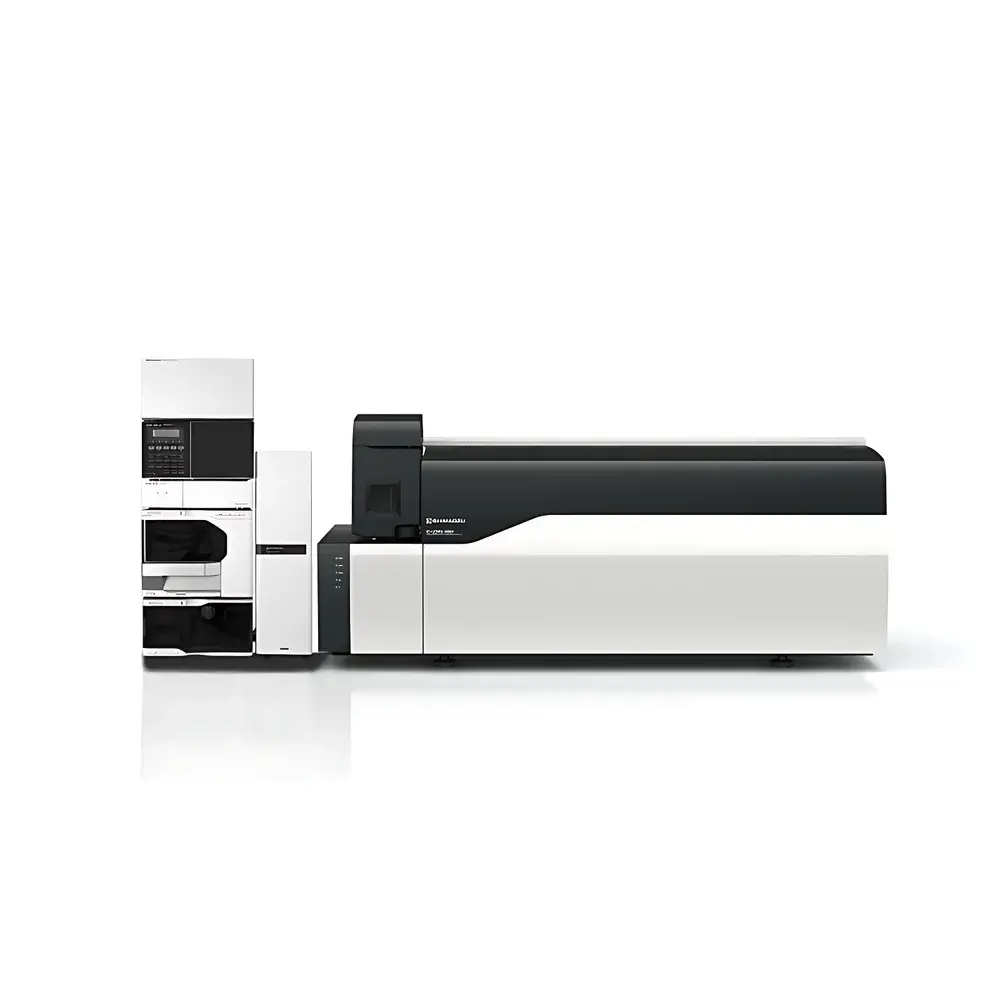
Shimadzu IC-MS System (Essentia IC-16 coupled with LCMS-8050)
| Brand | Shimadzu |
|---|---|
| Origin | Japan |
| Manufacturer Type | Original Equipment Manufacturer (OEM) |
| Import Status | Imported |
| Model | IC-MS |
| Instrument Type | Laboratory Benchtop System |
| Application Scope | General-Purpose Ion Analysis |
| Maximum Pump Pressure | 0–36 MPa |
| Flow Rate Range | 0.001–10.000 mL/min |
| Eluent Concentration Range | 0.1–100 mM |
Overview
The Shimadzu IC-MS System integrates the Essentia IC-16 ion chromatograph with the LCMS-8050 triple quadrupole mass spectrometer to deliver a robust, high-sensitivity analytical platform for the separation and detection of ionic and highly polar compounds. Unlike conventional reversed-phase LC-MS systems, this configuration leverages suppressed conductivity detection-compatible eluents—such as potassium hydroxide or methanesulfonic acid—while enabling soft ionization (e.g., electrospray ionization in negative or positive mode) directly from aqueous mobile phases. The system operates on the principle of sequential anion/cation exchange chromatography followed by mass-selective detection, providing orthogonal selectivity based on both retention time and m/z ratio. This dual-dimension resolution is essential for complex matrices encountered in environmental water analysis, pharmaceutical counterion profiling, food additive screening, and semiconductor-grade ultrapure water monitoring.
Key Features
- Modular architecture supporting seamless coupling between IC and MS without flow-splitting or post-column derivatization
- High-pressure IC pump capable of stable gradient elution up to 36 MPa, compatible with sub-2 µm particle-packed columns for enhanced peak capacity
- Precise low-flow delivery (0.001–10.000 mL/min) optimized for nanoflow and microbore column configurations
- Automated eluent generator (AEG) compatibility for on-demand preparation of KOH or MSA gradients within 0.1–100 mM range, minimizing baseline drift and improving reproducibility
- LCMS-8050 triple quadrupole mass spectrometer featuring ultra-fast polarity switching (< 5 ms), high-duty-cycle collision-induced dissociation (CID), and dynamic MRM™ acquisition for multiplexed quantitative analysis
- Integrated vacuum interlock and real-time pressure monitoring at the IC-MS interface to ensure stable nebulization and signal continuity
Sample Compatibility & Compliance
The system accommodates a broad spectrum of ionic analytes—including inorganic anions (F⁻, Cl⁻, NO₂⁻, PO₄³⁻), organic acids (oxalate, citrate, malate), cations (Na⁺, K⁺, NH₄⁺, Ca²⁺, Mg²⁺), and charged pharmaceutical impurities—without derivatization. It complies with key regulatory frameworks governing analytical method validation: ASTM D4327 (anion analysis in water), ISO 10304-1 (determination of dissolved anions by IC), USP (conductivity of purified water), and ICH Q2(R2) guidelines for precision, accuracy, and linearity assessment. Data integrity is maintained through full 21 CFR Part 11-compliant audit trails, electronic signatures, and role-based access control within LabSolutions IC software.
Software & Data Management
Control and data processing are unified under Shimadzu’s LabSolutions IC platform, which provides synchronized method development for both IC and MS modules. The software supports automated calibration curve generation, peak integration using retention time alignment algorithms, and spectral library matching against NIST/EPA/Tox21 databases. Raw data files adhere to open mzML format for third-party processing (e.g., Skyline, Compound Discoverer). All acquisition parameters, instrument logs, and user actions are timestamped and archived with immutable metadata, satisfying GLP/GMP documentation requirements for regulated laboratories.
Applications
- Environmental monitoring: Quantification of perchlorate, bromate, and chlorate in drinking water per EPA Method 314.1 and 300.1
- Pharmaceutical quality control: Residual counterion profiling (e.g., sodium, acetate, besylate) in APIs and injectables
- Food safety: Detection of preservatives (sorbate, benzoate), sweeteners (acesulfame-K, saccharin), and nitrite/nitrate in processed meats
- Electronics industry: Trace-level halide and sulfate contamination analysis in photoresist solvents and etchants
- Academic research: Metabolomic profiling of polar intermediates in plant and microbial extracts
FAQ
Can the IC-MS system operate without suppression?
Yes—the system supports both suppressed and non-suppressed modes; however, suppression is recommended for optimal sensitivity and lower chemical noise when using conductivity-compatible eluents.
Is post-column oxidation/reduction required for transition metal speciation?
No—speciation of Cr(III)/Cr(VI), As(III)/As(V), and Sb(III)/Sb(V) is achieved directly using selective chelating columns and isocratic elution, eliminating need for reactive reagents.
What mass spectrometer options are available beyond LCMS-8050?
Shimadzu offers configurable MS interfaces for single quadrupole (LCMS-2020), triple quadrupole (LCMS-8060), and high-resolution Q-TOF (LCMS-9030) platforms, each with dedicated IC source geometries and software modules.
Does the system support hyphenated detection (e.g., IC-MS-ICPMS)?
While not factory-integrated, the IC outlet can be routed to external ICP-MS via a flow-cell interface for elemental speciation; Shimadzu provides application notes and hardware adaptation kits for such configurations.



