
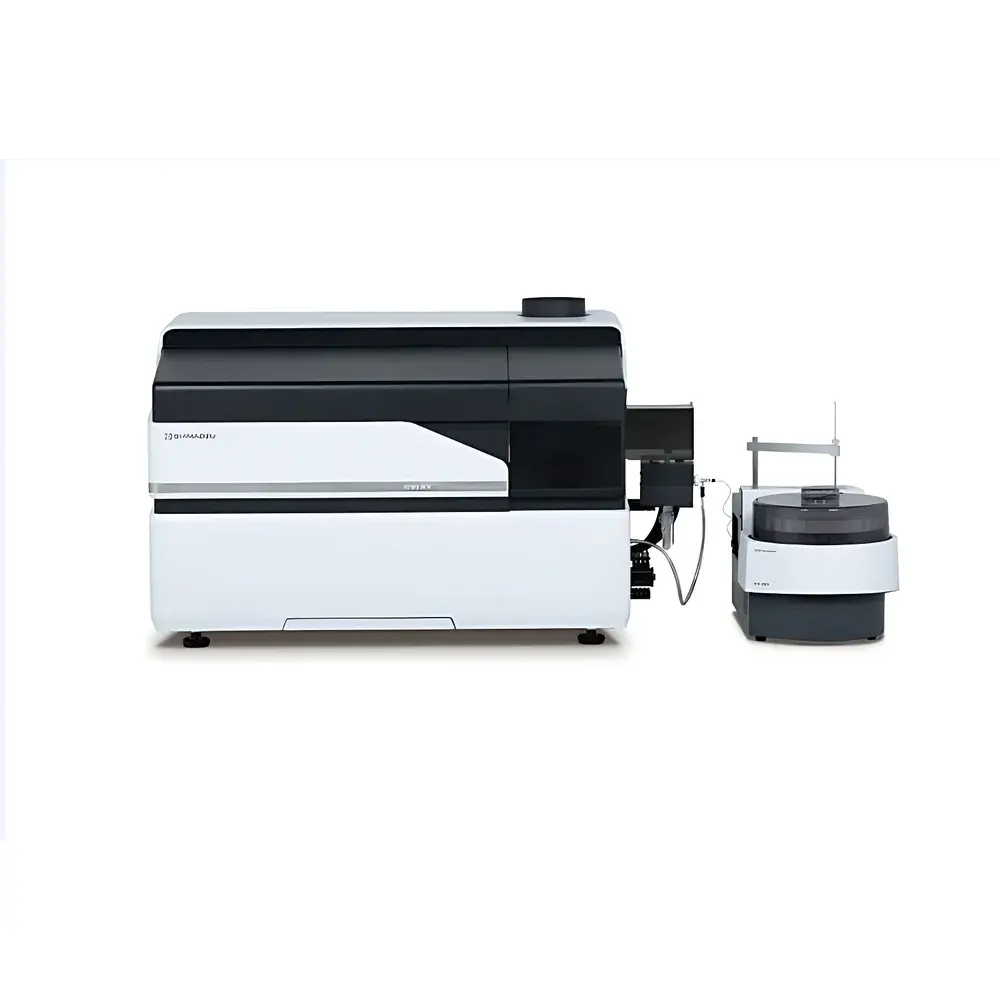
Shimadzu ICPMS-2030 Series Inductively Coupled Plasma Quadrupole Mass Spectrometer
| Brand | Shimadzu |
|---|---|
| Origin | Japan |
| Manufacturer Type | Original Equipment Manufacturer (OEM) |
| Import Status | Imported Instrument |
| Model | ICPMS-2030 Series |
| Instrument Type | Quadrupole Mass Spectrometer |
| Plasma Gas Consumption (Standard Mode) | 10 L/min |
| Plasma Gas Consumption (Eco Mode, Standby) | 5 L/min |
| Carrier Gas Purity Requirement | Standard Argon (99.95%) |
| Software Compliance | FDA 21 CFR Part 11, ERES, GLP/GMP Audit Trail Ready |
| LC-ICP-MS Compatibility | Yes |
| Collision Cell Technology | Integrated Quadrupole-Based Collision/Reaction Cell |
Overview
The Shimadzu ICPMS-2030 Series is a high-performance inductively coupled plasma quadrupole mass spectrometer engineered for trace multi-element analysis in environmental, clinical, pharmaceutical, geological, and industrial laboratories. It utilizes an argon-based inductively coupled plasma (ICP) source to efficiently ionize sample aerosols, followed by mass separation via a robust RF-driven quadrupole mass filter and detection using a high-gain electron multiplier. Designed with operational efficiency and regulatory compliance at its core, the ICPMS-2030 delivers exceptional sensitivity, long-term signal stability, and minimized polyatomic interferences—without requiring ultra-high-purity argon or complex gas handling infrastructure.
Key Features
- Low-Cost Plasma Operation: Incorporates Shimadzu’s proprietary Mini Torch assembly, reducing argon consumption to 10 L/min during analysis and further lowering to 5 L/min in Eco Mode during standby—approximately 30% less than conventional torches. This design enables stable plasma ignition and maintenance using standard-grade argon (99.95% purity), eliminating dependency on costly high-purity gases.
- Intelligent Method Development: The Method Development Assistant automates critical method parameters—including optimal isotope selection, internal standard recommendation, and calibration concentration range—based on a single qualitative survey scan of a representative sample.
- Real-Time Interference Diagnostics: The Diagnostic Assistant continuously evaluates all acquired mass channels to identify and classify spectral overlaps (e.g., 40Ar16O+ on 56Fe+, 40Ar35Cl+ on 75As+) and provides actionable mitigation guidance aligned with collision/reaction cell operating conditions.
- Collision Cell Integration: Features a dedicated quadrupole-type collision cell that supports both kinetic energy discrimination (KED) and reactive gas modes (e.g., He, H2, NH3) to suppress oxide, doubly charged, and polyatomic ions—enhancing accuracy for challenging matrices such as seawater, biological fluids, and digested soil extracts.
- Modular Hyphenation Support: Fully compatible with liquid chromatography (LC) interfaces for speciation analysis (e.g., As, Se, Cr, Hg species), enabling time-resolved elemental detection synchronized with molecular separation data.
Sample Compatibility & Compliance
The ICPMS-2030 accepts aqueous solutions (0.1–5% HNO3 matrix), digested solid samples (via microwave-assisted acid digestion), and laser ablation aerosols (with optional LA interface). Its robust sample introduction system—including a high-efficiency nebulizer, Peltier-cooled spray chamber, and nickel or platinum sampling/cone assemblies—ensures reproducible transport across wide dynamic ranges (ppt to ppm). All hardware and software components are validated for compliance with ISO/IEC 17025, USP , EPA Methods 200.8 and 6020B, and ASTM D5673. The instrument meets GLP/GMP requirements through full audit trail logging, user access controls, and electronic signature enforcement per FDA 21 CFR Part 11 and EU Annex 11.
Software & Data Management
LabSolutions DB/CS ICPMS serves as the unified acquisition, processing, and reporting platform. It supports centralized database architecture for multi-instrument integration—including HPLC, LC-MS, GC, GC-MS, UV-Vis, FTIR, RF, EDX, TOC, and PPSQ systems—within a single laboratory network. Raw data files are stored in vendor-neutral formats (e.g., mzML-compatible metadata structures) with embedded calibration history, QC flagging, and uncertainty propagation. Electronic records include immutable timestamps, operator ID, instrument configuration snapshots, and change logs—fully traceable for regulatory inspections.
Applications
- Environmental monitoring of heavy metals (Pb, Cd, Hg, As) in drinking water, wastewater, and sediment per EPA 200.8
- Ultra-trace elemental impurity testing in pharmaceutical excipients and APIs per ICH Q3D guidelines
- Isotopic ratio analysis (e.g., 87Sr/86Sr) in geochemical fingerprinting and provenance studies
- Speciation analysis of arsenic, selenium, chromium, and iodine in food and biological tissues using LC-ICP-MS coupling
- High-throughput clinical research for essential/toxic elements in serum, urine, and whole blood
FAQ
Does the ICPMS-2030 require ultra-high-purity argon for operation?
No. It is specifically engineered to operate stably with standard-grade argon (≥99.95% purity), significantly reducing consumable costs over the instrument’s lifecycle.
Can the system be integrated into an existing laboratory information management system (LIMS)?
Yes. LabSolutions DB/CS supports ODBC/JDBC connectivity and configurable export templates for seamless LIMS integration and automated report generation.
Is collision/reaction cell gas selection automated?
Yes—the Diagnostic Assistant recommends optimal gas type (He, H2, NH3) and flow rate based on detected interferences and target analytes.
What level of routine maintenance is required for the interface cones?
The nickel sampling and skimmer cones are designed for extended service intervals; routine cleaning is recommended every 100–200 hours of operation depending on matrix complexity.
Does the software support multi-user environments with role-based permissions?
Yes. LabSolutions DB/CS implements hierarchical user roles (Administrator, Analyst, Reviewer, Auditor) with granular permissions for method editing, data acquisition, result approval, and audit log access.





