
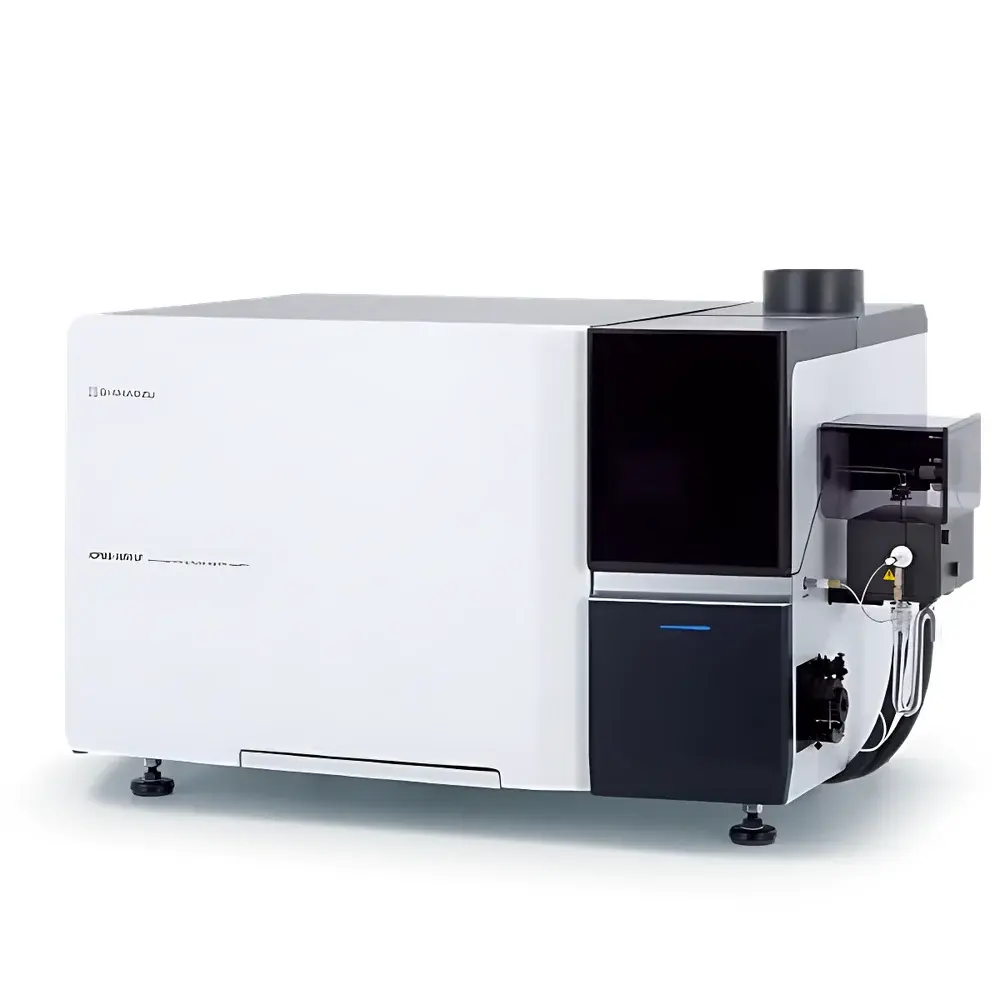
Shimadzu ICPMS-2040 LF / ICPMS-2050 LF Inductively Coupled Plasma Mass Spectrometer
| Brand | Shimadzu |
|---|---|
| Origin | Japan |
| Manufacturer Type | Original Equipment Manufacturer (OEM) |
| Origin Category | Imported |
| Model Series | ICPMS-2040/2050 |
| Instrument Type | Quadrupole Mass Spectrometer |
| Mass Range (amu) | 5–260 |
| Unit Mass Resolution (amu) | 0.3–0.6 |
| Short-Term Stability (RSD) | ≤3% |
| Long-Term Stability (RSD) | ≤3% |
Overview
The Shimadzu ICPMS-2040 LF and ICPMS-2050 LF are high-performance, quadrupole-based inductively coupled plasma mass spectrometers engineered for precise, robust, and regulatory-compliant elemental analysis at trace and ultratrace levels. These instruments operate on the fundamental principle of ionizing sample atoms in a high-temperature argon plasma (~7,000–10,000 K), followed by mass separation via a radiofrequency-driven quadrupole mass filter and detection using a secondary electron multiplier. Designed specifically for routine laboratory environments—including environmental monitoring, clinical research, geochemical testing, and high-purity material certification—the ICPMS-2040/2050 LF series integrates hardware innovations such as the Mini Torch, Collision/Reaction Cell (CRC) technology, and an electrostatically stabilized quadrupole to deliver exceptional sensitivity, interference mitigation, and operational stability without compromising analytical rigor.
Key Features
- Mini Torch Plasma Source: Optimized geometry reduces sample aerosol flow velocity into the plasma, enhancing ionization efficiency and matrix tolerance—particularly critical for complex, high-dissolved-solid samples (e.g., seawater, digested soils). Argon consumption is reduced to ~66% of conventional torches during analysis; in Eco Mode (standby), consumption drops to 5.5 mL/min. Operation with standard-grade argon (99.95% purity) eliminates dependency on ultra-high-purity gas supplies.
- Collision/Reaction Cell (CRC) with Dual-Mode Operation: Supports both collision (He) and reaction (H2, NH3, O2) gas modes to suppress polyatomic interferences (e.g., 40Ar16O+ on 56Fe+, 40Ar40Ar+ on 80Se+). Integrated Inter-Element Correction (IEC) algorithm enables quantitative correction for residual isobaric overlaps not fully resolved by CRC alone.
- Stabilized Quadrupole Mass Analyzer: Equipped with an integrated charge stabilizer that applies pulsed DC bias between mass scans to maintain consistent electrode surface charge distribution—minimizing signal drift during extended acquisition sequences (e.g., time-resolved or multi-isotope monitoring).
- High-Resolution Capability: Achieves unit mass resolution of 0.3–0.6 u across the full mass range (5–260 amu), enabling baseline separation of adjacent isotopes (e.g., 115In/116Cd) and supporting semi-mass calibration workflows when combined with IEC.
- Automated Workflow Integration: Includes rapid gas switching (<1 s), fast sample introduction (<2 s wash-in), intelligent rinse cycles (adaptive duration based on preceding analyte concentration), and pre-optimized method templates covering common applications (e.g., EPA Method 200.8, ISO 17294-2).
Sample Compatibility & Compliance
The ICPMS-2040/2050 LF accommodates liquid samples delivered via peristaltic or direct injection systems, including high-salinity matrices (e.g., seawater, brines) enabled by optional online dilution modules and dual-cone interface design requiring no tools for disassembly. The gravity-based waste drainage system eliminates pump tubing wear-related carryover or pressure fluctuations. All firmware and software modules comply with GLP/GMP documentation requirements and support full audit trails per FDA 21 CFR Part 11—including electronic signatures, user access controls, and immutable data archiving. Instrument validation packages align with ISO/IEC 17025 and ASTM D5673 guidelines for trace metal quantification.
Software & Data Management
Control and data reduction are performed using Shimadzu’s LabSolutions ICPMS software—a validated, Windows-based platform supporting method development, real-time spectral visualization, isotope ratio calculation, and automated QC reporting (e.g., calibration verification, continuing calibration verification, blank assessment). Raw data files (.raw) are stored in vendor-neutral formats compatible with third-party statistical tools (e.g., R, Python pandas). Network deployment supports centralized instrument management across multi-user laboratories, with role-based permissions and encrypted database backups compliant with institutional IT security policies.
Applications
- Environmental: Quantification of regulated metals (As, Cd, Pb, Hg, U) in drinking water (EPA 200.8), wastewater, and soil extracts.
- Clinical & Biological: Multi-element profiling in serum, urine, and tissue digests for nutritional/toxicological studies (e.g., Zn/Cu ratios, rare earth element biomarkers).
- Materials Science: Impurity screening in semiconductor-grade chemicals (SEMI F57), battery cathode precursors, and catalyst formulations.
- Geochemistry: Isotopic ratio measurements (e.g., 87Sr/86Sr) with interference-corrected accuracy in acid-digested rock standards.
- Food Safety: Screening for toxic elements (e.g., inorganic As in rice, Cd in cocoa) per EU Commission Regulation (EU) No 2023/915.
FAQ
Does the ICPMS-2040/2050 LF require ultra-high-purity argon?
No—standard-grade argon (≥99.95% purity) is sufficient for stable plasma operation under all modes, including Eco Mode.
Can the instrument analyze seawater directly without offline dilution?
Yes—when equipped with the optional online dilution module and optimized Mini Torch parameters, direct analysis of undiluted seawater is supported with minimal cone fouling.
Is the Collision/Reaction Cell compatible with hydrogen gas?
Yes—H2 is fully supported for reaction-mode removal of oxide-based interferences (e.g., 140CeO+/156GdO+) and argide species.
How does the charge stabilizer improve long-term signal stability?
By applying controlled pulsed DC compensation between mass scans, it mitigates charge accumulation on quadrupole rods—reducing baseline drift and improving reproducibility in >8-hour continuous runs.
Does the system support 21 CFR Part 11 compliance out-of-the-box?
Yes—LabSolutions ICPMS includes built-in electronic signature capability, audit trail logging, and secure user authentication, meeting core technical requirements for regulated environments.




