
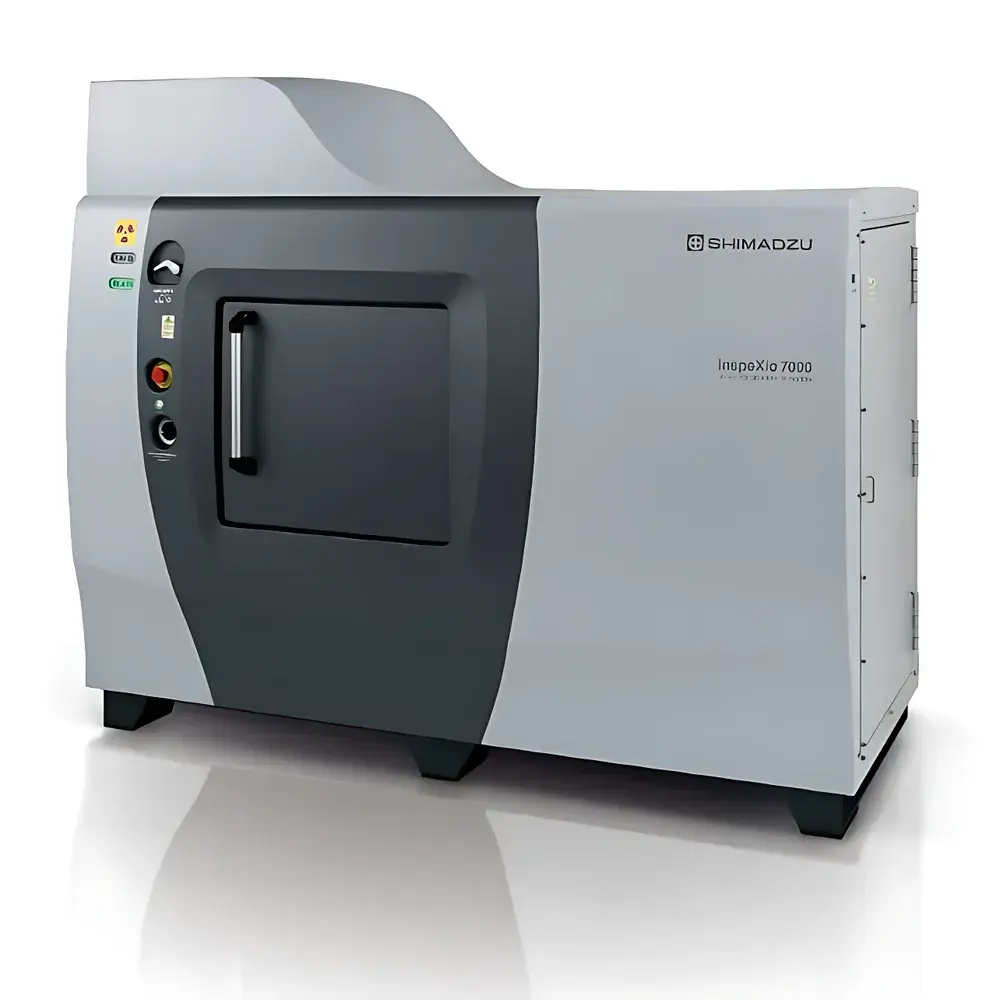
Shimadzu inspeXio 7000 Microfocus X-ray Computed Tomography System
| Brand | Shimadzu |
|---|---|
| Origin | Japan |
| Manufacturer Type | Original Equipment Manufacturer (OEM) |
| Product Origin | Imported |
| Model | inspeXio 7000 |
| Detector Type | Flat-Panel Detector |
| Scan Mode | Rotation-Only (RO) |
| X-ray Energy | 225 kV |
| Maximum Specimen Dimensions | Ø400 mm × H300 mm |
| Maximum Sample Weight | >12 kg |
Overview
The Shimadzu inspeXio 7000 is a high-performance microfocus X-ray computed tomography (micro-CT) system engineered for non-destructive, three-dimensional internal inspection of industrial components and advanced materials. Utilizing a sealed-tube microfocus X-ray source with a focal spot size optimized for high spatial resolution imaging, the system operates on the principle of cone-beam CT reconstruction—acquiring hundreds of 2D projection images over a full 360° rotation and reconstructing them into isotropic volumetric datasets via filtered back-projection or iterative algorithms. Its 225 kV maximum tube voltage enables deep penetration of dense metallic alloys—including aluminum die-castings, magnesium housings, and steel weldments—while preserving contrast sensitivity for low-Z features such as porosity, inclusions, and fiber orientation in composites. Designed for integration into quality control laboratories and R&D facilities, the inspeXio 7000 delivers sub-micron geometric magnification capability and supports quantitative analysis compliant with ASTM E1441, ISO 15732, and VDI/VDE 2630 standards for industrial CT.
Key Features
- Microfocus X-ray source with stable 225 kV output and <10 µm effective focal spot size, enabling high-resolution imaging without geometric unsharpness degradation
- Large-format flat-panel detector (FPD) with high dynamic range (16-bit depth), low electronic noise, and scintillator-based conversion for optimal signal-to-noise ratio in both low- and high-attenuation regions
- Rotation-only (RO) scanning geometry ensures mechanical stability and repeatability—eliminating translational motion artifacts common in helical or offset-stage configurations
- Robust sample stage with precision rotary air bearing and motorized height adjustment, supporting specimens up to Ø400 mm in diameter and 300 mm in height, with load capacity exceeding 12 kg
- Integrated thermal management system maintains consistent X-ray tube output and detector performance across extended acquisition sessions (e.g., multi-hour scans for large-volume reconstructions)
- Modular shielding cabinet conforming to IEC 61000-6-3 and local radiation safety regulations (e.g., FDA 21 CFR 1020.40), equipped with interlocked access doors and real-time dose monitoring
Sample Compatibility & Compliance
The inspeXio 7000 accommodates a broad spectrum of industrial samples—from automotive powertrain components (e.g., cylinder heads, transmission housings) to lightweight structural composites (carbon-fiber-reinforced polymer, glass-fiber laminates) and electronic assemblies (PCBs, encapsulated sensors). Its large field-of-view and high-energy beam facilitate defect detection in thick-walled castings, while its resolution scalability allows voxel sizes down to ~5 µm under optimal magnification conditions. All system operations adhere to GLP-compliant workflows: audit trails record operator identity, scan parameters, reconstruction settings, and timestamped metadata. Data export formats—including DICOM-CT, TIFF stack, and NRRD—are compatible with third-party analysis platforms used in failure analysis (e.g., VGStudio MAX, Avizo, Dragonfly) and support traceability requirements under ISO 9001 and AS9100 quality management systems.
Software & Data Management
Acquisition and reconstruction are managed through Shimadzu’s proprietary inspeXio CT software suite, which provides intuitive workflow guidance—from automatic beam hardening correction and ring artifact suppression to GPU-accelerated Feldkamp-Davis-Kress (FDK) reconstruction. The software supports batch processing of multi-sample scans, region-of-interest (ROI) cropping to reduce file size, and automated porosity quantification per ASTM E2864. Raw projection data and reconstructed volumes are stored with embedded EXIF-like metadata (kV, µA, exposure time, rotation step, detector binning), ensuring full experimental reproducibility. For regulated environments, optional 21 CFR Part 11 compliance modules provide electronic signatures, role-based access control, and immutable audit logs—validated for use in GMP-aligned manufacturing and supplier qualification programs.
Applications
- Automotive: Detection and volumetric characterization of shrinkage pores, gas porosity, and cold shuts in Al/Si alloy die-cast parts; validation of core pin integrity and sand residue in engine blocks
- Aerospace: Fiber misalignment and void content assessment in CFRP wing ribs and fuselage panels; inspection of additive-manufactured Ti-6Al-4V brackets for lack-of-fusion defects and residual powder entrapment
- Electronics: Non-destructive verification of solder joint integrity, wire bond lift-off, and delamination in stacked-die packages
- Materials Science: In situ monitoring of crack propagation during mechanical loading (with optional stages); 3D morphology analysis of battery electrode microstructures (anode/cathode porosity, separator thickness uniformity)
- Medical Device Manufacturing: Dimensional verification of metal orthopedic implants; coating thickness mapping on nitinol stents
FAQ
What is the minimum resolvable feature size achievable with the inspeXio 7000?
Feature resolution depends on geometric magnification, detector pixel pitch, and system MTF. Under optimal conditions (high magnification, small specimen, long source-to-detector distance), isotropic voxel sizes of 5–10 µm are routinely achieved.
Does the system support in situ mechanical testing?
Yes—via integration with third-party load frames using Shimadzu’s external trigger interface and synchronized acquisition mode; custom stage adapters are available upon request.
Can reconstruction be performed on a separate workstation?
Yes—raw projection data can be exported for offline reconstruction on high-end workstations equipped with CUDA-enabled GPUs and licensed third-party software.
Is training and application support provided for first-time CT users?
Shimadzu offers comprehensive on-site installation qualification (IQ), operational qualification (OQ), and user training covering acquisition protocol optimization, artifact diagnosis, and quantitative analysis workflows.
How is radiation safety ensured during routine operation?
The cabinet is certified to IEC 61000-6-3 for electromagnetic compatibility and incorporates dual redundant door interlocks, lead-equivalent shielding (≥2 mm Pb), and real-time dosimeter feedback integrated into the control interface.



