
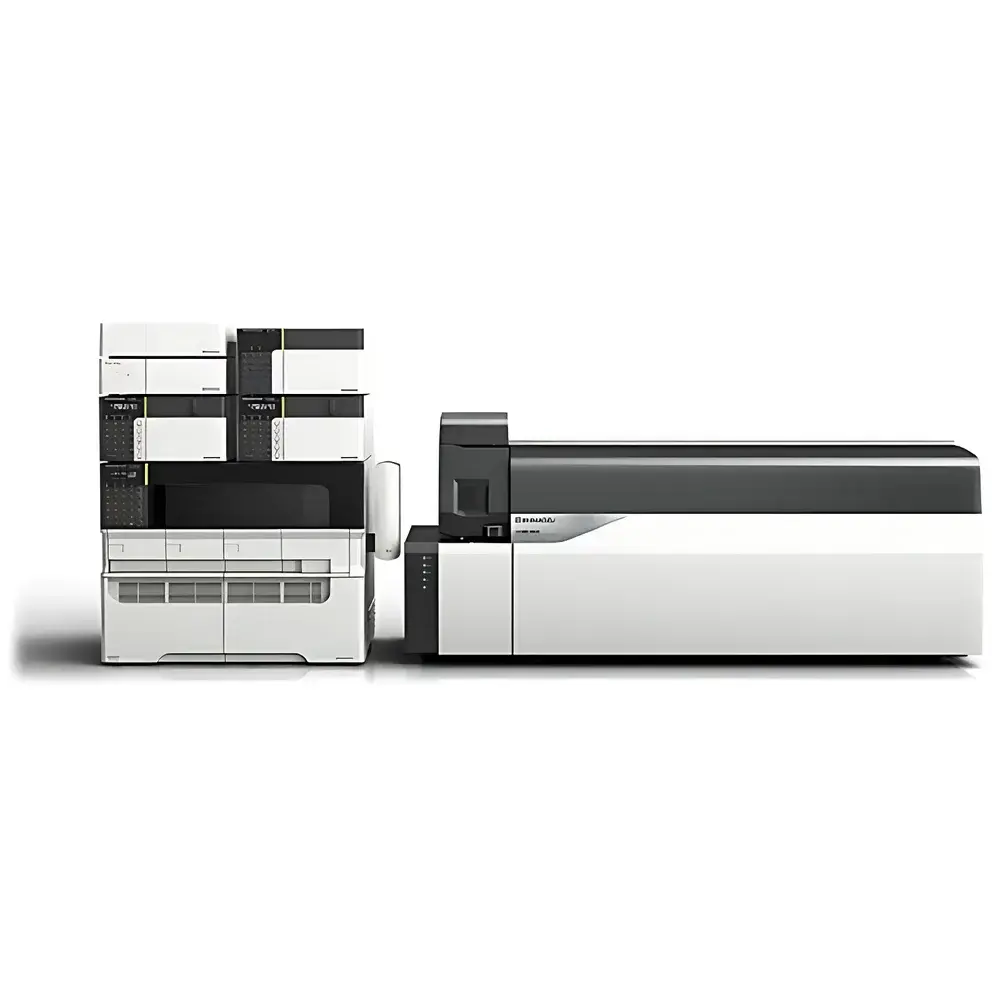
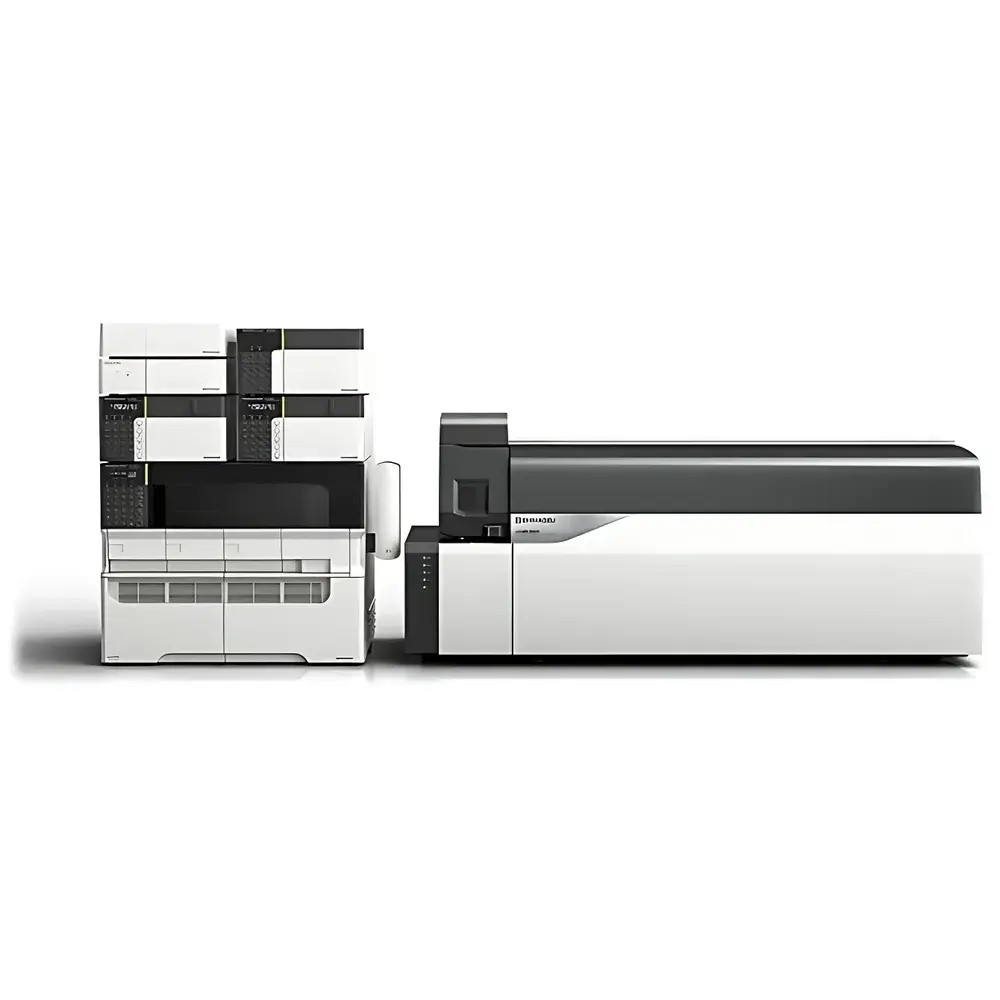
Shimadzu LCMS-8045 Triple Quadrupole Liquid Chromatography Mass Spectrometer
| Brand | Shimadzu |
|---|---|
| Origin | Jiangsu, China |
| Manufacturer Type | Original Equipment Manufacturer (OEM) |
| Regional Classification | Domestic (PRC) |
| Model | LCMS-8045 |
| Instrument Type | Tandem Quadrupole (QqQ) |
| Application Scope | General-Purpose |
| Mass Range | 2–2000 Da |
| Sensitivity | S/N ≥ 100,000:1 (1 pg reserpine, ESI+) |
| Resolution | < 0.7 Da (FWHM) |
| Mass Accuracy | ±0.1 Da |
Overview
The Shimadzu LCMS-8045 is a high-performance triple quadrupole liquid chromatography mass spectrometer engineered for robust, high-throughput quantitative analysis in regulated and research laboratories. It operates on the tandem quadrupole (QqQ) principle: the first quadrupole (Q1) selects precursor ions; the second (q2), acting as a collision cell under controlled argon or nitrogen gas pressure, induces collision-induced dissociation (CID); and the third quadrupole (Q3) filters and detects specific product ions. This configuration delivers exceptional selectivity and sensitivity for multiple reaction monitoring (MRM) — the gold-standard acquisition mode for targeted quantitation in complex matrices. Designed with industrial-grade reliability and optimized ion transmission efficiency, the LCMS-8045 supports routine operation across pharmaceutical QC, food safety testing, environmental residue analysis, and clinical biomarker validation — all without compromising data integrity or analytical reproducibility.
Key Features
- High-efficiency electrospray ionization (ESI) and atmospheric pressure chemical ionization (APCI) sources with active desolvation and low-noise ion optics for stable signal generation across wide dynamic ranges.
- Optimized RF/DC voltage control architecture enabling rapid polarity switching (< 15 ms) and seamless MRM transition scheduling — critical for multi-analyte assays requiring both positive and negative ion detection within a single run.
- Robust vacuum system with dual-stage turbomolecular pumps ensuring stable operating pressure (< 1 × 10⁻⁶ Pa) in Q2 and Q3 regions, minimizing background noise and sustaining long-term sensitivity.
- Integrated collision cell with adjustable collision energy (CE) and gas flow control, supporting method-optimized fragmentation for diverse compound classes including polar metabolites, peptides, and small-molecule pharmaceuticals.
- Thermally stabilized quadrupole rods and precision-machined ion guides contribute to sub-0.7 Da full-width-at-half-maximum (FWHM) resolution and ±0.1 Da mass accuracy — essential for regulatory-compliant method validation per ICH Q2(R2) guidelines.
Sample Compatibility & Compliance
The LCMS-8045 interfaces seamlessly with standard UHPLC and HPLC systems (e.g., Shimadzu Nexera series) via industry-standard analog/digital I/O and Ethernet-based instrument control. It accommodates a broad range of sample types — from aqueous extracts and protein digests to lipid-rich tissue homogenates and pesticide-spiked food matrices — without requiring extensive source cleaning between injections. Its hardware design emphasizes contamination resistance: replaceable ion source components, heated capillary with ceramic insulation, and self-cleaning desolvation gas paths reduce downtime and enhance inter-batch consistency. The platform meets key international compliance requirements: fully compatible with 21 CFR Part 11–compliant audit trails when deployed with validated LabSolutions LCMS software configurations; supports GLP/GMP documentation workflows; and aligns with ISO/IEC 17025 analytical quality management principles. Routine performance verification follows ASTM D7923–22 (for pesticide residue analysis) and USP chromatographic system suitability criteria.
Software & Data Management
LabSolutions LCMS is a modular, Windows-based workstation software suite designed for end-to-end LC-MS method development, acquisition, processing, and reporting. Its intuitive workflow interface enables rapid MRM method creation — including automatic dwell time optimization, retention time alignment, and internal standard ratio calibration — without scripting. Quantitative results are traceable through integrated electronic signatures, version-controlled method archives, and time-stamped raw data logs. All processing parameters (peak integration, baseline correction, calibration curve fitting) are stored within the project file, ensuring full reprocessing capability and audit readiness. The software includes pre-validated application method packages for common use cases: residual solvent screening (ICH Q3C), mycotoxin quantification (AOAC 2012.02), vitamin D metabolite profiling, and therapeutic drug monitoring (TDM) panels — each containing optimized MRM transitions, CE values, and chromatographic conditions.
Applications
- Pharmaceutical quality control: assay validation, impurity profiling, and extractable/leachable studies per ICH Q5A–Q5E.
- Food safety: multi-residue pesticide screening (EU SANTE/11312/2021), veterinary drug residue quantification (Commission Decision 2002/657/EC), and allergen marker detection.
- Environmental analysis: persistent organic pollutant (POP) monitoring (e.g., PCBs, PBDEs) in water and soil per EPA Method 1694.
- Clinical research: steroid hormone profiling, acylcarnitine screening for inborn errors of metabolism, and pharmacokinetic (PK) sample analysis in ADME studies.
- Academic proteomics: targeted peptide quantification (SRM/MRM) in SILAC- or TMT-labeled experiments.
FAQ
Is the LCMS-8045 compliant with FDA 21 CFR Part 11 for electronic records and signatures?
Yes — when deployed with LabSolutions LCMS v5.95 or later under a validated IT infrastructure, it supports role-based user access, electronic signatures, and immutable audit trails meeting Part 11 requirements.
Can the system be upgraded to support high-resolution accurate-mass (HRAM) analysis?
No — the LCMS-8045 is a dedicated triple quadrupole platform. For HRAM capabilities, Shimadzu offers the LCMS-9030 (Q-TOF) or LCMS-8060NX (triple quadrupole with enhanced mass accuracy).
What maintenance intervals are recommended for optimal performance?
Ion source cleaning every 2–4 weeks (depending on matrix complexity), turbo pump oil replacement annually, and quarterly calibration verification using tuning mix (e.g., reserpine, caffeine, MRFA) are standard practice.
Does the LCMS-8045 support scheduled MRM (sMRM) acquisition?
Yes — sMRM dynamically adjusts dwell times and Q1/Q3 settings based on predicted retention windows, improving peak fidelity and cycle time efficiency in large-panel assays.
Is remote monitoring and control supported?
Yes — via LabSolutions Remote Access module over secure LAN/WAN connections, enabling real-time status checks, queue management, and emergency shutdown protocols.




