
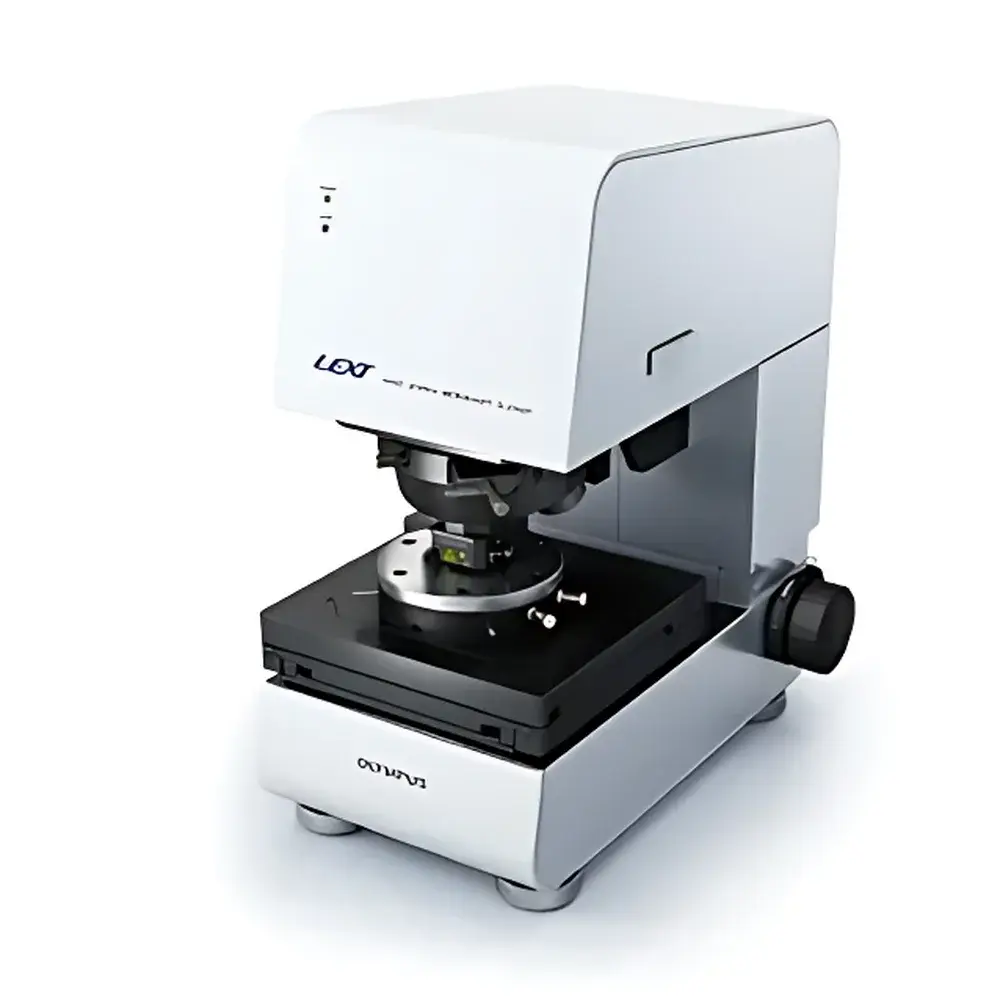
Shimadzu LEXT OLS4500 Laser Scanning Confocal Microscope
| Brand | Shimadzu |
|---|---|
| Origin | Japan |
| Manufacturer Type | Original Equipment Manufacturer (OEM) |
| Import Status | Imported |
| Model | LEXT OLS4500 |
| Pricing | Upon Request |
Overview
The Shimadzu LEXT OLS4500 Laser Scanning Confocal Microscope is a hybrid metrological imaging platform engineered for quantitative 3D surface topography analysis across macro-to-nanoscale dimensions. It integrates three complementary optical and scanning modalities—optical microscopy (OM), laser scanning microscopy (LSM), and scanning probe microscopy (SPM)—within a single, co-registered mechanical architecture. This convergence enables seamless transition between observation scales ranging from ×10 to ×1,000,000 magnification without sample relocation or recalibration. The system operates on the principle of confocal point-scanning with a 405 nm violet semiconductor laser, delivering diffraction-limited lateral resolution down to ~120 nm and axial resolution below 400 nm under optimal conditions. Its dual-path optical design supports simultaneous acquisition of high-contrast intensity images and precise height data, making it suitable for applications requiring traceable dimensional metrology, surface roughness characterization (in accordance with ISO 25178 and ASME B46.1), and failure analysis in R&D and quality control environments.
Key Features
- Multi-modal imaging architecture: Unified platform supporting optical microscopy (brightfield, DIC, polarized light, HDR), laser confocal scanning, and SPM-based surface profiling—all aligned to a common coordinate system.
- 405 nm laser source with high-NA objective lenses: Optimized for superior lateral resolution and signal-to-noise ratio in reflective and semi-transparent samples.
- Automated objective turret with four parfocal objectives: Enabling rapid switching between low-magnification survey imaging and high-resolution nanoscale inspection.
- Integrated SPM module with precision tip alignment fixture: Eliminates manual laser spot adjustment; ensures repeatable cantilever positioning and minimizes tip wear during routine operation.
- Navigation-assisted scanning: Allows users to define regions of interest directly on previously acquired wide-field or confocal maps, enabling targeted high-resolution rescan without stage repositioning errors.
- Robust mechanical design with vibration-damped base and temperature-stabilized optics: Supports long-duration measurements with high positional stability and measurement repeatability.
Sample Compatibility & Compliance
The LEXT OLS4500 accommodates a broad range of solid, non-volatile specimens—including metals, ceramics, polymers, semiconductors, thin films, and coated surfaces—without requiring conductive coating or vacuum environments. Sample height tolerance exceeds 50 mm, and maximum stage travel is 100 × 100 mm XY with 50 mm Z-range. All measurement modes comply with international standards for surface texture analysis: ISO 25178-2 (areal surface texture parameters), ISO 4287 (profile-based roughness), and ASTM E2927-21 (standard guide for 3D surface topography measurement using confocal microscopy). Data integrity protocols support GLP/GMP workflows, including audit-trail-enabled user authentication, timestamped metadata embedding, and exportable calibration certificates traceable to NIST standards.
Software & Data Management
Operation is managed through Shimadzu’s proprietary OLS Analysis Software, which provides a unified interface for instrument control, real-time image acquisition, multi-layer surface reconstruction, and ISO-compliant parameter calculation (Sa, Sq, Sz, Sdr, etc.). The software features automated focus tracking, stitching of large-area scans (>1 mm²), cross-sectional profile extraction, and statistical process control (SPC) chart generation. Raw data is stored in vendor-neutral HDF5 format with embedded metadata, ensuring long-term archival compatibility. For regulated environments, optional 21 CFR Part 11 compliance packages are available, including electronic signatures, role-based access control, and immutable audit logs for all measurement sessions and report exports.
Applications
- Microelectromechanical systems (MEMS) inspection: Quantitative assessment of etch depth uniformity, sidewall angle, and release-related stiction defects.
- Advanced materials R&D: Nanoscale grain boundary mapping, coating thickness verification, and interfacial delamination detection in multilayer stacks.
- Medical device surface characterization: Verification of surface finish on orthopedic implants per ISO 14644-1 cleanliness requirements and USP surface evaluation guidelines.
- Failure analysis labs: Correlation of optical defect signatures (e.g., scratches, pits, residues) with 3D height data to determine root cause mechanisms.
- Academic nanoscience: In situ comparison of topographic, phase contrast, and birefringence responses on anisotropic 2D materials such as MoS₂ or h-BN.
FAQ
Does the LEXT OLS4500 require vacuum or conductive coating for non-conductive samples?
No. Unlike SEM or conventional AFM, the LEXT OLS4500 performs non-contact, ambient-air surface profiling using optical and laser-based detection methods.
Can measurement data be exported in formats compatible with third-party metrology software?
Yes. Height maps, intensity images, and parameter reports can be exported as TIFF, CSV, XYZ, and HDF5 files with full metadata preservation.
Is calibration verification supported for ISO/IEC 17025-accredited laboratories?
Yes. Shimadzu provides certified reference standards (e.g., step-height gratings, roughness standards) and documented calibration procedures compliant with ISO/IEC 17025 requirements.
What is the typical measurement repeatability for Sa values on standard roughness samples?
Under controlled environmental conditions (23 ± 1°C, <40% RH), Sa repeatability is ≤±0.5% for measurements repeated across five sessions using NIST-traceable roughness standards.
How does the system handle samples with high aspect-ratio features or steep slopes?
The combination of high-NA optics, dynamic focus tracking, and multi-angle illumination (DIC/HDR) enables reliable capture of features with slopes up to 70°, subject to material reflectivity and surface scattering properties.




