
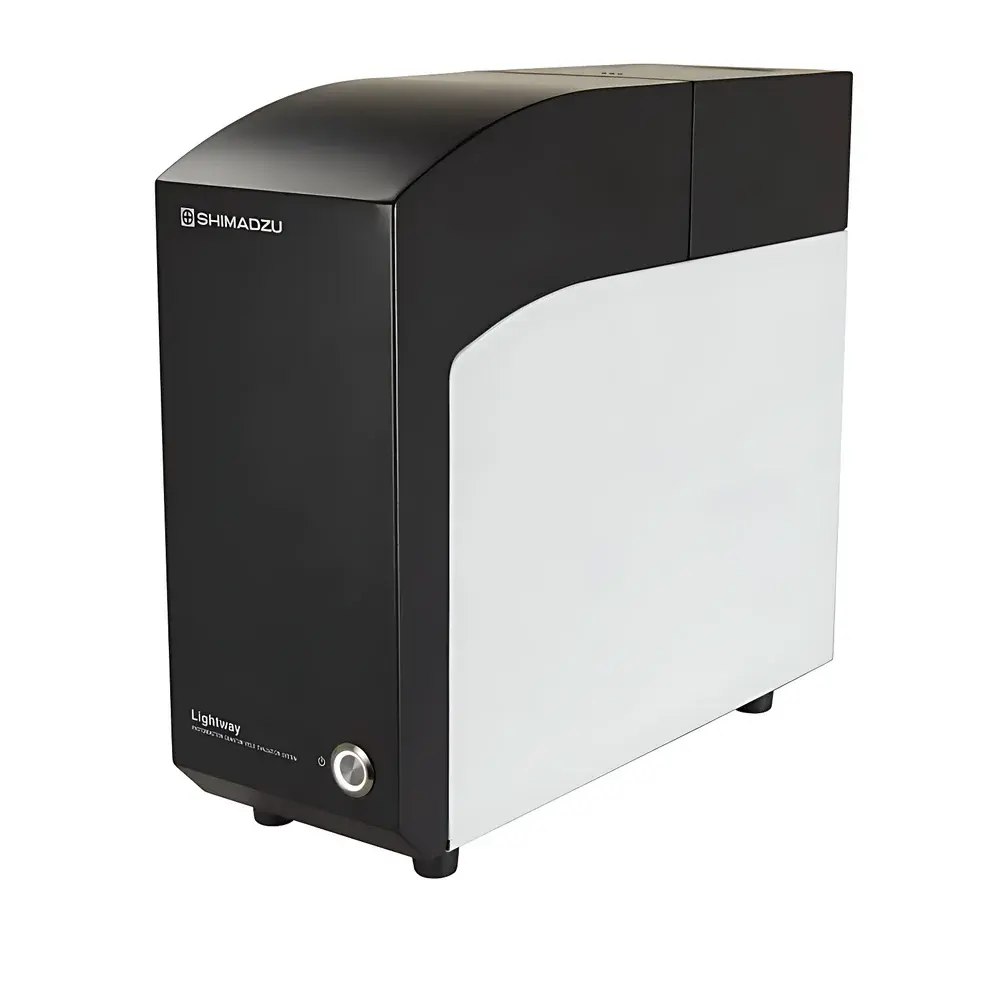
Shimadzu Lightway PQY-01 Photochemical Quantum Yield Evaluation System
| Brand | Shimadzu |
|---|---|
| Origin | Japan |
| Manufacturer Type | Original Equipment Manufacturer (OEM) |
| Product Origin | Imported |
| Model | PQY-01 |
| Wavelength Range | 250–800 nm |
| Detection System | Photodiode Array (PDA) |
| Optical Configuration | Dual-Wavelength Simultaneous Acquisition |
| Automation Level | Fully Automated Wavelength Scanning & Photonic Flux Calibration |
| Photon Flux Calibration Standard | NIST-Traceable Radiometric Power Meter |
| Measurement Throughput | <10 min per sample for absorbed photon quantification |
Overview
The Shimadzu Lightway PQY-01 Photochemical Quantum Yield Evaluation System is a dedicated, integrated photometric platform engineered for the precise, traceable quantification of absorbed photons in photochemical reaction systems. Unlike conventional UV-Vis spectrophotometers optimized for static absorbance profiling, the PQY-01 implements a dual-wavelength, time-resolved optical architecture grounded in actinometric principles—specifically designed to determine quantum yields (Φ) via direct measurement of spectral photon flux incident upon and absorbed by the reaction medium. Its core methodology combines calibrated broadband irradiance monitoring with real-time spectral acquisition across 250–800 nm, enabling calculation of wavelength-resolved photon absorption profiles without reliance on chemical actinometers. This eliminates inter-operator variability, solvent compatibility constraints, and kinetic interference inherent in classical ferrioxalate or Reinecke’s salt-based methods.
Key Features
- Dual-wavelength optical path design enables simultaneous reference and sample beam monitoring, minimizing drift-induced errors during extended irradiation experiments.
- Photodiode array (PDA) detector with thermoelectric cooling ensures high signal-to-noise ratio and photometric stability over multi-hour kinetic runs.
- Fully automated wavelength scanning and internal calibration routine, initiated with a single software command—no manual alignment or lamp repositioning required.
- NIST-traceable radiometric calibration integrated into system startup; certified power meter data is embedded directly into photon flux calculations, satisfying ISO/IEC 17025 metrological traceability requirements.
- LED-based excitation source module with selectable narrowband (±5 nm FWHM) and broadband emission profiles, offering long-term intensity stability (<0.5% RMS fluctuation over 100 h) and negligible thermal load on reaction vessels.
- Integrated temperature-controlled cuvette holder (±0.1 °C) compatible with standard 1-cm quartz cells, supporting both batch and flow-through configurations.
Sample Compatibility & Compliance
The PQY-01 accommodates liquid-phase homogeneous photocatalytic systems—including aqueous suspensions of TiO₂, g-C₃N₄, MOFs, and molecular photosensitizers—as well as thin-film samples mounted on quartz substrates. It supports compliance with ASTM E2623-22 (Standard Practice for Determining Quantum Yields of Photochemical Reactions) and aligns with IUPAC recommendations for actinometric validation. All firmware and data handling modules conform to FDA 21 CFR Part 11 requirements for electronic records and signatures, including full audit trail logging, user access control, and immutable raw-data archiving. System validation documentation (IQ/OQ/PQ protocols) is provided for GLP and GMP-regulated laboratories.
Software & Data Management
Shimadzu PQY-Manager v3.2 is a Windows-based application delivering guided workflow execution across three standardized operational modes: (1) Photochemical Reaction Mode (time-resolved photon absorption + product formation tracking), (2) Spectral Characterization Mode (high-resolution transmission/absorbance mapping), and (3) Calibration Curve Mode (multi-point photonic flux verification). Each mode includes context-aware prompts, real-time quality indicators (e.g., signal saturation warning, stray light flag), and auto-generated metadata tags (wavelength, integration time, LED drive current, ambient temperature). Export formats include CSV (for kinetic modeling in MATLAB or Python), .jdx (JCAMP-DX compliant), and PDF reports with embedded digital signatures. All raw spectral datasets are stored in HDF5 format with embedded calibration coefficients and timestamped hardware configuration logs.
Applications
The PQY-01 serves as a primary evaluation tool in academic and industrial R&D laboratories focused on solar fuel generation, including photocatalytic hydrogen evolution (HER), CO₂ reduction, and nitrogen fixation. It is routinely deployed in the development of photoelectrochemical cells (PECs), UV-curable resin formulations (e.g., acrylate and epoxy systems), photochromic dye characterization (e.g., spirooxazines and diarylethenes), and artificial photosynthesis mimics (e.g., Z-scheme heterojunctions and supramolecular assemblies). Its capacity to decouple spectral photon absorption from chemical turnover kinetics makes it indispensable for structure–activity relationship studies in heterogeneous photocatalysis and mechanistic validation in transient absorption spectroscopy correlative workflows.
FAQ
Does the PQY-01 require external actinometric standards for routine operation?
No. The system performs self-contained photon flux calibration using its integrated NIST-traceable power sensor; chemical actinometers are optional for method cross-validation only.
Can the PQY-01 measure quantum yield for gas-phase reactions?
Not directly. It is optimized for transparent or semi-transparent liquid-phase and thin-film solid-state systems. Gas-phase quantum yield determination requires coupling with in situ IR or MS detection, which falls outside the PQY-01’s native scope.
Is spectral stray light correction applied automatically during acquisition?
Yes. A factory-characterized stray light matrix is applied in real time during PDA readout, with residual error <0.05% at 254 nm in the presence of 350 nm primary irradiation.
What is the minimum detectable photon flux density?
At 365 nm, with 1 s integration and 1 cm pathlength, the system achieves a limit of detection of 1.2 × 10¹⁴ photons·cm⁻²·s⁻¹ (SNR ≥ 3).
How is instrument performance verified between user calibrations?
A built-in LED reference channel monitors optical throughput stability daily; deviations >1.5% trigger an automated recalibration prompt with full diagnostic log generation.
Related Products





