
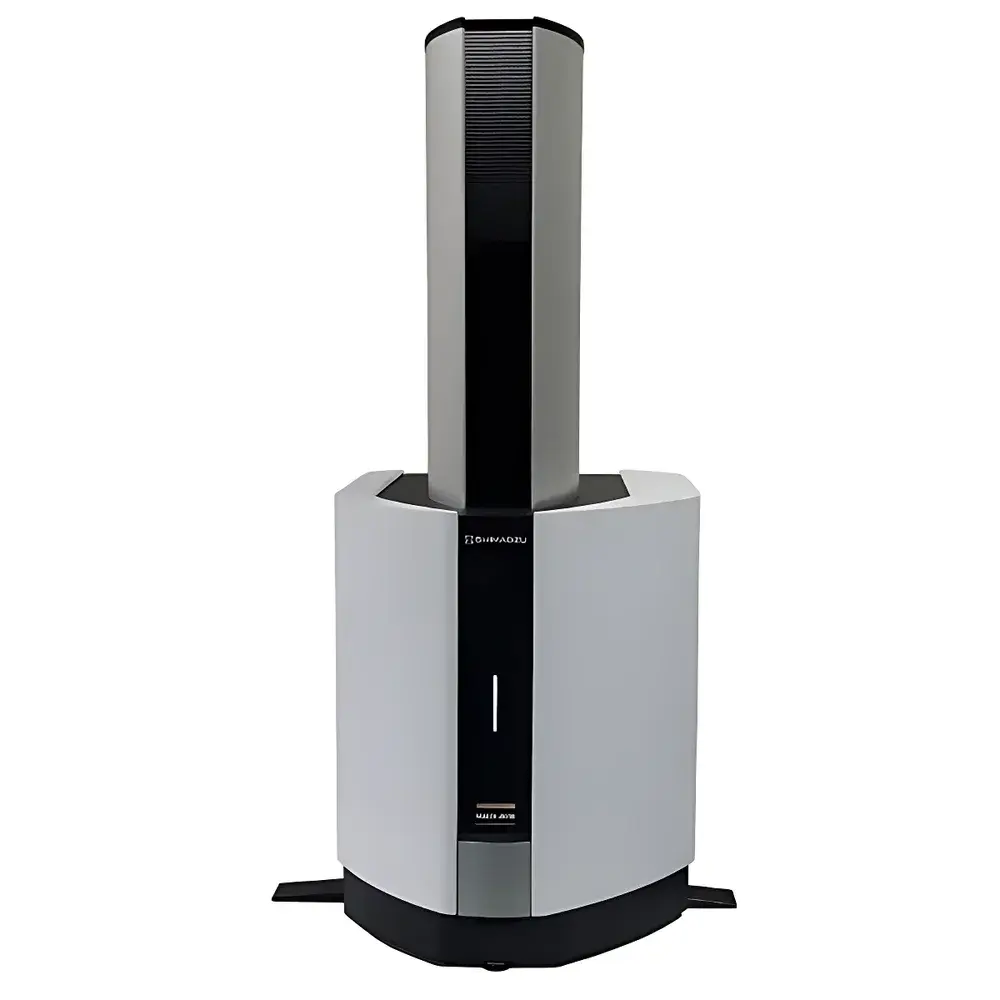
Shimadzu MALDI-8030 EasyCare TOF Mass Spectrometer
| Brand | Shimadzu |
|---|---|
| Origin | United Kingdom |
| Manufacturer Type | Original Equipment Manufacturer (OEM) |
| Product Origin | Imported |
| Model Series | MALDI EasyCare |
| Instrument Type | Time-of-Flight (TOF) Mass Spectrometer |
| Resolution | >5000 FWHM in Linear Mode |
| Application Scope | General-Purpose Biomolecular and Small-Molecule Analysis |
| Form Factor | Benchtop |
| Compliance | Designed for GLP/GMP-aligned laboratories |
Overview
The Shimadzu MALDI-8030 EasyCare is a benchtop time-of-flight (TOF) mass spectrometer engineered for high-reproducibility matrix-assisted laser desorption/ionization (MALDI) analysis across diverse life science and materials research applications. Utilizing orthogonal acceleration TOF geometry, the system delivers robust mass accuracy, linear dynamic range, and stable signal intensity over extended acquisition periods—critical for quantitative profiling and longitudinal biomarker studies. Its compact footprint and low power consumption enable deployment in shared core facilities, clinical research labs, or regulated QC environments without dedicated infrastructure. The instrument operates in both linear and reflectron modes, with the linear mode optimized for high-mass detection (up to m/z 500,000) of intact proteins, polymers, and synthetic macromolecules, while reflectron mode provides enhanced resolution and mass accuracy for peptides and oligonucleotides.
Key Features
- EasyCare Maintenance Framework: Integrated software-guided workflows automate critical calibration routines—including ion optic tuning, detector voltage optimization, and delayed extraction timing adjustment—reducing dependency on service engineers and minimizing instrument downtime.
- Benchtop Design with Environmental Efficiency: Consumes <1.2 kW during operation and requires no external chillers or compressed air, significantly lowering total cost of ownership compared to high-vacuum, high-power alternatives.
- Barcode-Enabled Sample Tracking: Built-in 2D barcode scanner reads sample plate identifiers and links metadata directly to acquisition files, ensuring traceability from sample registration through data export—essential for ISO/IEC 17025 and CLIA-compliant workflows.
- Robust Vacuum Architecture: Dual-stage turbomolecular pumping system maintains base pressure <5 × 10⁻⁷ Pa, enabling rapid pump-down (<15 min from atmosphere) and stable long-term vacuum integrity during unattended overnight runs.
- Modular Ion Source: Interchangeable source plates accommodate standard 96- and 384-well MALDI targets, as well as custom imaging slides, supporting both discrete-spot analysis and high-resolution MALDI imaging (down to 25 µm spatial resolution with optional raster control).
Sample Compatibility & Compliance
The MALDI-8030 EasyCare accepts a broad spectrum of analytes without chemical derivatization: intact monoclonal antibodies (mAbs), glycoproteins, synthetic polymers (PEG, PLA), antimicrobial peptides, phospholipids, glycans, and small-molecule metabolites (e.g., antibiotics, steroids). It complies with ASTM E2906-22 (Standard Guide for MALDI-TOF MS Performance Verification) and supports method validation per USP Analytical Instrument Qualification. When configured with Shimadzu’s LabSolutions LCMS software and optional electronic signature modules, the system meets FDA 21 CFR Part 11 requirements for audit trail generation, user access controls, and data integrity preservation.
Software & Data Management
Controlled via Shimadzu LabSolutions LCMS v5.9 or later, the platform provides intuitive acquisition wizards, real-time spectral preview, and automated peak detection with customizable mass tolerance (±0.1–5 Da). Raw data is stored in vendor-neutral .yep format (compatible with open-source tools such as MSConvert), while processed results export to CSV, PDF, or structured XML for LIMS integration. Batch processing supports up to 96 samples per queue with auto-normalization against internal calibrants. All acquisition parameters, operator logs, and instrument status reports are embedded in metadata headers—enabling full retrospective traceability required under GLP and GMP audits.
Applications
- Microbial Identification: Rapid species-level classification of Gram-positive/negative bacteria and yeasts using ribosomal protein fingerprints (e.g., S10–spc operon region), validated against Bruker Biotyper and CDC databases.
- Biopharmaceutical Characterization: Intact mass analysis of mAbs and ADCs, disulfide bond mapping via partial reduction, and aggregate detection in formulation stability studies.
- MALDI Imaging: Spatially resolved molecular distribution mapping in tissue sections—validated for lipidomics (e.g., phosphatidylcholines in brain tissue) and oncology biomarker localization (e.g., amyloid-β in Alzheimer’s models).
- Polymer Analysis: Determination of polydispersity index (PDI), end-group identification, and sequence verification of copolymers via controlled fragmentation in reflectron mode.
- Clinical Biomarker Discovery: High-throughput serum/plasma profiling for differential expression analysis in cohort studies, with statistical filtering integrated into the software suite (PCA, PLS-DA, ROC curve generation).
FAQ
Is the MALDI-8030 EasyCare compliant with regulatory data integrity standards?
Yes—when deployed with LabSolutions LCMS and enabled audit trail modules, it satisfies 21 CFR Part 11, EU Annex 11, and ISO 13485 documentation requirements.
What vacuum pump maintenance is required?
The turbomolecular pump features sealed magnetic bearings and requires no routine oil changes; annual performance verification is recommended per Shimadzu PM guidelines.
Can the system be integrated with laboratory information management systems (LIMS)?
Yes—via standardized ODBC and RESTful API interfaces, supporting automated result ingestion and bidirectional sample tracking.
Does it support external laser sources or alternative ionization methods?
No—the system is purpose-built for MALDI only; it does not accommodate ESI, DESI, or other ionization modalities.
What is the typical mass accuracy in reflectron mode?
With external calibration using peptide standards, mass accuracy is ≤5 ppm RMS for m/z 500–3000 under routine operating conditions.
Related Products






