
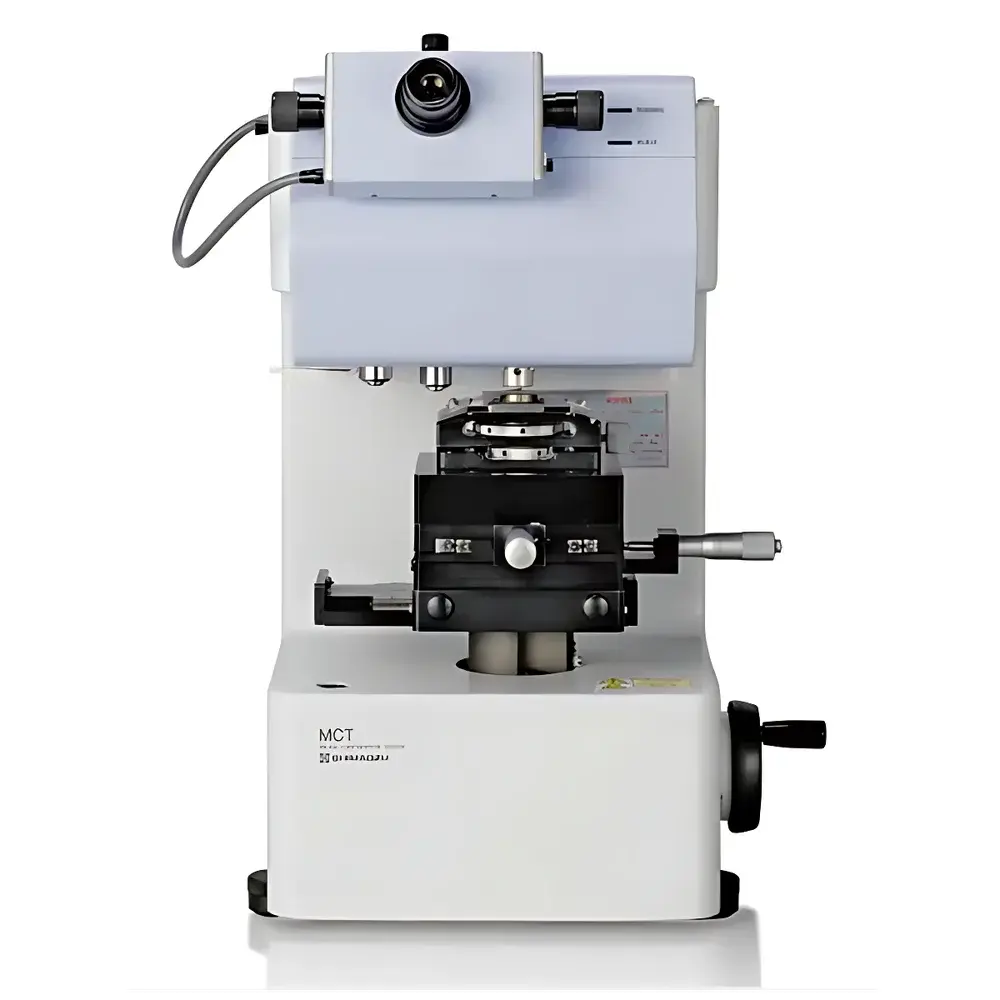
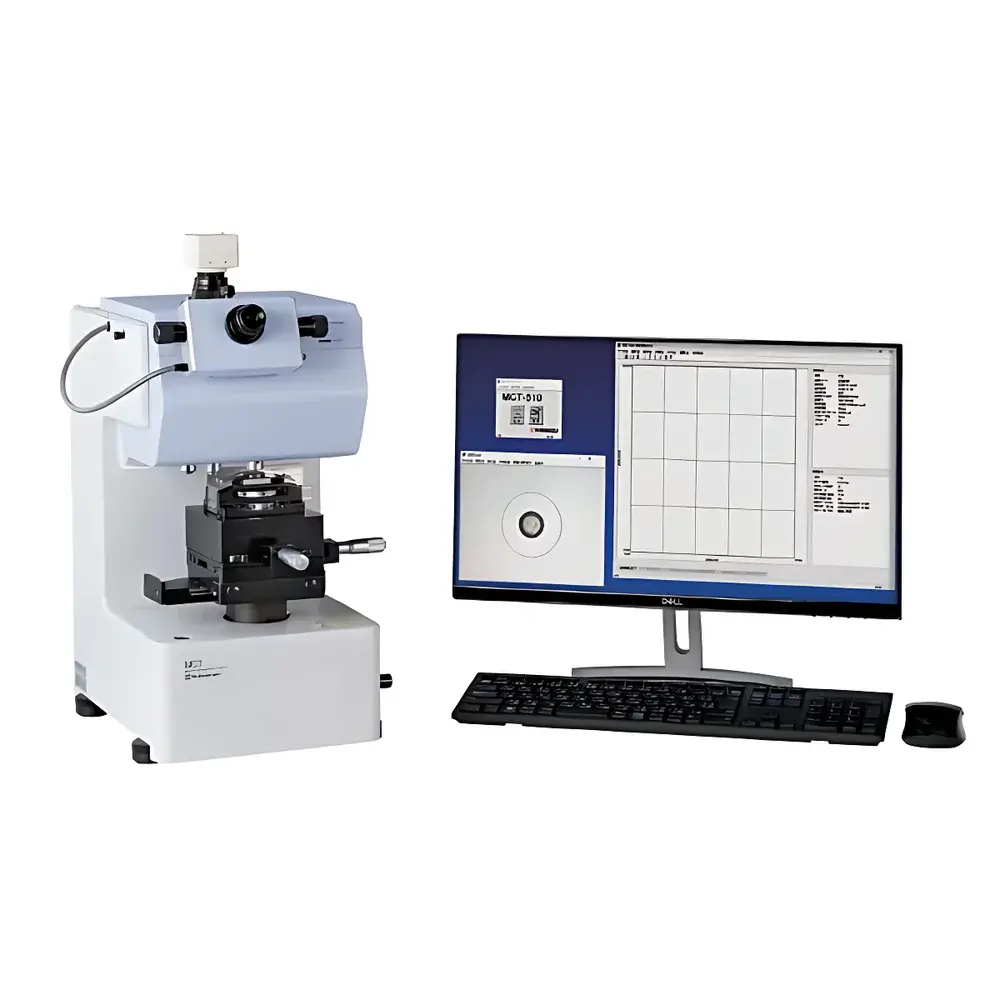
Shimadzu MCT Series Micro-Compression Tester
| Brand | Shimadzu |
|---|---|
| Origin | Japan |
| Manufacturer Type | Original Equipment Manufacturer (OEM) |
| Product Origin | Imported |
| Model | MCT Series |
| Load Range | 9.8–1961 mN / 9.8–4903 mN |
| Load Accuracy | ±1% of set or displayed load (whichever is greater) |
Overview
The Shimadzu MCT Series Micro-Compression Tester is a precision-engineered instrument designed for quantitative mechanical characterization of sub-millimeter-scale specimens under controlled uniaxial compression. It operates on the principle of force-displacement transduction using high-stiffness load cells and ultra-high-resolution capacitive or optical displacement sensors, enabling direct measurement of compressive stress–strain behavior in geometrically constrained microstructures. Unlike conventional universal testing machines, the MCT series is specifically optimized for specimens with characteristic dimensions ranging from ~1 µm to ~500 µm—spanning spherical powder particles, short fibers, microcapsules, granules, and miniature fabricated components. Its architecture supports quasi-static loading protocols compliant with ASTM E9, ISO 14577 (for microhardness-related compression), and emerging guidelines for particulate mechanical property assessment in pharmaceutical, advanced ceramics, and metal additive manufacturing R&D workflows.
Key Features
- Ultra-High-Resolution Displacement Measurement: Dual-mode sensor configuration: (i) 100 µm full-scale range with 0.001 µm resolution; (ii) 10 µm full-scale range with 0.0001 µm (0.1 nm) resolution—enabling nanoscale deformation tracking during initial contact and elastic regime analysis.
- Configurable Load Capacity: Two standard load cell options: 2 N (max 1961 mN) and 5 N (max 4903 mN), both calibrated traceably to JCSS (Japan Calibration Service System) standards and validated per ISO/IEC 17025 requirements.
- Force Control Accuracy: Maintains applied load within ±1% of the setpoint or displayed value (whichever is numerically larger), verified across the entire dynamic range via dead-weight calibration and real-time digital feedback compensation.
- Integrated Top-View Imaging System (Standard): Built-in coaxial optical path with 5 MP monochrome CMOS camera and telecentric lens enables automated geometric quantification—including projected area, Feret diameter, Martin diameter, and aspect ratio—prior to compression initiation.
- Optional Side-View Imaging Module: Synchronized high-speed side-view capture (up to 100 fps) allows real-time visualization of lateral deformation, buckling onset, fracture propagation, and interfacial slip during compression—critical for anisotropic fiber or layered microstructure analysis.
- High-Temperature Compression Capability (Optional): Integrated furnace module with PID-controlled heating (50–250°C), inert gas purge port, and thermal shielding maintains dimensional stability of the load train while minimizing thermal drift in displacement measurement.
Sample Compatibility & Compliance
The MCT Series accommodates discrete, freestanding micro-specimens including spherical metal/ceramic powders (1–500 µm), polymer microspheres, pharmaceutical microcapsules, food-grade granules, pigment agglomerates, carbon or glass microfibers (diameter < 50 µm, length < 1 mm), and MEMS-scale fabricated pillars. Specimen handling utilizes vacuum-assisted micro-positioning stages with XYZ fine adjustment (±0.5 µm repeatability). All hardware and software comply with ISO 17025-accredited laboratory infrastructure requirements. Data acquisition meets FDA 21 CFR Part 11 criteria when used with Shimadzu’s optional audit-trail-enabled software package, supporting GLP/GMP documentation for regulated material qualification in pharma and medical device development.
Software & Data Management
Control and analysis are performed via Shimadzu’s dedicated MCT-Analysis Suite—a Windows-based application supporting scriptable test sequence definition, real-time force–displacement curve overlay, automatic yield point detection (using tangent intersection or offset methods), modulus calculation (secant, tangent, or polynomial-fit), and statistical batch reporting. Raw data export is available in ASCII (.txt), CSV, and HDF5 formats. Image metadata—including timestamp, load value, displacement, and environmental parameters—is embedded directly into TIFF files. Optional integration with LIMS platforms is supported via OPC UA and RESTful API interfaces.
Applications
- Mechanical screening of spherical powders for binder jetting and cold spray processes
- Crush strength evaluation of pharmaceutical microcapsules and enteric-coated granules
- Compressive modulus and failure strain measurement of electrospun polymer nanofibers
- Interparticle bonding strength assessment in green-state ceramic compacts
- Texture analysis of food-derived microparticles (e.g., starch granules, protein aggregates)
- Calibration validation of discrete element method (DEM) simulation parameters
FAQ
What specimen geometries are compatible with the MCT Series?
Spherical, cylindrical, ellipsoidal, and irregularly shaped discrete micro-specimens with maximum dimension ≤ 500 µm and aspect ratio ≤ 5:1.
Is force calibration traceable to national standards?
Yes—load cells are factory-calibrated against JCSS-certified dead-weight standards, with calibration certificates provided per ISO/IEC 17025 Annex A.
Can the system perform cyclic or relaxation tests?
Yes—the MCT-Analysis Suite supports user-defined multi-step loading profiles, including hold periods, ramp reversals, and dwell-controlled creep sequences.
What is the minimum recommended sample quantity per test?
One specimen per test; statistical significance is achieved through replicate testing (typically n ≥ 10–30 per batch, per ICH Q5E guidance).
Does the system support third-party image analysis plugins?
Yes—via open TIFF export and documented API hooks, enabling integration with MATLAB, Python (OpenCV, scikit-image), or commercial packages such as ImageJ/Fiji and Definiens.



