
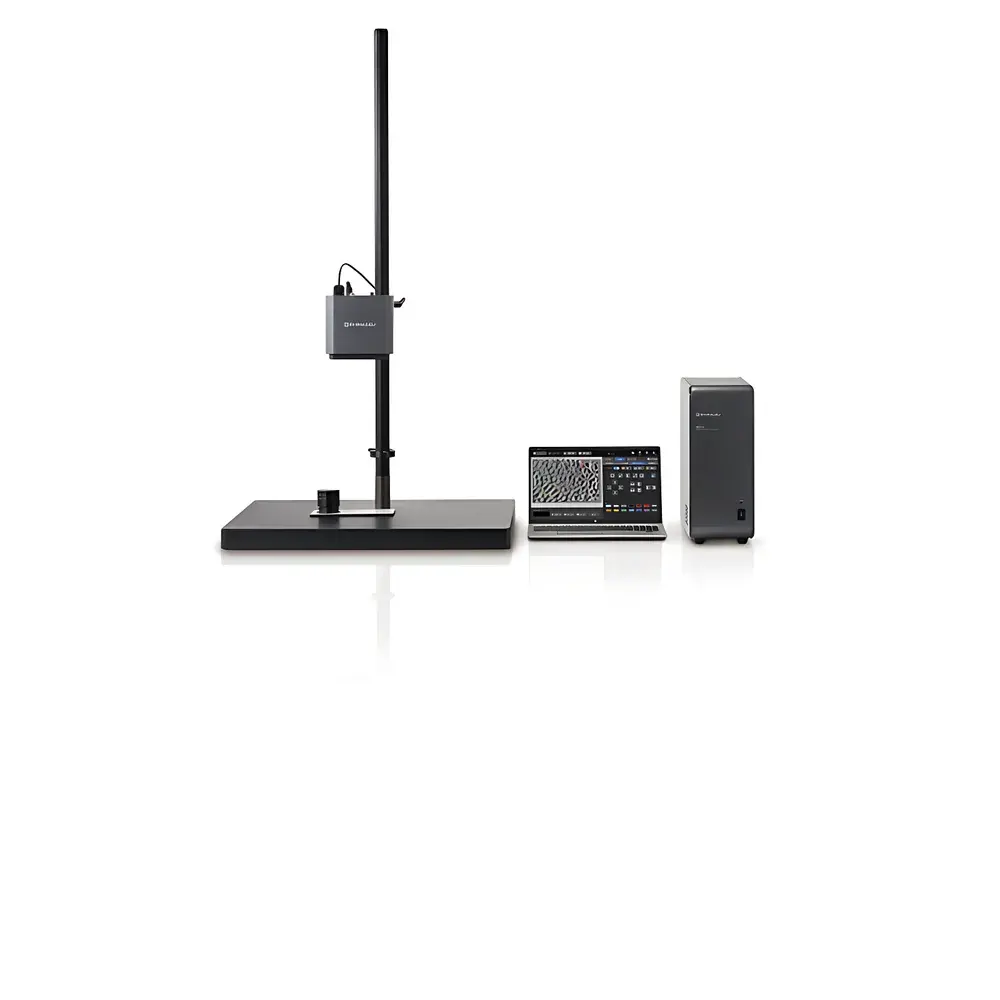
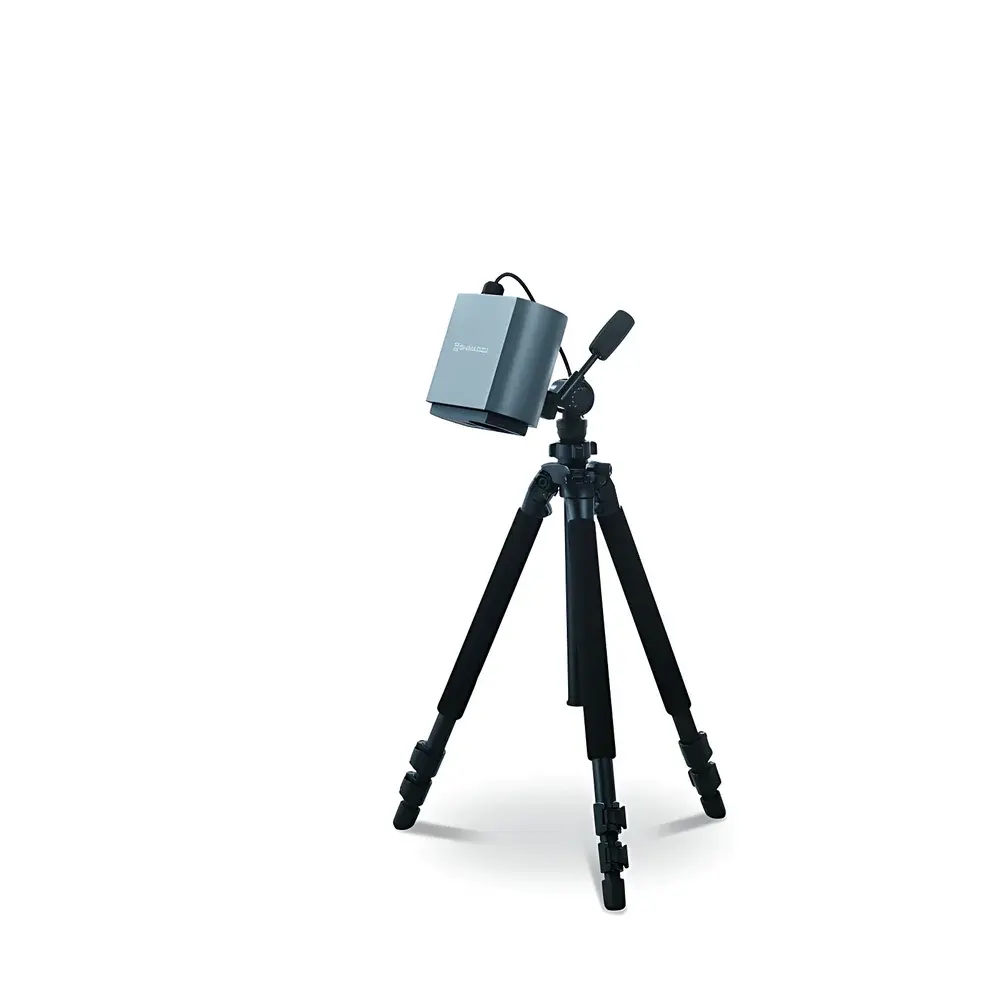
Shimadzu MIV-X Ultrasonic Optical Imaging System
| Brand | Shimadzu |
|---|---|
| Origin | Japan |
| Manufacturer Type | Original Equipment Manufacturer (OEM) |
| Product Origin | Imported |
| Model | MIV-X |
| Pricing | Available upon Request |
Overview
The Shimadzu MIV-X Ultrasonic Optical Imaging System is a non-contact, non-destructive evaluation (NDE) platform engineered for high-fidelity visualization of surface and near-surface discontinuities in solid materials. Unlike conventional pulse-echo ultrasonic testing (UT), which relies on acoustic impedance mismatch and backscattered echo amplitude, the MIV-X employs a hybrid opto-acoustic principle: it couples a controlled ultrasonic excitation source (piezoelectric transducer) with high-speed stroboscopic optical imaging to capture dynamic surface displacement fields induced by propagating ultrasonic waves. This technique—termed Ultrasonic-Induced Surface Displacement Imaging (UISDI)—enables direct spatial mapping of wavefront distortion caused by subsurface anomalies such as interfacial delamination, coating debonding, micro-cracks, and porosity within the top ~100–500 µm of the sample. The system operates in air without couplant, eliminating operator-dependent coupling variability and enabling rapid screening of large-area or complex-geometry components.
Key Features
- Stroboscopic optical detection synchronized with ultrasonic excitation frequency (range: 20 kHz – 10 MHz, adjustable in discrete steps)
- Real-time video acquisition at up to 10,000 fps (full-frame) with sub-pixel displacement resolution (<0.1 µm)
- Integrated piezoelectric transducer with calibrated force feedback and contact-pressure monitoring
- Modular optical path design accommodating macro-lens configurations for field-of-view adjustment (5 mm × 4 mm to 100 mm × 80 mm)
- Automated image registration and differential displacement contrast enhancement for defect edge delineation
- Rugged aluminum-alloy chassis with ESD-safe surface finish and IP52-rated enclosure for lab and controlled industrial environments
Sample Compatibility & Compliance
The MIV-X supports a broad spectrum of engineering materials including metallic alloys (Al, Ti, stainless steel), composites (CFRP, GFRP), ceramics, polymer coatings, thermal barrier coatings (TBCs), and adhesive-bonded joints. It is particularly effective for multi-layer structures where interfacial integrity is critical—e.g., aerospace turbine blade coatings, automotive battery module laminates, and medical device encapsulation layers. The system complies with ISO 16810:2014 (Non-destructive testing — General principles for ultrasonic testing), ASTM E2700-21 (Standard Guide for Ultrasonic Testing Using Electromagnetic Acoustic Transducers), and supports GLP/GMP-aligned documentation workflows via audit-trail-enabled software logging. All optical components meet IEC 60825-1:2014 Class 1 laser safety requirements.
Software & Data Management
The proprietary MIV-View™ acquisition and analysis suite runs on Windows 10/11 (64-bit) and provides full traceability per FDA 21 CFR Part 11 requirements—including electronic signatures, user role-based access control, and immutable raw-data archiving. Key modules include: (1) Real-time wavefield visualization with FFT-based spectral filtering; (2) Defect annotation with geometric measurement tools (length, area, depth estimation via phase-shift calibration); (3) Batch processing for comparative analysis across multiple samples; (4) Export of time-resolved displacement maps in HDF5 and TIFF formats for third-party finite element validation. Software updates are delivered via secure HTTPS channel with SHA-256 signature verification.
Applications
- Detection of adhesive bond failure in carbon-fiber reinforced polymer (CFRP) assemblies used in aircraft fuselage panels
- Assessment of thermal spray coating adhesion strength on nickel-based superalloy substrates
- Quality assurance of painted steel sheets in automotive body-in-white production lines
- Validation of ultrasonic welding integrity in lithium-ion battery tab connections
- Research-grade characterization of microstructural evolution during fatigue cycling in additively manufactured Ti-6Al-4V specimens
FAQ
How does the MIV-X differ from conventional ultrasonic testing (UT)?
It replaces echo-time analysis with direct optical observation of surface motion, making it insensitive to material attenuation and highly sensitive to shallow discontinuities that produce minimal backscatter.
Can the MIV-X inspect curved or irregular surfaces?
Yes—the transducer features a conformable elastomeric interface pad, and the optical head includes motorized focus and tilt adjustment to maintain diffraction-limited resolution across radii ≥25 mm.
Is calibration required before each test?
A one-time system-level calibration (performed annually or after hardware service) establishes displacement-to-pixel scaling; no per-sample calibration is needed due to built-in reference vibration amplitude normalization.
What file formats are supported for data export?
HDF5 (for quantitative displacement time-series), TIFF (8/16-bit grayscale video stacks), CSV (defect metadata), and PDF (report templates compliant with ISO/IEC 17025).
Does the system support automated pass/fail decision logic?
Yes—threshold-based defect classification rules can be scripted using Python API integration, and results are logged with timestamp, operator ID, and environmental sensor data (temperature, humidity).



