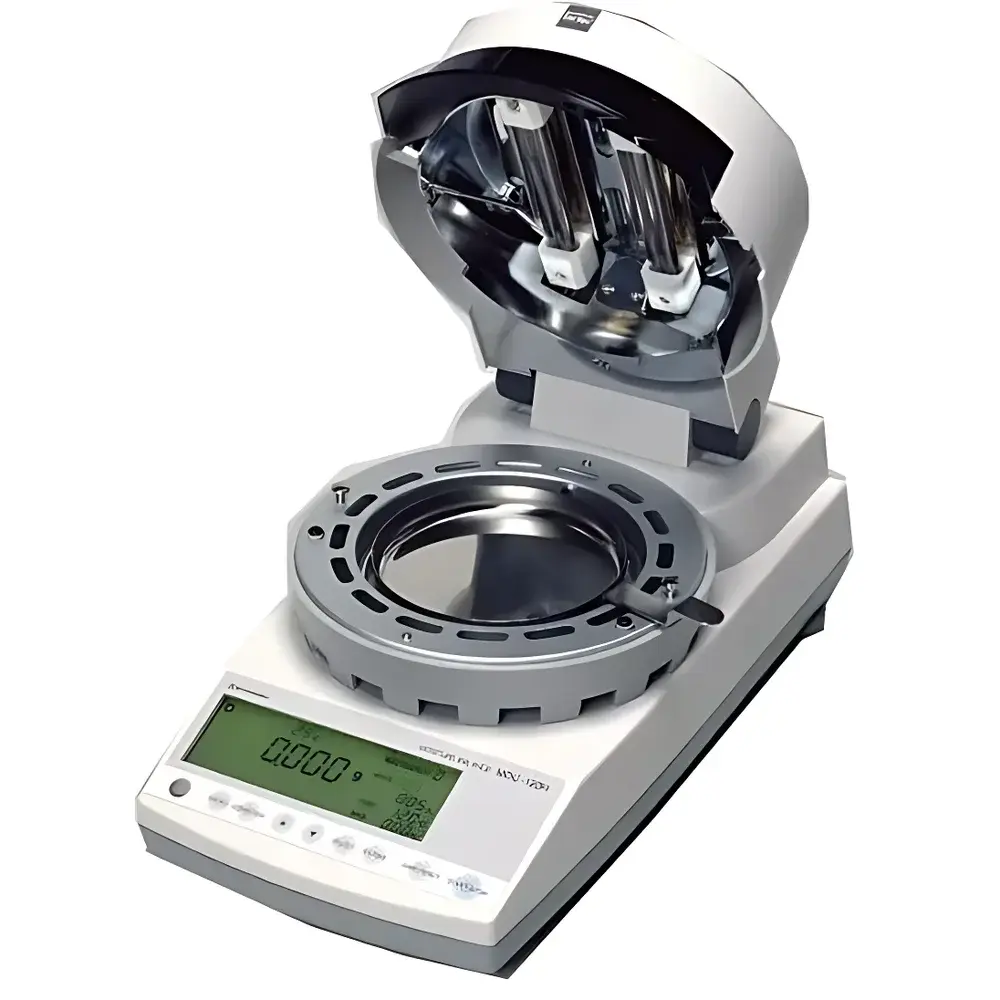
Shimadzu MOC-120H Electronic Moisture Analyzer
| Brand | Shimadzu |
|---|---|
| Origin | Japan |
| Manufacturer Type | Manufacturer |
| Origin Category | Imported |
| Model | MOC-120H |
| Pricing | Upon Request |
| Measurement Principle | Gravimetric Loss-on-Drying (Infrared Heating) |
| Sample Capacity | 0.5–120 g |
| Moisture Resolution | 0.1% or 0.01% (selectable) |
| Mass Resolution | 0.001 g |
| Moisture Range | 0–100% (w/w, solid moisture) |
| Repeatability (SD) | ≤0.05% (≥5 g sample), ≤0.02% (≥10 g sample) |
| Drying Modes | Auto-Stop, Timer-Stop (1–240 min or continuous up to 12 h), Rapid Dry, Gradual Dry, 5-Stage Programmable Ramp, Comparative Prediction Mode |
| Temperature Range | 30–180 °C (1 °C increments) |
| Heating Source | Medium-Wave Infrared Lamp (625 W max) |
| Power Supply | AC 100–120 V / 220–240 V, 50/60 Hz |
| Max Power Consumption | 640 W |
| Dimensions (W×D×H) | 220 × 415 × 190 mm |
| Weight | 4.5 kg |
| Sample Pan | Stainless Steel (Ø130 mm × 13 mm depth) |
| Display | LCD |
| Interface | RS-232C |
| Data Storage | 100 measurement records |
| Method Storage | 10 user-defined protocols |
| Operating Environment | 5–40 °C, ≤85% RH |
| Key Hardware | Monolithic Load Cell Sensor |
| Auto-Zero Compensation | Yes (real-time drift correction during heating) |
Overview
The Shimadzu MOC-120H Electronic Moisture Analyzer is a precision gravimetric instrument engineered for rapid, reliable determination of moisture content in solid and semi-solid materials using the loss-on-drying (LOD) principle. It employs medium-wave infrared (MWIR) radiation—optimized for uniform thermal energy transfer—to dehydrate samples while continuously monitoring mass loss with a monolithic load cell sensor. Unlike convection ovens or halogen-based systems, the MOC-120H’s infrared source delivers efficient, controllable heating without air turbulence, minimizing thermal degradation risks for heat-sensitive substances such as pharmaceutical actives, polymers, food powders, and botanical extracts. The instrument complies with core methodology standards referenced in ASTM E1447, ISO 712, USP <921>, and AOAC 952.07, supporting validated workflows in quality control laboratories operating under GLP or GMP frameworks.
Key Features
- Monolithic Load Cell Architecture: A single-piece sensor design eliminates mechanical hysteresis and mounting-induced drift, ensuring long-term stability and high reproducibility across repeated thermal cycles.
- Real-Time Zero-Point Compensation: Automatically corrects for thermal expansion effects on the weighing mechanism during active heating—critical for maintaining sub-milligram accuracy throughout extended drying sequences.
- Five-Stage Programmable Ramp Drying: Enables precise thermal profiling (e.g., gentle pre-drying followed by accelerated final dehydration), essential for heterogeneous or layered samples where uniform moisture removal is nontrivial.
- Dual-Resolution Moisture Readout: Switchable between 0.1% and 0.01% moisture resolution—supporting both routine QC screening and high-precision R&D applications requiring fine-grained trend analysis.
- Comprehensive Drying Flexibility: Six distinct operational modes—including comparative prediction (reference-based estimation), rapid dry, and gradual dry—allow method optimization without hardware modification.
- Robust Environmental Tolerance: Stable performance within 5–40 °C and ≤85% RH ensures consistent operation in non-climate-controlled production labs or field-deployed settings.
Sample Compatibility & Compliance
The MOC-120H accommodates samples ranging from 0.5 g to 120 g in standard stainless-steel pans (Ø130 mm × 13 mm depth), suitable for granular, powdered, paste-like, and flake-form materials. Its non-contact infrared heating avoids cross-contamination and supports direct analysis of hygroscopic or volatile compounds that may migrate or decompose under forced-air conditions. Regulatory alignment includes full traceability support for FDA 21 CFR Part 11-compliant data handling when integrated with Shimadzu LabSolutions software (via RS-232C). All drying methods are fully documentable per ISO/IEC 17025 requirements, including audit trails for parameter changes, calibration events, and user logins.
Software & Data Management
Data output is supported via RS-232C serial interface, enabling seamless integration with LIMS platforms or custom SCADA systems. The built-in Windows Direct-View function allows real-time display and capture of live mass curves, temperature profiles, and endpoint detection logic on external PCs. Up to 100 complete measurement records—including time-stamped mass vs. time datasets, final moisture %, dry weight, and solids content—are stored internally. Ten user-defined drying protocols can be saved with full parameter sets (temperature ramp steps, stop criteria, resolution settings), facilitating SOP-driven operation and reducing operator-dependent variability.
Applications
- Pharmaceutical manufacturing: Moisture verification of APIs, excipients, and tablet granules per USP <921> and ICH Q5C guidelines.
- Food & beverage QA/QC: Rapid assessment of flour, dairy powders, coffee, spices, and pet food for shelf-life prediction and HACCP compliance.
- Polymer & chemical industry: Resin moisture specification checks prior to extrusion or molding; catalyst drying validation.
- Agricultural & feed testing: Grain moisture quantification aligned with ISO 6540 and AOAC official methods.
- Research laboratories: Kinetic moisture loss modeling, thermal stability profiling, and method development for novel biomaterials.
FAQ
What is the primary measurement principle used by the MOC-120H?
Gravimetric loss-on-drying (LOD) with medium-wave infrared heating and continuous high-resolution mass monitoring.
Does the instrument meet regulatory requirements for pharmaceutical use?
Yes—it supports audit-trail-capable data export and method storage, enabling alignment with FDA 21 CFR Part 11, EU Annex 11, and GMP documentation standards when paired with compliant software.
Can the MOC-120H measure moisture in liquid or gel samples?
No—it is designed exclusively for solid and semi-solid matrices. Liquids require distillation or Karl Fischer titration methods.
How is thermal drift compensated during prolonged heating?
Through real-time auto-zero compensation, which dynamically adjusts the baseline reading to offset sensor thermal expansion effects.
Is calibration traceable to national standards?
Yes—internal calibration uses Shimadzu-certified weights traceable to NIST or JCSS-accredited references; external verification follows ISO 17025 procedures.