
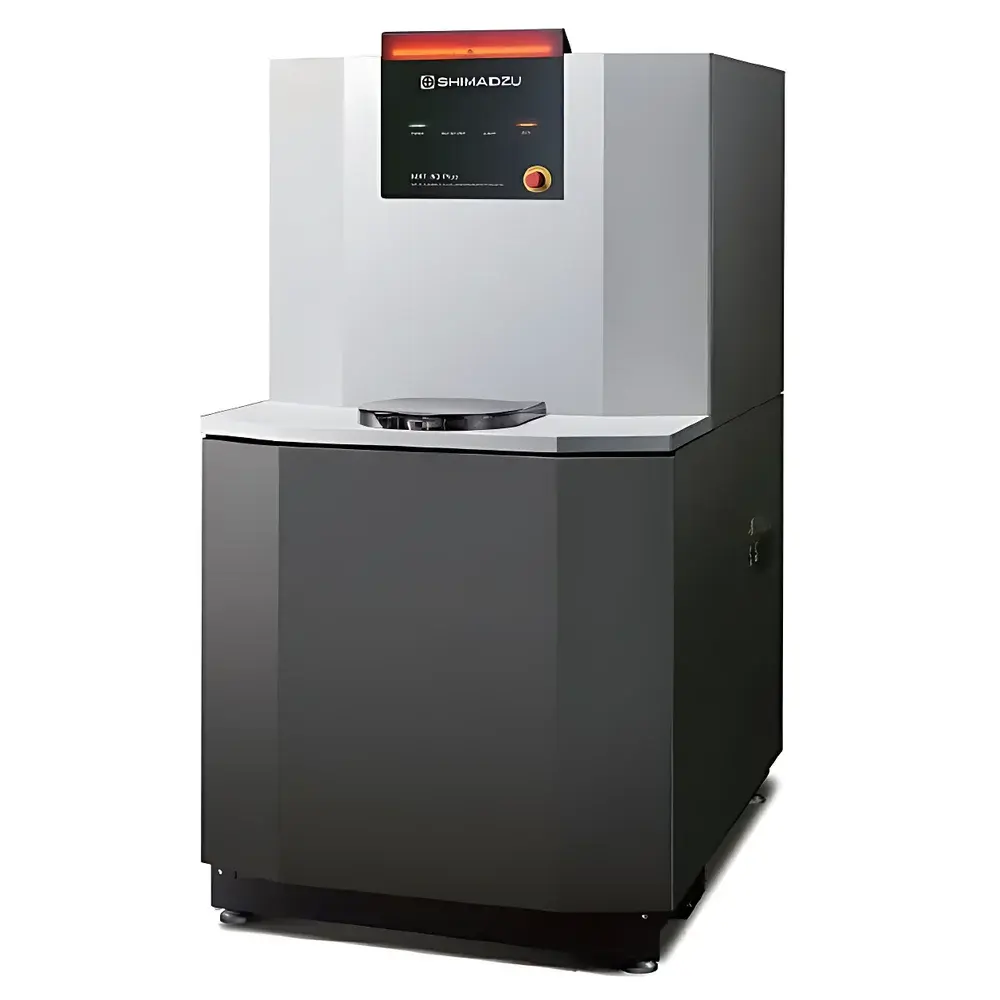
Shimadzu MXF-N3 Plus Wavelength Dispersive X-Ray Fluorescence Spectrometer
| Brand | Shimadzu |
|---|---|
| Origin | Jiangsu, China |
| Manufacturer Type | Manufacturer |
| Regional Category | Domestic |
| Model | MXF-N3 Plus |
| Price Range | USD 210,000 – 280,000 |
| Instrument Type | Simultaneous Multi-Channel |
| X-ray Tube Power | 3 kW |
| Elemental Range | Na (11) to U (92) |
Overview
The Shimadzu MXF-N3 Plus is a high-performance, simultaneous multi-channel wavelength dispersive X-ray fluorescence (WDXRF) spectrometer engineered for routine, high-throughput elemental analysis in industrial quality control and research laboratories. Based on Bragg diffraction principles, the instrument utilizes fixed crystal analyzers and dedicated proportional counters to measure characteristic X-ray emissions at discrete wavelengths—enabling simultaneous detection of all target elements without mechanical scanning. This architecture eliminates moving optical components, significantly enhancing long-term measurement stability, reproducibility, and uptime. Designed specifically for demanding production environments—including cement, metallurgy, ceramics, and raw materials processing—the MXF-N3 Plus delivers sub-minute per-sample analysis while maintaining rigorous precision across light (Na) through heavy (U) elements. Its robust mechanical design, low-voltage tolerance, and comprehensive dust mitigation strategies reflect Shimadzu’s engineering focus on operational resilience and minimal dependency on field service interventions.
Key Features
- Simultaneous multi-channel detection architecture with fully fixed optics: 10–20 dedicated analytical channels (configurable), each equipped with a custom-focusing crystal and sealed proportional counter for optimized intensity and peak-to-background ratio.
- 3 kW high-power X-ray tube with Shimadzu’s proprietary “Fault-Free” high-voltage generator: operates stably within ±10% fluctuation of 220 V AC input; grounding resistance tolerance up to 30 Ω ensures compatibility with variable facility power infrastructure.
- Integrated dust-protection system: includes top-irradiation X-ray tube geometry (prevents sample dust deposition on beryllium window), vacuum-sealed detector channels, conformally coated and thermally managed circuit boards, and a dedicated vacuum-line particulate trap upstream of the turbomolecular pump.
- Low-maintenance mechanical design: slide-rail sample introduction mechanism replaces legacy bearing-based systems—improving positioning repeatability and reducing wear-related drift; compact high-vacuum chamber allows user-performed maintenance without OEM dispatch.
- Sealed-flow proportional counters: eliminate reliance on P10 (Ar/CH₄) gas mixtures, removing risks associated with gas leakage, pressure instability, and aging anode wire contamination—reducing consumables cost and downtime.
Sample Compatibility & Compliance
The MXF-N3 Plus accommodates solid discs (32 mm or 40 mm diameter), fused beads, and pressed pellets. It supports both air-path (for elements ≥Na) and vacuum-path (for elements down to Na) analysis modes. The instrument complies with ISO 2936:2022 (XRF — General requirements for calibration and verification), ASTM E1361 (Standard Guide for XRF Analysis of Ceramic Whiteware), and JIS R 9501 (Cement analysis by WDXRF). Its hardware architecture and firmware support audit-trail-enabled operation under GLP and GMP frameworks; full electronic records—including instrument parameters, calibration history, and raw spectral data—are exportable in CSV and XML formats for regulatory review.
Software & Data Management
MXF-N3 Plus is operated via Shimadzu’s proprietary WDXRF Control Suite—a native Windows application featuring single-window, icon-driven workflow navigation. The software includes pre-loaded certified reference material (CRM) calibrations for common matrices (e.g., Portland cement clinker, limestone, blast furnace slag, low-alloy steels), collectively referred to as “Master Curves,” eliminating the need for user-developed calibration standards in routine applications. Real-time instrument status monitoring covers high-voltage stability, vacuum level, detector count rate, and sample stage position. All analytical sessions are timestamped and logged with operator ID; raw intensity data, net peak areas, and inter-element correction coefficients are stored in a relational database compliant with FDA 21 CFR Part 11 requirements when deployed with optional electronic signature modules.
Applications
Primary use cases include quantitative major- and minor-element analysis (0.001–100 wt%) in cement manufacturing (CaO, SiO₂, Al₂O₃, Fe₂O₃, MgO, SO₃, K₂O, Na₂O, Cl⁻), ferrous and non-ferrous metallurgy (C, Mn, Cr, Ni, Mo, V, Co in steels; Cu, Zn, Pb, Sn in brass/alloys), geological surveying (Ti, P, S, Ba, Zr in ores), and environmental compliance testing (heavy metals in fly ash, slag, and waste-derived fuels). The instrument’s fixed-channel configuration ensures consistent dwell times and counting statistics across repeated analyses—critical for statistical process control (SPC) implementation in continuous production lines.
FAQ
What is the minimum detectable limit (MDL) for sodium (Na) in cement matrix using the MXF-N3 Plus?
MDL for Na is typically 30–50 ppm under vacuum conditions with 60-second counting time, depending on sample homogeneity and background subtraction method.
Does the system support ASTM C114 or EN 196-2 compliant cement analysis workflows?
Yes—preconfigured method templates, CRM libraries, and uncertainty propagation algorithms align with both ASTM C114-22 and EN 196-2:2013 reporting structures.
Can the MXF-N3 Plus be integrated into a LIMS environment?
Yes—via ODBC-compliant database export and configurable ASCII/CSV output protocols; Shimadzu provides documented API hooks for third-party LIMS middleware integration.
Is remote diagnostics and firmware update supported?
Remote secure access (SSH/TLS-encrypted) is available for diagnostic log retrieval and firmware patch deployment, subject to customer network policy approval.
What vacuum pumping strategy is used, and what is typical base pressure?
A hybrid vacuum system combines a dry scroll roughing pump and a magnetically levitated turbomolecular pump; ultimate pressure in the goniometer chamber is ≤5 × 10⁻⁵ Pa after 30 minutes of pump-down.



