
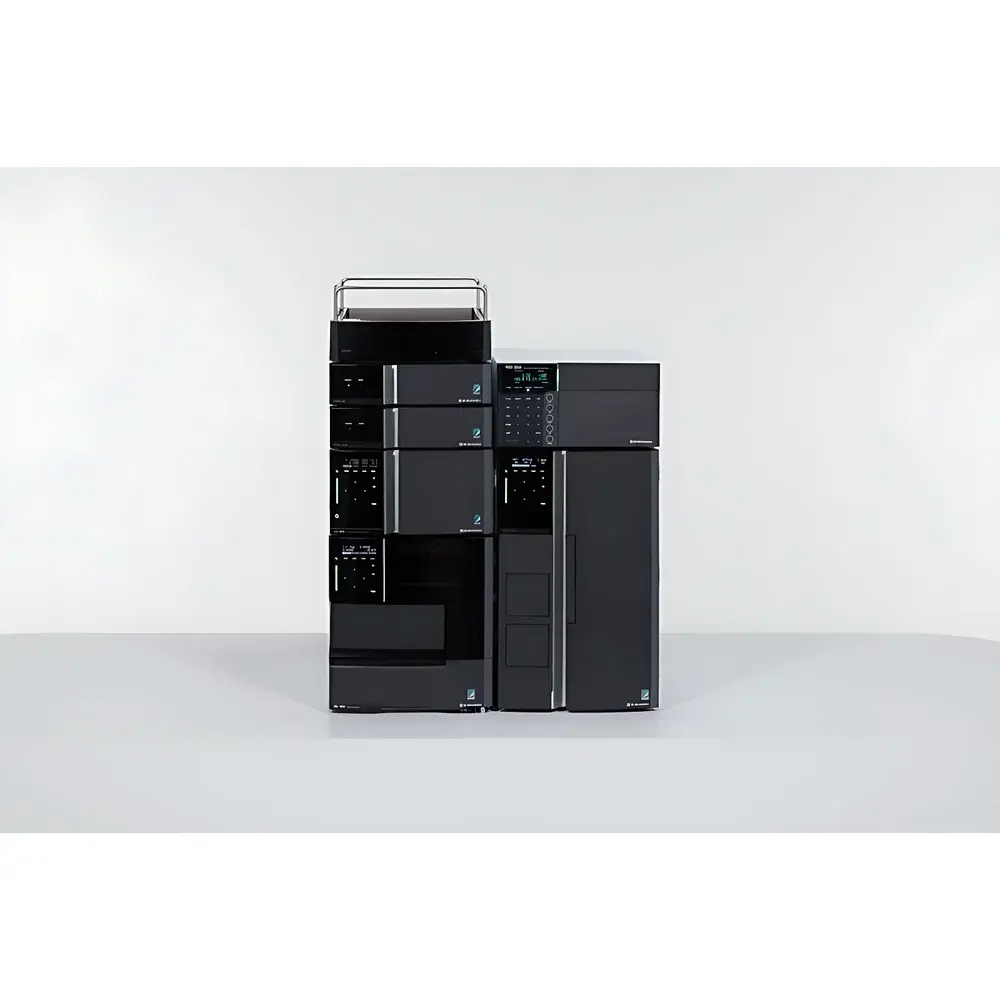
Shimadzu Nexera GPC System
| Brand | Shimadzu |
|---|---|
| Origin | Japan |
| Manufacturer Type | Original Equipment Manufacturer (OEM) |
| Product Category | Imported Instrument |
| Model | Nexera GPC System |
| Instrument Type | Conventional High-Performance Liquid Chromatography (HPLC) System for Gel Permeation Chromatography |
| Price Range | USD 70,000 – 140,000 (approx. based on ¥500,000–¥1,000,000 at current exchange rate) |
| Flow Rate Range | Not applicable (GPC-specific isocratic or low-gradient elution |
| Maximum Pressure Rating | Not specified in source (typical for GPC: ≤40 MPa) |
| Sample Injection Positions | Configurable via SIL-40 series autosampler (up to 216 vials standard) |
| Injection Volume Range | 0.1–100 µL (autosampler-dependent) |
| Column Oven Temperature Range | 4–85 °C (standard CTO-40 series column oven) |
| UV/VIS Wavelength Range | 190–800 nm (with SPD-M40 photodiode array detector or SPD-40V UV-Vis detector) |
| Data Acquisition Rate | Up to 100 Hz (detector-dependent) |
Overview
The Shimadzu Nexera GPC System is a purpose-engineered high-performance liquid chromatography platform optimized for gel permeation chromatography (GPC), also known as size-exclusion chromatography (SEC). Unlike general-purpose HPLC systems, the Nexera GPC integrates hardware architecture and software intelligence specifically for polymer molecular weight distribution (MWD) analysis—leveraging separation physics based on hydrodynamic volume in porous stationary phases. The system employs robust dual-plunger parallel-flow pumps with active solvent compressibility compensation, thermally stabilized column compartments, and low-dispersion flow paths to ensure baseline stability and retention time reproducibility critical for absolute and relative MWD quantification. Designed for compliance-driven environments—including polymer R&D, quality control in synthetic resin manufacturing, and regulatory submission support—the Nexera GPC meets core performance expectations of ISO 16014, ASTM D5296, and USP for SEC methodology validation.
Key Features
- FlowPilot Intelligent Flow Control: Prevents mechanical stress on sensitive GPC columns during method startup/shutdown by ramping flow rate incrementally to target values—eliminating pressure shock and extending column lifetime without user intervention.
- Real-Time Mobile-Enabled Solvent Monitoring: Optional integrated sensors in the solvent tray monitor volume levels across up to 12 reservoirs (mobile phase + wash solvents); alerts and remote status updates are accessible via web browser or mobile interface.
- Automated Diagnostic & Recovery Protocol: Continuously monitors baseline noise, pressure transients, and detector signal drift; triggers automatic purge, equilibration, and re-injection upon detection of air bubble ingress or flow instability—minimizing manual troubleshooting.
- Overlapping Injection (Standard on SIL-40 Series Autosampler): Enables sample needle washing and column equilibration to occur concurrently with data acquisition from the prior injection—reducing cycle time by up to 50% in multi-sample sequences.
- Column Protection via Thermal-Flow Synchronization: Column oven temperature stabilization is coordinated with FlowPilot activation, ensuring thermal equilibrium precedes full-flow operation—critical for minimizing thermal degradation of polymer standards and samples.
Sample Compatibility & Compliance
The Nexera GPC System supports a broad range of synthetic and natural polymers—including polystyrene, polyethylene, polypropylene, poly(methyl methacrylate), polyvinyl chloride, polysaccharides, and proteins—when paired with appropriate SEC columns (e.g., SHODEX, Waters Styragel, Agilent PLgel). It complies with GLP/GMP documentation requirements through LabSolutions™ GPC’s audit-trail-enabled workflow, including electronic signatures, instrument state logging, and change history tracking per FDA 21 CFR Part 11. All calibration procedures—including universal calibration using Mark–Houwink parameters, Q-factor correction, and degree-of-polymerization referencing—are traceable and exportable in CSV or PDF format. System suitability testing (SST) is embedded into sequence methods and enforced before sample analysis—ensuring consistent resolution, asymmetry, and plate count across batches.
Software & Data Management
LabSolutions GPC provides an intuitive, task-oriented interface for SEC data processing. Its graphical calibration builder supports up to 64 standard points with visual overlay of virtual points and real-time curve fitting against linear, quadratic, cubic, or Mark–Houwink models. Peak integration dynamically updates MWD curves, enabling immediate calculation of Mn, Mw, Mz, dispersity (Đ), intrinsic viscosity, and branching ratios. Multi-detector data (e.g., RI, UV, viscometer, light scattering) are synchronized and managed within a single project file. Comparative analysis allows overlay of up to 10 chromatograms with statistical summary tables for key parameters. Reporting is fully customizable: templates support regulatory-compliant layouts, automated PDF generation, database archiving, and direct export to Excel-compatible spreadsheets—reducing post-acquisition data handling and supporting paperless laboratory operations.
Applications
The Nexera GPC System serves analytical needs across polymer science and industrial quality assurance. Typical use cases include batch-to-batch consistency verification of commercial resins, degradation profiling of aged polyolefins, characterization of biodegradable polymers (e.g., PLA, PHA), evaluation of graft copolymer architecture, and comparative MWD analysis of nanoparticle-stabilized emulsions. In pharmaceutical development, it supports excipient characterization (e.g., PEG, dextran, hyaluronic acid) under ICH Q5E guidelines. Academic labs utilize its high reproducibility for fundamental studies on polymerization kinetics and living/controlled radical polymerization mechanisms. Its modular design permits future expansion with multi-angle light scattering (MALS), differential viscometry, or FTIR detection modules—all controlled through unified LabSolutions architecture.
FAQ
Is the Nexera GPC System compatible with non-aqueous SEC solvents such as THF, chloroform, or DMF?
Yes—it supports common organic SEC mobile phases with chemically resistant fluidic components (e.g., PEEK, sapphire, and Hastelloy parts) and temperature-controlled detectors suitable for volatile solvent handling.
Can LabSolutions GPC generate reports compliant with ISO/IEC 17025 accreditation requirements?
Yes—audit trails, raw data immutability, electronic signature support, and full metadata capture meet ISO/IEC 17025 Clause 7.7 and Annex A3 for data integrity and reporting transparency.
Does the system support automated column switching for 2D-LC-SEC applications?
While not natively configured for 2D-LC, the Nexera platform’s valve control architecture (via CBM-40 controller) allows integration of external switching valves and secondary columns when implemented with custom method programming in LabSolutions.
What is the minimum detectable molecular weight range for typical polystyrene standards?
With optimal column selection (e.g., SHODEX K-807 + K-806 combination) and RI detection, the system achieves reliable resolution from ~200 Da to >107 Da—subject to column calibration and sample solubility.
How does Analytical Intelligence differ from conventional instrument diagnostics?
Analytical Intelligence combines M2M telemetry, rule-based anomaly detection, and adaptive recovery logic—not predictive AI—to autonomously stabilize operational parameters without requiring operator expertise or pre-defined failure modes.





