
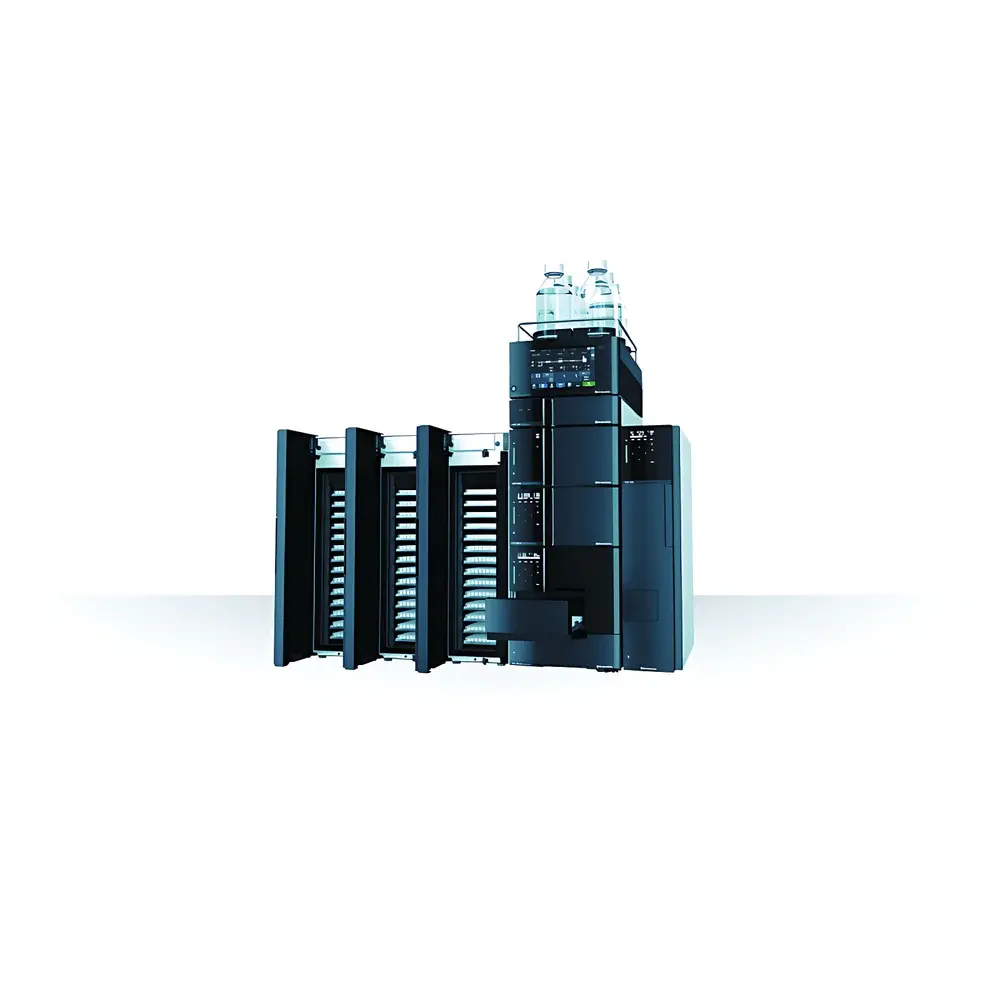
Shimadzu Nexera LC-40 Ultra-High Performance Liquid Chromatograph
| Brand | Shimadzu |
|---|---|
| Origin | Japan |
| Manufacturer | Shimadzu Corporation |
| Instrument Type | Ultra-High Performance Liquid Chromatograph (UHPLC) |
| Flow Rate Range | 0.001–10 mL/min |
| Maximum System Pressure | 130 MPa |
| Autosampler Capacity | Up to 16,800 positions (via microplate stacking) |
| Injection Volume Range | 0.1–100 µL |
| Column Oven Temperature Range | –10°C to 85°C |
| UV-Vis Detector Wavelength Range | 190–800 nm |
| Data Acquisition Rate | 100 Hz |
| Detector Options | SPD-40/SPD-40V UV-Vis, SPD-M40 Diode Array Detector (DAD) |
| Compliance | ASTM D7097, ISO 17025, USP <621>, FDA 21 CFR Part 11 (with LabSolutions™ CS audit trail enabled) |
Overview
The Shimadzu Nexera LC-40 is an ultra-high performance liquid chromatograph engineered for precision, reproducibility, and seamless integration into modern analytical laboratories. Built upon over 45 years of Shimadzu’s HPLC platform evolution, the LC-40 series implements advanced fluidic architecture based on low-dispersion binary gradient pumping, high-pressure-compatible capillary routing, and thermally stabilized optical detection. It operates under the fundamental principles of reversed-phase, normal-phase, ion-exchange, and size-exclusion chromatography—enabling robust separation of small molecules, peptides, oligonucleotides, and polar metabolites at sub-2-µm particle column conditions. Designed for compliance-critical environments—including pharmaceutical QC, clinical research, and contract testing laboratories—the system supports method transfer from legacy HPLC platforms while delivering up to 3× higher resolution and 50% shorter run times under equivalent method parameters.
Key Features
- Binary gradient pump unit (LC-40) with integrated solvent degassing, real-time pressure monitoring, and autonomous diagnostics—including automatic leak detection, flow calibration verification, and self-recovery from transient pressure spikes.
- Autosampler SIL-40 series featuring dual-needle design, plate-changer capability for up to 44 standard microplates (96-/384-well), and programmable sample preparation functions: dilution, internal standard addition, derivatization incubation, and post-injection wash protocols.
- Three-zone thermal management across detector (SPD-40V/SPD-M40), autosampler chamber, and column oven (CTO-40): each independently controlled with ±0.1°C stability; chamber airflow optimization prevents condensation during low-temperature operation.
- Smart solvent management via MPM-40 solvent manager with built-in level sensors, RFID-tagged solvent bottle recognition, and predictive low-volume alerts synchronized with LabSolutions™ workflow scheduling.
- System controller SCL-40/CBM-40 supporting remote access via secure TLS-encrypted web interface; touchscreen-guided maintenance routines (e.g., purge, baseline stabilization, lamp energy check) reduce operator dependency.
- Column intelligence module: CTO-40 records cumulative injection count, average backpressure, temperature history, and seal wear indicators—integrated with LabSolutions™ CS column health scoring algorithm for proactive replacement planning.
Sample Compatibility & Compliance
The Nexera LC-40 accommodates a broad range of sample matrices—including aqueous extracts, organic extracts, plasma supernatants, cell lysates, and formulated drug products—without modification to core hardware. Its low-dead-volume flow path (<1.2 µL from injector to detector cell) ensures minimal band broadening for narrow peaks generated by sub-2-µm columns. All firmware and software modules comply with ISO/IEC 17025:2017 requirements for testing and calibration laboratories. When configured with LabSolutions™ CS v5.9 or later and enabled audit trail, electronic signature, and data integrity controls, the system meets FDA 21 CFR Part 11, EU Annex 11, and PIC/S GMP guidelines for regulated environments. Routine IQ/OQ/PQ documentation packages are available per instrument configuration.
Software & Data Management
LabSolutions™ CS serves as the unified acquisition, processing, and reporting platform—supporting multi-user role-based access control, electronic lab notebook (ELN) synchronization, and automated report generation in PDF/A-2 format. Raw data files (.lcd) are stored with embedded metadata: instrument configuration, consumables lot numbers (tracked via QR-coded vials and columns), environmental logs (temperature/humidity), and user authentication tokens. Version-controlled method templates enforce consistency across shifts and sites. Data archiving complies with long-term retention policies (≥15 years) through optional integration with enterprise LIMS and cloud-based object storage (AWS S3 or Azure Blob with WORM compliance).
Applications
- Pharmaceutical stability-indicating assays per ICH Q5C and Q1A(R2)
- Residual solvent analysis in APIs (ICH Q3C) using headspace-GC/LC hybrid workflows
- Peptide mapping and intact mass analysis in biologics characterization
- Quantitative bioanalysis of small-molecule drugs in plasma (FDA Bioanalytical Method Validation Guidance)
- Environmental contaminant screening (e.g., PFAS, pesticides) per EPA Method 1694 and ISO 21675
- Food safety testing for mycotoxins, veterinary drug residues, and adulterants per EU Commission Regulation (EC) No 401/2006
FAQ
Does the LC-40 support method transfer from older Shimadzu LC systems?
Yes—LabSolutions™ includes a dedicated Method Conversion Tool that adjusts gradient dwell volume compensation, flow rate scaling, and injection timing to maintain retention time reproducibility across LC-20/30/40 generations.
Is the SPD-M40 diode array detector compatible with peak purity assessment?
Yes—the SPD-M40 acquires full 190–800 nm spectra at 100 Hz with 1-nm resolution; spectral library matching and peak purity angle calculation (per USP ) are natively supported in LabSolutions™ CS.
Can the system operate unattended for extended periods?
With validated autosampler cooling (4°C), solvent level monitoring, and predictive maintenance alerts, the LC-40 supports 72+ hour unattended operation when loaded with ≥44 microplates and scheduled via LabSolutions™ Scheduler.
What column dimensions and particle sizes are recommended for optimal UHPLC performance?
Recommended configurations include 2.1 × 50 mm or 3.0 × 75 mm columns packed with 1.7–1.9 µm fully porous or superficially porous particles; maximum efficiency is achieved at flow rates ≤0.6 mL/min for 2.1-mm ID columns.
How is data integrity ensured during remote operation?
All remote sessions are authenticated via certificate-based login; all user actions—including method edits, sequence changes, and report exports—are timestamped, digitally signed, and logged in an immutable audit trail meeting ALCOA+ principles.



