
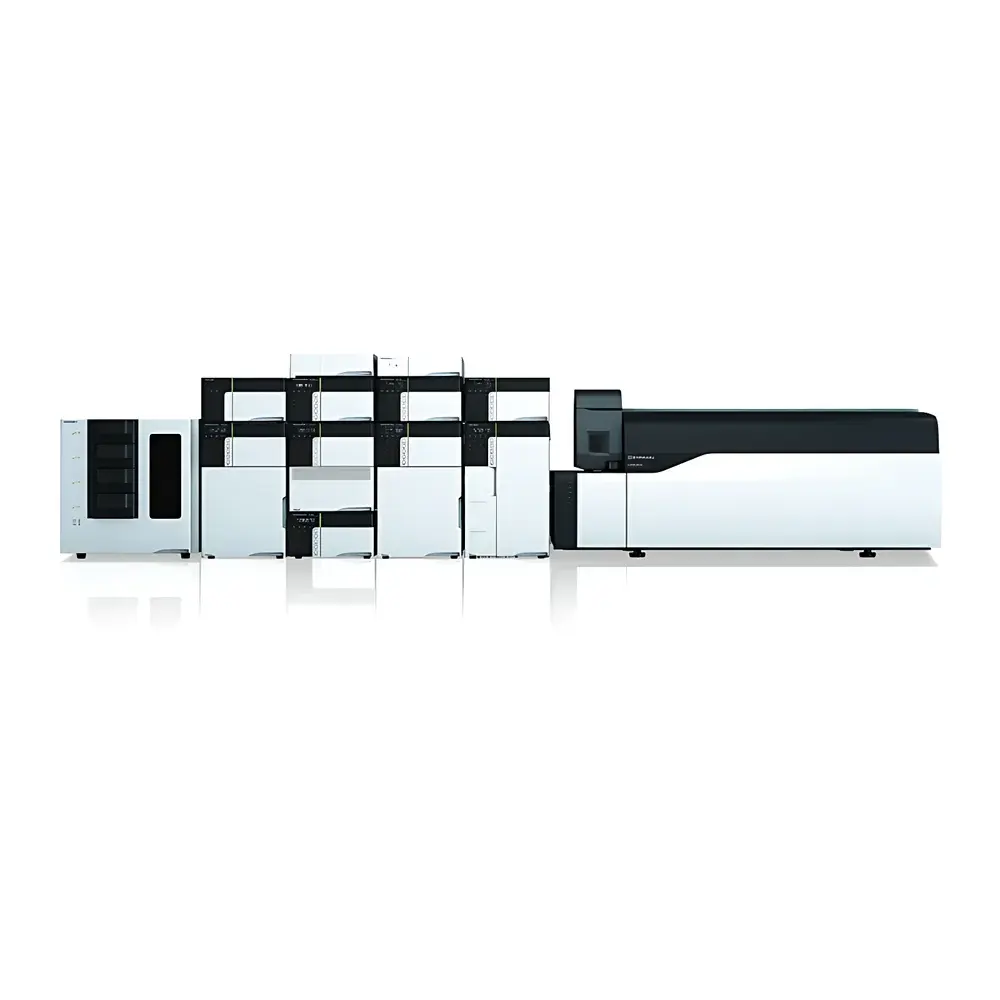
Shimadzu Nexera UC Online Supercritical Fluid Extraction–Chromatography–Mass Spectrometry Coupling System
| Brand | Shimadzu |
|---|---|
| Origin | Japan |
| Manufacturer Type | Original Equipment Manufacturer (OEM) |
| Product Origin | Imported |
| Model | Nexera UC |
| Instrument Type | Analytical |
| Detector Types | UV, Photodiode Array (PDA), Mass Spectrometer (MS) |
| Maximum Operating Pressure | 66 MPa |
| Flow Rate Range | 0.0001–5.0000 mL/min |
Overview
The Shimadzu Nexera UC is an integrated online analytical platform that couples supercritical fluid extraction (SFE), supercritical fluid chromatography (SFC), and mass spectrometry (MS) into a single, fully automated workflow. Engineered for precision and reproducibility in complex matrix analysis, the system utilizes carbon dioxide (CO₂) as the primary supercritical mobile phase—offering tunable solvent strength, low viscosity, high diffusivity, and environmentally benign operation. Unlike conventional liquid chromatography–mass spectrometry (LC–MS) systems, the Nexera UC leverages the unique physicochemical properties of supercritical CO₂ to achieve rapid, selective extraction and separation of thermally labile, nonpolar to moderately polar analytes—including pesticides, lipids, chiral pharmaceuticals, and oxidative-sensitive biomarkers—without derivatization or extensive sample cleanup. Its modular architecture enables seamless transition from solid/semi-solid sample introduction through on-line SFE, column-based SFC separation, and real-time MS detection—all under controlled pressure and temperature conditions up to 66 MPa.
Key Features
- Fully automated end-to-end workflow: Integrated SFE–SFC–MS coupling eliminates manual transfer steps, minimizing analyte loss, contamination, and exposure to ambient oxygen or moisture.
- High-pressure robustness: Precision-engineered fluidic pathways and pump modules sustain stable operation at pressures up to 66 MPa—enabling optimization of CO₂ density and solvation power across diverse compound classes.
- Ultra-precise flow control: Dual-gradient-capable pumps deliver flow rates from 0.0001 to 5.0000 mL/min with <0.1% RSD, critical for method development in chiral separations and trace-level quantitation.
- 48-position autosampler with inert sample handling: Equipped with temperature- and atmosphere-controlled vial storage to preserve oxidation-prone analytes such as unsaturated fatty acids, catecholamines, and polyphenols.
- Multi-detector compatibility: Simultaneous or sequential UV, photodiode array (PDA), and mass spectrometric detection supports orthogonal identification, peak purity assessment, and structural elucidation per ICH Q2(R2) guidelines.
- Modular expandability: Designed to integrate with optional add-ons including back-pressure regulators with active thermal control, column ovens rated to 100 °C, and electrospray ionization (ESI) or atmospheric pressure chemical ionization (APCI) sources.
Sample Compatibility & Compliance
The Nexera UC accommodates solid, semi-solid, and viscous matrices—including food homogenates, plant tissues, biological fluids (after protein precipitation), and environmental soil extracts—without requiring off-line derivatization or solid-phase extraction (SPE). Its closed-loop SFE interface ensures quantitative transfer of volatile and semi-volatile compounds while preventing degradation of air-sensitive species. The system conforms to key regulatory frameworks governing analytical instrumentation: it supports audit-trail-enabled data acquisition compliant with FDA 21 CFR Part 11, facilitates GLP/GMP-aligned validation protocols per ISO/IEC 17025, and aligns with ASTM D7087 (standard practice for SFC method development) and USP <621> (chromatography). Method transfer documentation and IQ/OQ/PQ templates are provided to support laboratory accreditation and inspection readiness.
Software & Data Management
Controlled via Shimadzu’s LabSolutions LCMS software, the Nexera UC provides unified instrument control, real-time pressure/temperature monitoring, and synchronized data acquisition across all modules. The software includes embedded SFC method scouting tools, automated gradient optimization algorithms, and retention time prediction models based on CO₂ density modulation. All raw data files are stored in vendor-neutral .cdf format, compatible with third-party processing platforms including OpenMS and Skyline. Full electronic records—including sequence logs, calibration reports, detector response curves, and system suitability test results—are timestamped, digitally signed, and archived with role-based access control. Audit trails record every user action, parameter change, and data export event—meeting ALCOA+ principles for data integrity.
Applications
- Routine pesticide residue screening in fruits, vegetables, and cereals—reducing sample preparation time from 35 minutes to under 5 minutes without compromising recovery or LOD.
- Chiral separation and quantification of enantiomeric impurities in pharmaceutical intermediates per ICH Q5A and Q6A requirements.
- Comprehensive lipidomics profiling in plasma and tissue samples, where oxidative stability during extraction preserves double-bond geometry and sn-position specificity.
- Environmental analysis of persistent organic pollutants (POPs) in sediment and sludge, leveraging SFE selectivity for nonpolar contaminants and SFC resolution for structurally similar congeners.
- Metabolite identification in disease biomarker discovery workflows, particularly for redox-labile metabolites such as glutathione disulfide, ascorbic acid derivatives, and nitro-fatty acids.
FAQ
Can the Nexera UC be operated without mass spectrometry?
Yes—the system functions as a standalone SFE–SFC–UV/PDA platform; MS detection is optional and configurable based on application needs.
Is method transfer from conventional HPLC possible?
Method translation tools in LabSolutions LCMS assist in estimating equivalent SFC conditions using mobile phase strength parameters (ε0) and retention modeling; empirical optimization is recommended for chiral or complex matrices.
What maintenance intervals are recommended for the high-pressure fluidic system?
Pump seals and check valves require inspection every 500 operational hours; CO₂ filtration cartridges must be replaced after 2000 standard liters of gas consumption, per Shimadzu Technical Bulletin LCMS-TB-2023-04.
Does the system support GPC or SEC mode for polymer analysis?
No—the Nexera UC is optimized for supercritical fluid-based separations; size-exclusion applications require dedicated LC systems with appropriate columns and detectors.
How is system suitability verified for regulated environments?
Built-in system suitability tests include retention time repeatability (RSD ≤ 0.5%), peak area precision (RSD ≤ 2.0%), resolution between critical pairs, and back-pressure stability monitoring—all logged automatically and exportable for regulatory submission.





