
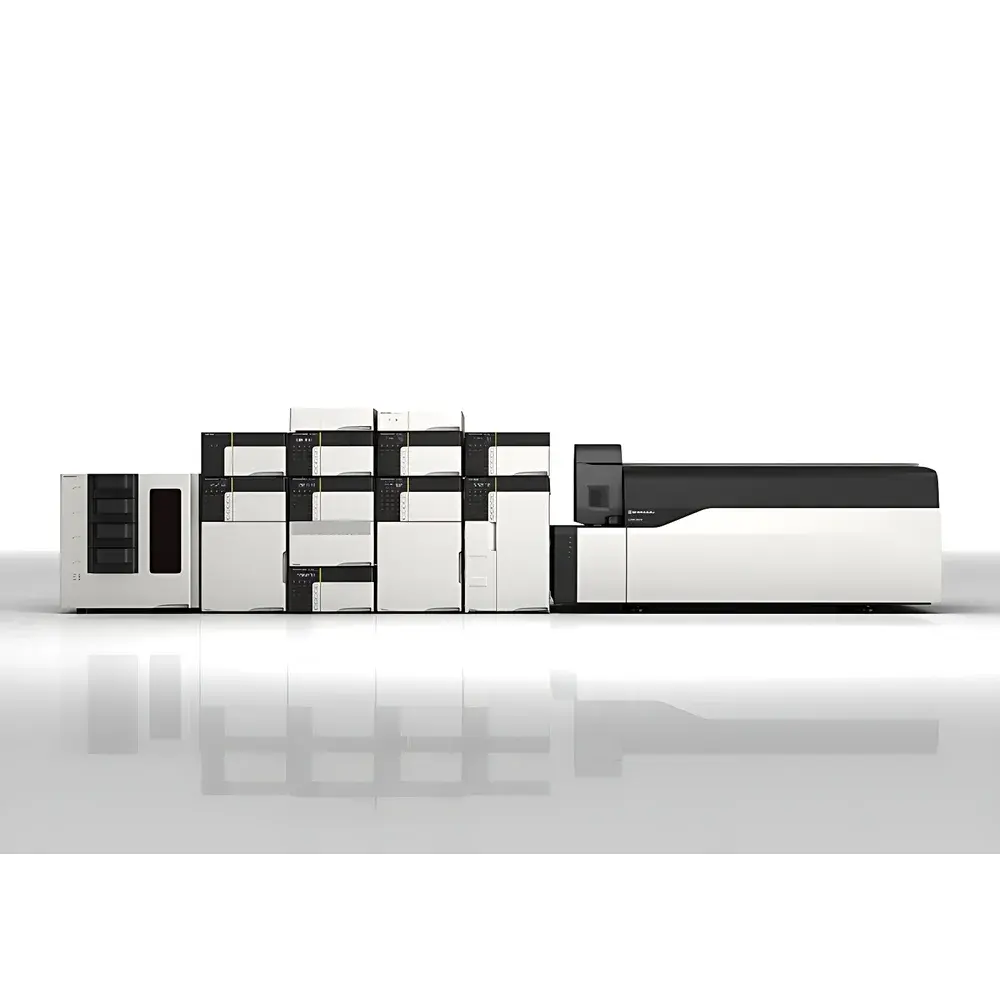
Shimadzu Nexera UC Supercritical Fluid Extraction and Chromatography System
| Brand | Shimadzu |
|---|---|
| Origin | Japan |
| Manufacturer Type | Original Equipment Manufacturer (OEM) |
| Import Status | Imported |
| Model | Nexera UC |
| Instrument Type | Analytical |
| Detector Options | UV, Photodiode Array (PDA), Mass Spectrometer (MS) |
| Maximum Operating Pressure | 66 MPa |
| Flow Rate Range | 0.0001–5.0000 mL/min |
Overview
The Shimadzu Nexera UC Supercritical Fluid Extraction and Chromatography System is an integrated analytical platform engineered for high-efficiency sample preparation and separation of thermally labile, polar, and non-polar compounds. It combines supercritical fluid extraction (SFE) and supercritical fluid chromatography (SFC) in a single, fully automated workflow—leveraging carbon dioxide (CO₂) as the primary mobile phase above its critical point (31.1 °C, 7.38 MPa). This enables rapid mass transfer, low viscosity, and tunable solvent strength via pressure and co-solvent modulation—principles rooted in the thermodynamic behavior of supercritical fluids. Unlike conventional liquid chromatography (LC) or gas chromatography (GC), SFC provides orthogonal selectivity, especially for chiral, semi-volatile, and high-molecular-weight analytes that degrade under thermal stress or exhibit poor solubility in organic solvents. The Nexera UC system is designed for laboratories requiring robust, reproducible, and GxP-aligned workflows in pesticide residue analysis, natural product profiling, pharmaceutical impurity testing, and environmental screening.
Key Features
- Fully automated online SFE–SFC–detection coupling, eliminating manual transfer and minimizing analyte exposure to light, oxygen, and ambient temperature
- High-pressure fluid handling architecture rated to 66 MPa, supporting stable supercritical CO₂ delivery across wide density gradients
- Precision binary gradient pumping with flow accuracy ±0.1% RSD and programmable flow rates from 0.0001 to 5.0000 mL/min—enabling method scalability from analytical to preparative conditions
- Modular detector compatibility: UV, photodiode array (PDA), and mass spectrometry (MS) interfaces compliant with Shimadzu LCMS-8040/8050/8060 platforms
- Integrated back-pressure regulation with active pressure control (±0.05 MPa), ensuring retention time stability and method transferability
- Chillable column oven (5–85 °C) and optional light-shielded autosampler compartment to preserve photo-sensitive and oxidation-prone analytes
Sample Compatibility & Compliance
The Nexera UC accommodates solid, semi-solid, and viscous matrices—including soil, plant tissue, food homogenates, and formulated agrochemicals—without derivatization or extensive cleanup. Its SFE capability allows selective extraction of target analytes under inert, low-temperature conditions, significantly reducing degradation of unstable compounds such as organophosphates, carbamates, and certain mycotoxins. Method development aligns with internationally recognized guidelines: EPA Method 3545A (SFE), ISO 17025 requirements for method validation, and ICH Q2(R2) for analytical procedure verification. Data integrity complies with FDA 21 CFR Part 11 when operated with Shimadzu LabSolutions software configured for audit trail, electronic signatures, and user access control—supporting GLP and GMP laboratory environments.
Software & Data Management
LabSolutions UC software provides unified control of extraction parameters (pressure, temperature, dynamic/static time), chromatographic gradients (CO₂ %, modifier %, flow ramping), and detector acquisition. Real-time pressure–temperature–flow synchronization ensures thermodynamic consistency during method execution. Peak integration, spectral deconvolution (for PDA), and MS library matching are performed within the same interface. All raw data, method files, and audit logs are stored in a secure, timestamped database with version history. Export formats include .cdf, .mzML, and .csv for third-party processing (e.g., Compound Discoverer, Simca-P). Software validation documentation (IQ/OQ/PQ protocols) is available upon request for regulated users.
Applications
- Pesticide multiresidue analysis: Simultaneous quantification of >100 compounds spanning log Pow −0.5 to 6.5—achieving sub-ng/g sensitivity in fruits, vegetables, and cereals
- Chiral separation of pharmaceutical intermediates without derivatization, leveraging SFC’s inherent enantioselectivity on polysaccharide-based columns
- Natural product fractionation: Rapid isolation and profiling of terpenoids, flavonoids, and alkaloids directly from crude extracts
- Environmental monitoring: Analysis of PAHs, PCBs, and brominated flame retardants in sediment and biota with reduced solvent consumption vs. Soxhlet or ASE
- Food safety: Screening of veterinary drug residues (e.g., tetracyclines, sulfonamides) in muscle and milk matrices using online SFE-SFC-MS/MS
FAQ
How does Nexera UC reduce analysis time compared to QuEChERS-LC/MS?
QuEChERS involves multiple manual steps—including extraction, dispersive SPE cleanup, and evaporation—requiring ~35 minutes per sample. Nexera UC performs online SFE followed by SFC separation in <5 minutes total, with no analyst intervention after sample loading.
Can Nexera UC analyze both polar and non-polar compounds in one run?
Yes—by adjusting co-solvent composition (e.g., methanol, ethanol, isopropanol) and pressure, the solvent strength of supercritical CO₂ is continuously tuned, enabling elution of analytes across a broad polarity range without method reconfiguration.
Is method transfer from HPLC to SFC feasible on Nexera UC?
Method scouting tools in LabSolutions UC support retention prediction based on HPLC log k values; column chemistries (e.g., silica, diol, amino) and mobile phase modifiers are optimized empirically using built-in gradient scouting sequences.
What maintenance is required for high-pressure SFE/SFC operation?
Routine checks include CO₂ cylinder moisture content (<10 ppm), filter replacement every 500 hours, and periodic calibration of pressure transducers per ISO/IEC 17025 traceable standards.
Related Products







