
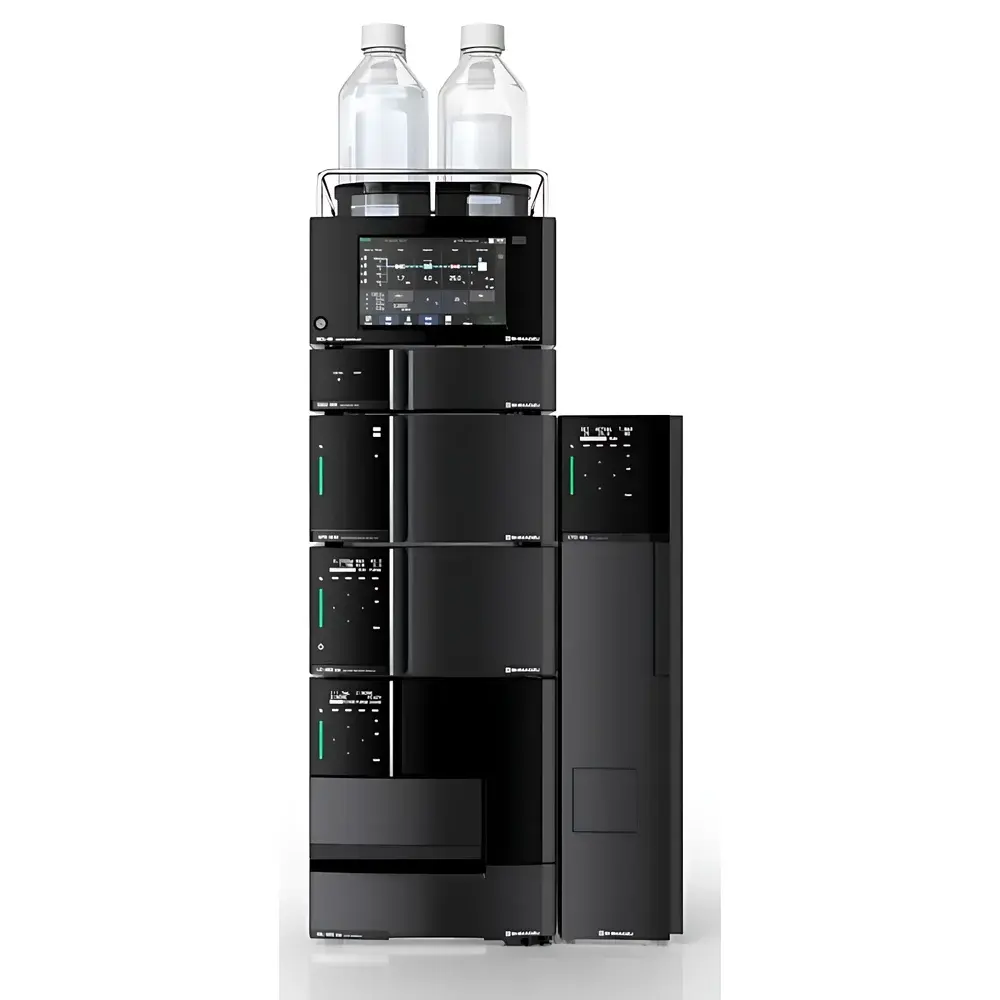
Shimadzu Nexera XS inert Bio-Inert Ultra-High Performance Liquid Chromatograph
| Brand | Shimadzu |
|---|---|
| Origin | Japan |
| Manufacturer Type | Original Equipment Manufacturer (OEM) |
| Origin Category | Imported |
| Model | Nexera XS inert |
| Instrument Type | Ultra-High Performance Liquid Chromatograph (UHPLC) |
| Application Scope | General-Purpose Bioanalytical LC |
| Flow Rate Range | 0.0001–10.0000 mL/min |
| Maximum Operating Pressure | 105 MPa |
| Flow Precision | ≤0.06% RSD or ≤0.02 min SD (whichever is greater) |
| Injection Volume Range | 0.1–50 µL |
| Autosampler Capacity | 252 positions (1 mL vials) / 162 positions (1.5–2 mL vials) / 84 positions (4 mL vials) |
| Column Oven Temperature Range | Ambient −10 °C to 100 °C (85 °C for high-stability operation) |
| UV-Vis Wavelength Range | SPD-40 detector: 190–700 nm |
| SPD-40V detector | 190–1000 nm |
Overview
The Shimadzu Nexera XS inert is an ultra-high performance liquid chromatograph engineered specifically for the robust, reproducible, and quantitative analysis of biologically active and surface-sensitive analytes—including proteins, monoclonal antibodies (mAbs), peptides, oligonucleotides, and post-translationally modified biomolecules. Unlike conventional UHPLC systems with stainless-steel fluidic pathways, the Nexera XS inert employs a fully bio-inert flow path constructed from chemically resistant materials such as titanium, ceramic-coated components, and fluoropolymer-lined tubing—eliminating metal–analyte interactions that cause adsorption, peak tailing, recovery loss, and nonlinear calibration responses. Its 105 MPa pressure capability supports sub-2 µm particle columns and enables high-resolution separations under low-flow, high-efficiency conditions. The system operates on the fundamental principle of high-pressure liquid chromatography (HPLC), where analyte partitioning between a mobile phase and stationary phase is governed by physicochemical properties—including hydrophobicity, charge, size, and hydrogen bonding—while maintaining thermodynamic stability across extreme pH (1–13) and high-salt mobile phases commonly used in biopharmaceutical characterization.
Key Features
- Fully bio-inert fluidic path: No wetted stainless-steel surfaces; titanium pump heads, ceramic-coated check valves, PEEK-lined capillaries, and fluoropolymer-sealed injection valves ensure minimal nonspecific binding.
- Ultra-low dispersion autosampler: Precise 0.1–50 µL injection volume control with <0.06% RSD flow precision and <0.02 min SD retention time stability—critical for trace-level biomolecule quantification.
- High-pressure gradient capability: Dual-gradient pumps deliver stable binary or quaternary gradients up to 105 MPa, supporting shallow gradients for complex peptide maps and steep gradients for rapid screening.
- Thermally stabilized column compartment: Temperature control from ambient −10 °C to 100 °C (85 °C continuous operation) ensures retention time reproducibility and method transfer compatibility across labs.
- Expandable detection architecture: Compatible with Shimadzu SPD-40 (190–700 nm) and SPD-40V (190–1000 nm) UV-Vis detectors, as well as optional fluorescence, CAD, and MS interfaces for orthogonal detection strategies.
- No pre-conditioning required: Eliminates system passivation protocols—enabling immediate start-up, reduced method development time, and consistent peak shape across multi-day sequences without carryover or drift.
Sample Compatibility & Compliance
The Nexera XS inert is validated for use with highly sensitive biological samples prone to surface adsorption, including acidic/alkaline mobile phases (e.g., 0.1% TFA, 20 mM ammonium bicarbonate, 50 mM sodium phosphate), high-concentration salt buffers (up to 500 mM), and volatile additives (e.g., triethylamine, heptafluorobutyric acid). It complies with ISO/IEC 17025:2017 requirements for analytical instrument qualification and supports IQ/OQ/PQ documentation per GMP Annex 11 and FDA 21 CFR Part 11 when integrated with LabSolutions software. All hardware components meet USP extractables and leachables criteria for pharmaceutical applications. System suitability testing (SST) parameters—including tailing factor, resolution, and %RSD of peak area—are maintained within ICH Q2(R2) acceptance criteria across >1,000 injections without recalibration.
Software & Data Management
Controlled via Shimadzu LabSolutions LC/GC software (v5.9+), the Nexera XS inert supports audit-trail-enabled data acquisition, electronic signatures, and role-based user access control compliant with 21 CFR Part 11. Integrated i-PeakFinder™ automates peak detection, integration, and baseline correction using adaptive algorithms trained on real-world biomolecule chromatograms. LabSolutions Insight™ provides LC/MS data alignment, deconvolution, and relative quantitation workflows for intact mass analysis and peptide mapping. Optional pHM-40 real-time mobile-phase pH monitoring ensures gradient fidelity during method transfer and long-term stability assessment. Raw data files are stored in vendor-neutral .lcd format and exportable to CDF, mzML, or CSV for third-party processing (e.g., Skyline, MaxQuant).
Applications
- Quantitative analysis of therapeutic proteins and biosimilars (e.g., SEC-MALS, cation-exchange, HIC)
- Oligonucleotide purity profiling and impurity identification (ASO, siRNA, mRNA fragments)
- Peptide mapping and post-translational modification (PTM) analysis under denaturing/reducing conditions
- Stability-indicating assays for forced degradation studies (acid/base/oxidative stress)
- High-throughput QC of recombinant enzymes and viral vector preparations
- Method development for regulatory submissions (ICH Q5, Q5A, Q6B)
FAQ
Does the Nexera XS inert require system passivation before first use?
No. Its fully inert fluidic architecture eliminates the need for preconditioning runs or “column conditioning” with target analytes—reducing method development time and conserving precious sample.
Can it be interfaced with mass spectrometry?
Yes. The system features standard ESI and APCI source compatibility via low-dead-volume connections and supports real-time LC/MS synchronization through LabSolutions Insight.
Is the autosampler compatible with 96-well and 384-well microplates?
While optimized for vial-based formats (1 mL, 1.5–2 mL, 4 mL), optional plate-handling modules enable direct microplate injection with programmable needle wash and dwell-time optimization.
How does it handle high-salt mobile phases without corrosion?
Titanium pump bodies, ceramic-coated sapphire pistons, and fluoropolymer seals resist pitting and crevice corrosion—even at 500 mM NaCl or 1 M ammonium acetate, extending service life beyond 20,000 injections.
What validation documentation is provided?
Shimadzu supplies comprehensive IQ/OQ documentation kits, including test protocols, acceptance criteria, and raw data templates aligned with ASTM E2500-13 and EU GMP Annex 15 guidelines.




