
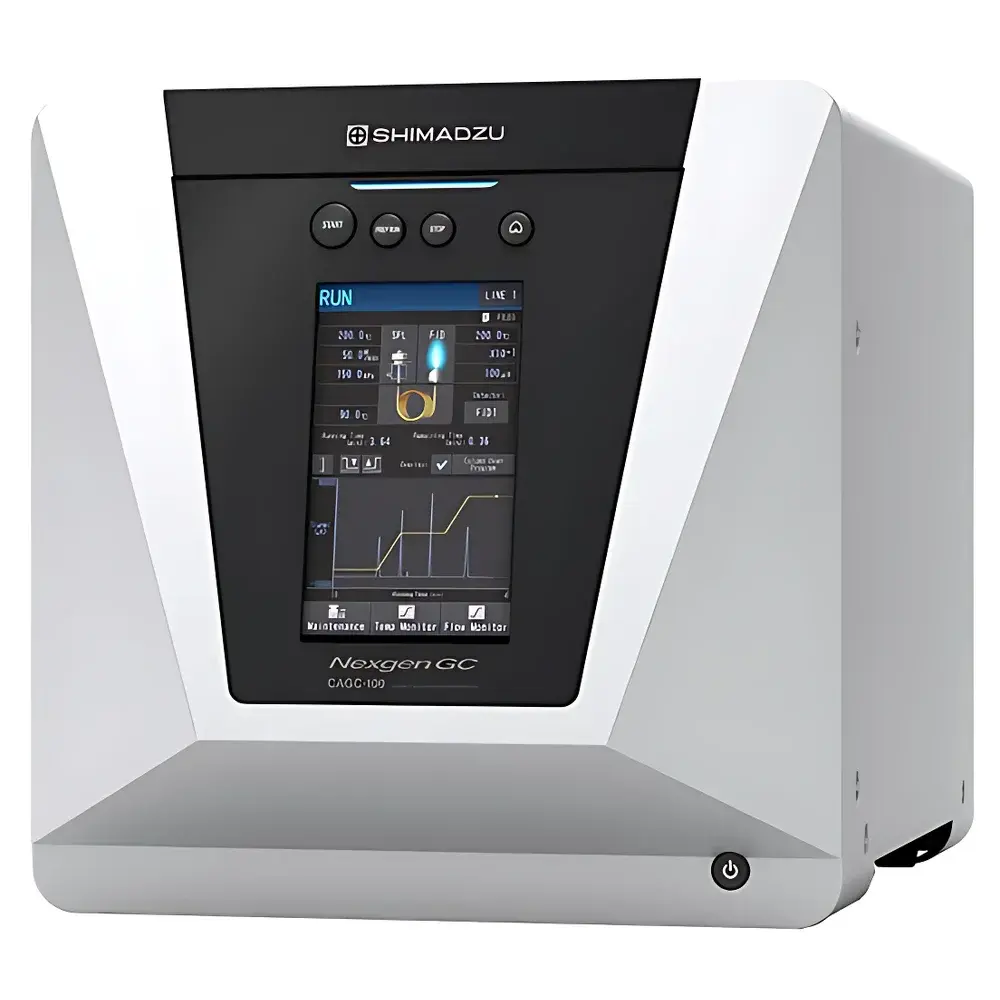
Shimadzu NexgenGC Portable Multidimensional Gas Chromatograph CAGC-2030
| Brand | Shimadzu |
|---|---|
| Origin | Japan |
| Manufacturer Type | Original Equipment Manufacturer (OEM) |
| Import Status | Imported |
| Model | CAGC-2030 |
| Price Range | USD 42,000 – 70,000 |
Overview
The Shimadzu NexgenGC CAGC-2030 is a next-generation portable multidimensional gas chromatograph engineered for high-resolution separation of complex volatile and semi-volatile organic compounds in field-deployable and resource-constrained laboratory environments. Unlike conventional single-dimension GC systems, the NexgenGC implements Shimadzu’s proprietary Multidimensional Gas Chromatography (MDGC) architecture—specifically, heart-cutting (MDGC-HC) and comprehensive two-dimensional GC (GC×GC)–capable configurations—enabled by dual independently controlled column ovens and orthogonal stationary phase combinations. Its core innovation lies in the Disk-Type Stainless Steel Capillary Column: a monolithic, photolithographically micro-machined stainless steel substrate (thickness <1 mm) coated with standard polymeric or porous-layer stationary phases identical to those used in fused-silica capillaries. This eliminates fragile glass tubing, enhances thermal stability, and enables rapid oven ramping (up to 120 °C/min). The integrated ultra-compact disk-shaped column oven reduces total instrument footprint by >65% versus legacy benchtop GC platforms, while maintaining ISO/IEC 17025-compliant temperature uniformity (±0.1 °C) across the column bed.
Key Features
- Disk-type stainless steel capillary column: Micro-machined from 316L stainless steel; channel depth 150 µm, width 250 µm; coated with DB-5ms, DB-WAX, or custom-phase polymers via dynamic vapor deposition
- Dual independent column ovens: Each oven supports precise temperature programming (range: 30–300 °C; ramp rate: 0.1–120 °C/min; stability: ±0.05 °C at setpoint)
- Integrated MDGC interface: Electropneumatically actuated dual-valve system for precise heart-cutting (0.1–5 s cut windows) with <100 ms switching reproducibility
- Low-carrier-gas consumption design: Optimized flow paths and miniaturized columns reduce helium or hydrogen consumption to ≤8 mL/min (vs. 25–40 mL/min in conventional GC)
- Modular detector compatibility: Supports FID, TCD, PID, and optional electron-capture (ECD) or nitrogen-phosphorus (NPD) detectors with plug-and-play electrical and pneumatic interfaces
- Ruggedized portable chassis: IP54-rated enclosure; shock-mounted optical bench; 12 V DC / 24 V DC / AC 100–240 V input; operational range: 5–40 °C ambient
Sample Compatibility & Compliance
The NexgenGC CAGC-2030 is validated for analysis of environmental VOCs (e.g., EPA Method TO-17, ASTM D5502), petrochemical hydrocarbons (ASTM D3606, D5769), food flavor volatiles (ISO 11021), and pharmaceutical residual solvents (ICH Q3C, USP <467>). Its MDGC configuration meets ASTM E2887 requirements for forensic ignitable liquid residue (ILR) profiling and complies with ISO/IEC 17025 method validation criteria for selectivity, linearity (r² ≥ 0.999), LOD/LOQ (sub-ppb for FID), and intermediate precision (RSD ≤ 3.5% over 3 days). All firmware and control logic are designed per IEC 62443-3-3 for industrial cybersecurity; data integrity conforms to FDA 21 CFR Part 11 requirements—including electronic signatures, audit trails, and role-based access control—when operated with Shimadzu LabSolutions GC software.
Software & Data Management
Control and data acquisition are managed through Shimadzu LabSolutions GC v5.92 or later, a validated Windows-based platform supporting method development, sequence scheduling, real-time chromatogram monitoring, and automated peak integration using iterative deconvolution algorithms. The software includes built-in MDGC method templates (e.g., “Aromatic Cut from Aliphatic Matrix”, “Chiral Isomer Separation”), retention time locking (RTL) for cross-instrument transferability, and spectral library search (NIST MS Search 2.7g compatible). Raw data files (.gcw) are stored in vendor-neutral HDF5 format with embedded metadata (instrument parameters, calibration history, user ID, timestamp). Audit trail logs record all method edits, injection events, and detector parameter changes with immutable timestamps and operator authentication. Export options include CSV, PDF reports (GLP-compliant), and direct LIMS integration via ASTM E1394 or HL7 protocols.
Applications
- On-site environmental monitoring: Real-time detection of BTEX, chlorinated solvents, and PAHs in soil headspace or ambient air using sorbent tube thermal desorption coupling
- Process analytical technology (PAT): In-line monitoring of reactor effluents in fine chemical synthesis, including reaction intermediate quantification and impurity profiling
- Forensic toxicology: Rapid screening of volatile drugs of abuse (e.g., ethanol, acetone, isopropanol) in biological fluids with MDGC-enhanced specificity
- Food authenticity verification: Discrimination of adulterated olive oil or honey via volatile fingerprinting with GC×GC–FID resolution enhancement
- Pharmaceutical QC: Residual solvent testing in active pharmaceutical ingredients (APIs) per ICH Q3C Class 1–3 limits, with automated pass/fail reporting against configurable acceptance criteria
FAQ
Is the Disk-Type Column compatible with standard GC consumables and maintenance procedures?
Yes—the column is installed using industry-standard ferrule-based compression fittings; column conditioning, bake-out, and trimming follow identical protocols as fused-silica capillaries. Shimadzu provides dedicated cleaning kits and lifetime column performance validation reports.
Can the NexgenGC be integrated into an existing LIMS or ELN infrastructure?
Yes—via ODBC, RESTful API, or ASTM E1394-compliant middleware. Shimadzu offers preconfigured LIMS connectors for Thermo Fisher SampleManager, LabWare LIMS, and Agilent OpenLab ECM.
What carrier gases are supported, and what are the typical flow optimization guidelines?
Helium, hydrogen, and nitrogen are fully supported. Hydrogen is recommended for speed and efficiency; optimal linear velocity is 35–45 cm/s for 0.25 mm ID equivalent channels. Built-in flow calculators auto-adjust pressure based on column dimensions and temperature.
Does the system support unattended operation for extended sequences?
Yes—integrated autosampler (100-position tray) with programmable vial chilling (4–15 °C), syringe wash stations, and leak-tight septum piercing ensures >72 h continuous operation with remote status monitoring via Ethernet or optional 4G LTE module.
How is calibration traceability maintained across field deployments?
Each unit ships with NIST-traceable calibration certificates for oven temperature, detector response, and flow sensors. Field recalibration is performed using certified gas standards (e.g., Scott-Marrin PVT-100 series) and validated against internal reference peaks (e.g., n-alkane series).
Related Products





