
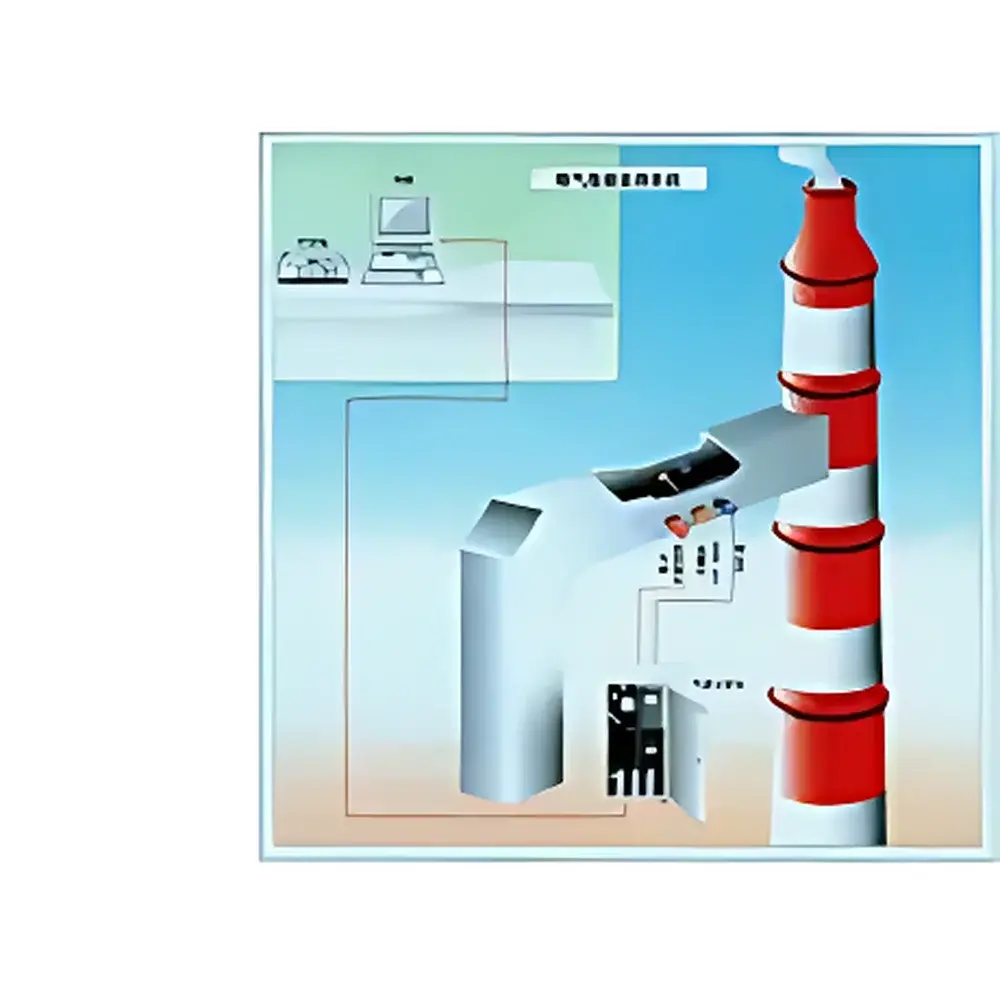
Shimadzu NSA-3080A-Based Continuous Emission Monitoring System (CEMS)
| Brand | Shimadzu |
|---|---|
| Origin | Jiangsu, China |
| Manufacturer Type | Original Equipment Manufacturer (OEM) |
| Product Category | Domestic |
| Model | CEMS |
| Instrument Type | Continuous Emission Monitoring System (CEMS) |
| Core Analyzers | NSA-3080A Online Gas Analyzer, RBV-DUST/II In-Situ Dust Monitor, VPT511BF-A Volumetric Flow Meter |
| Data Acquisition | Integrated DAQ & Reporting Platform |
| Regulatory Alignment | Designed for compliance with HJ 75–2017, HJ 76–2017, EPA Method 1–4, 6C, 7E, 10, and ISO 12141, ISO 15712 |
Overview
The Shimadzu NSA-3080A-Based Continuous Emission Monitoring System (CEMS) is an integrated, stack-mounted environmental instrumentation platform engineered for real-time, regulatory-grade quantification of gaseous and particulate emissions from stationary combustion sources. Operating on the principles of non-dispersive infrared (NDIR) spectroscopy for SO₂ and NOₓ, laser backscatter photometry for particulate matter (PM), and thermal mass flow compensation with integrated temperature, pressure, and moisture sensing for volumetric flow correction, this system delivers traceable, continuous measurements aligned with international stack emission monitoring protocols. Its architecture follows a direct-extraction (for gas analyzers) and in-situ (for dust and flow) hybrid configuration—minimizing sample transport delay, condensation artifacts, and calibration drift. The system is deployed at flue gas ducts or stacks across thermal power plants, municipal solid waste incinerators, petrochemical crackers, sintering facilities, and cement kilns where long-term stability, multi-parameter synchronization, and audit-ready data integrity are mandatory.
Key Features
- Multi-analyte detection: Simultaneous, independent measurement of SO₂, NOₓ (as NO and NO₂), O₂, particulate mass concentration (mg/m³ @ STP), and volumetric flue gas flow rate (Nm³/h)
- NSA-3080A analyzer: Dual-beam NDIR optical path with automatic zero/span verification, heated sample cell (180 °C), and built-in interference compensation for CO₂ and H₂O cross-sensitivity
- RBV-DUST/II particulate monitor: In-situ laser backscatter sensor with auto-cleaning optics, temperature-compensated signal processing, and PM₁₀/PM₂.₅-referenced calibration traceability
- VPT511BF-A flow meter: Differential pressure-based volumetric flow transducer with integrated Pt100 temperature sensor, piezoresistive pressure sensor, and chilled-mirror dew point compensation module
- Real-time environmental compensation: Concurrent acquisition of flue gas temperature (−10 to 200 °C), static/dynamic pressure (±5 kPa), and moisture content (0–30 vol% H₂O) for stoichiometric and dry/wet basis conversion
- Embedded DAQ unit: Industrial-grade embedded controller with dual Ethernet ports, redundant SD card logging, and hardware watchdog timer for unattended operation (>12 months MTBF)
Sample Compatibility & Compliance
The system accommodates flue gas matrices with operating temperatures up to 250 °C, dust loadings ≤10 g/Nm³, and moisture content ≤40 vol%. It meets structural and performance requirements defined in Chinese Ministry of Ecology and Environment standards HJ 75–2017 (technical specification for CEMS installation and acceptance) and HJ 76–2017 (performance verification). Internationally, its measurement methodology aligns with U.S. EPA Methods 6C (SO₂), 7E (NOₓ), 10 (O₂), and ASTM D6522 (NOₓ by chemiluminescence), while particulate and flow subsystems conform to ISO 12141 (dust monitoring) and ISO 15712 (flow velocity profiling). All firmware and data handling modules support audit trails, electronic signatures, and time-stamped event logs compliant with GLP and GMP documentation frameworks.
Software & Data Management
The proprietary CEMS Control Suite provides browser-based SCADA interface accessible via secure HTTPS with role-based access control (RBAC). Data acquisition occurs at 1-second intervals; 1-minute averaged values are automatically calculated and validated per QA/QC rules (e.g., ±2% span drift tolerance, <5% relative accuracy test audit [RATA] error). Reports—including hourly averages, daily summaries, monthly compliance dashboards, and annual trend exports—are generated in PDF and CSV formats with embedded digital signatures. Raw data archives are retained for ≥18 months on local storage and optionally synchronized to cloud-hosted platforms supporting IEC 62443-3-3 cybersecurity certification. The system supports Modbus TCP, OPC UA, and MQTT protocols for integration into plant-wide DCS or EMS infrastructure.
Applications
- Regulatory compliance monitoring for coal-, biomass-, and gas-fired utility boilers under national emission permit programs
- Continuous opacity and mass loading verification at municipal waste incinerator exhaust stacks per EU Directive 2000/76/EC
- Emissions accounting for carbon trading schemes (e.g., China National Carbon Market) requiring verified SO₂ and NOₓ mass flow rates
- Process optimization feedback in iron sintering plants, where O₂ and CO co-monitoring informs combustion efficiency tuning
- Stack testing support during performance qualification (PQ) and periodic technical verification (TV) audits conducted by third-party certifiers
FAQ
What gas species does the NSA-3080A analyzer measure?
SO₂, NO, NO₂, and O₂—using dedicated NDIR channels with optical filters matched to their fundamental absorption bands.
Is the system certified for use in hazardous areas (Zone 1/21)?
The NSA-3080A and VPT511BF-A are available with ATEX/IECEx-certified variants (II 2G Ex d IIB T4 Gb / II 2D Ex tb IIIC T135°C Db); RBV-DUST/II requires field-mounted explosion-proof enclosures for Zone 21 deployment.
How frequently does the system require calibration verification?
Per HJ 75–2017, zero/span checks must be performed every 24 hours; full multi-point calibration verification is mandated quarterly, supported by onboard standard gas manifold and automated sequence control.
Can historical data be exported for third-party audit submission?
Yes—raw second-level data, 1-minute validated averages, calibration logs, maintenance records, and system status events are exportable in timestamped, digitally signed packages meeting EPA 40 CFR Part 60 and ISO/IEC 17025 reporting requirements.
Does the system support remote diagnostics and firmware updates?
Remote SSH and VNC access is enabled via TLS-secured tunnel; firmware updates follow a dual-bank flash architecture with rollback capability and SHA-256 signature validation prior to installation.
Related Products







