
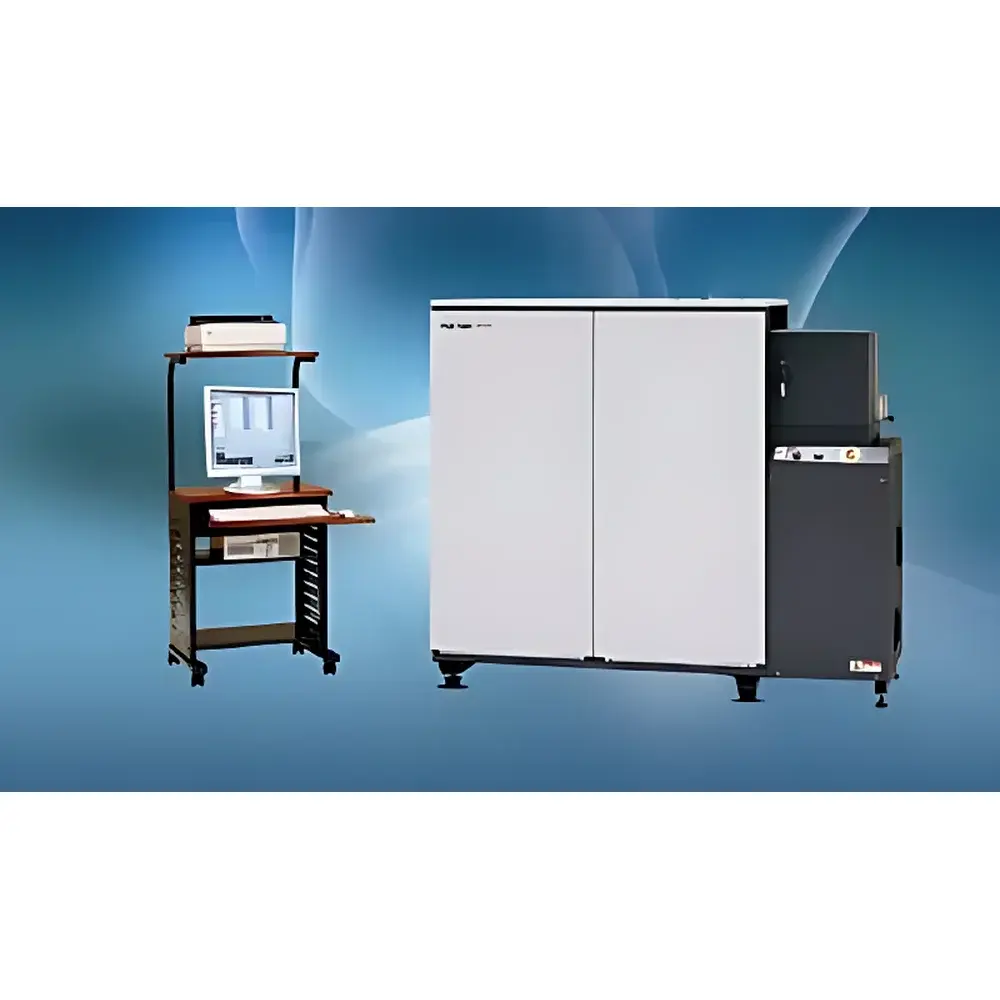
Shimadzu PDA-5500 S Vacuum Direct-Reading Optical Emission Spectrometer
| Brand | Shimadzu |
|---|---|
| Origin | Japan |
| Manufacturer Type | Original Equipment Manufacturer (OEM) |
| Instrument Type | Floor-Standing |
| Excitation Source | Spark |
| Detector Type | Photomultiplier Tube (PMT) |
| Focal Length | 600 mm |
| Groove Density | 2400 lines/mm |
| Wavelength Range | 120–800 nm |
| Maximum Channel Count | 64 |
Overview
The Shimadzu PDA-5500 S is a high-performance floor-standing vacuum direct-reading optical emission spectrometer (OES) engineered for precise, trace-level elemental analysis of metallic materials—particularly ferrous and non-ferrous alloys used in steelmaking, foundry, and precision machining industries. It operates on the principle of spark-induced atomic emission spectroscopy: a controlled high-voltage spark excites atoms at the sample surface, causing them to emit characteristic ultraviolet–visible radiation. This emitted light is dispersed by a high-resolution holographic ion-etched diffraction grating and detected with an array of photomultiplier tubes (PMTs), enabling simultaneous multi-element quantification with high spectral resolution and signal-to-noise ratio. The instrument’s vacuum optical chamber eliminates atmospheric absorption—especially critical for accurate measurement of vacuum-UV elements such as carbon (C), phosphorus (P), sulfur (S), and boron (B)—without reliance on continuous argon purging or consumable gas filters.
Key Features
- Vacuum optical system maintained at ≤1.33 Pa within 10 minutes using Shimadzu’s proprietary oil-free rotary vacuum pump—eliminates oil backstreaming, minimizes hydrocarbon contamination, and reduces long-term maintenance intervals.
- Holographic ion-etched diffraction grating (2400 lines/mm, 600 mm focal length) delivers optimal balance between spectral resolution (≤0.008 nm at 200 nm) and radiant throughput—enabling reliable detection of interstitial and trace alloying elements.
- Digital spark source with programmable discharge modes: high-energy spark for bulk analysis, arc-spark hybrid mode for improved sensitivity on low-conductivity or coated samples, and time-resolved pulse distribution analysis (PDA) for matrix-matched background correction and enhanced precision.
- Modular PMT-based detector architecture supports up to 64 fixed analytical channels—each independently calibrated and optimized for specific emission lines per ASTM E415, ISO 11577, and JIS G 1253 standards.
- Robust mechanical design with temperature-stabilized optics and rigid cast-iron base ensures long-term wavelength stability (<±0.002 nm/8 h) and reproducibility (RSD <0.5% for certified reference materials).
Sample Compatibility & Compliance
The PDA-5500 S accommodates solid metal samples up to Ø40 mm × 30 mm height, including cast iron, stainless steels, aluminum alloys, copper-based alloys, and nickel superalloys. Sample preparation follows standardized grinding protocols per ISO 11084 and ASTM E1184. The system complies with electromagnetic compatibility (IEC 61326-1), electrical safety (IEC 61010-1), and environmental requirements (RoHS Directive 2011/65/EU). Its analytical workflow supports GLP/GMP environments through audit-trail-enabled software logging, user-access control, and calibration history tracking aligned with FDA 21 CFR Part 11 principles.
Software & Data Management
The instrument is operated via Shimadzu’s Windows-based PDA Analysis Station software—fully localized in English with intuitive graphical interface. Key capabilities include real-time status monitoring of vacuum pressure, spark energy, detector voltage, and lamp aging; automated diagnostic routines with actionable remediation guidance; context-sensitive online help; password-protected method editing and result reporting; and auto-calibration using certified reference materials (CRMs). Data export conforms to ASTM E1382-compliant formats (CSV, XML, PDF), and optional LIMS integration is supported via ODBC and HL7 interfaces.
Applications
The PDA-5500 S serves as a primary tool for incoming raw material inspection, melt-process control, heat-treatment verification, and final product certification across metallurgical supply chains. Typical use cases include quantitative determination of C, Si, Mn, P, S, Cr, Ni, Mo, Cu, Al, Ti, V, Nb, B, and N in low-alloy steels; rapid grade identification of stainless grades (e.g., 304 vs. 316); sulfur segregation mapping in large castings; and micro-alloying element verification in automotive crankshafts and turbine discs. Its performance meets routine QC requirements defined in ISO 4949, ASTM A751, and EN 10027.
FAQ
What vacuum level does the PDA-5500 S achieve, and how quickly?
The system reaches ≤1.33 Pa within 10 minutes using its dedicated oil-free rotary vacuum pump.
Can additional analytical channels be added after installation?
Yes—hardware expansion is supported on-site via PMT module retrofitting and firmware reconfiguration.
Is the instrument compliant with FDA 21 CFR Part 11 for regulated laboratories?
While not validated out-of-the-box as Part 11–compliant, the software architecture provides all technical prerequisites—including electronic signatures, audit trails, and role-based access—enabling customer-led validation under internal SOPs.
What are the minimum detectable limits for carbon and sulfur?
Typical MDLs are 3 ppm for C and 5 ppm for S in low-carbon steel matrices, dependent on sample homogeneity and CRM traceability.
Does the system require liquid nitrogen or external cooling for PMTs?
No—PMTs operate at ambient temperature with thermally stabilized housings; no cryogenic or chiller support is needed.






