
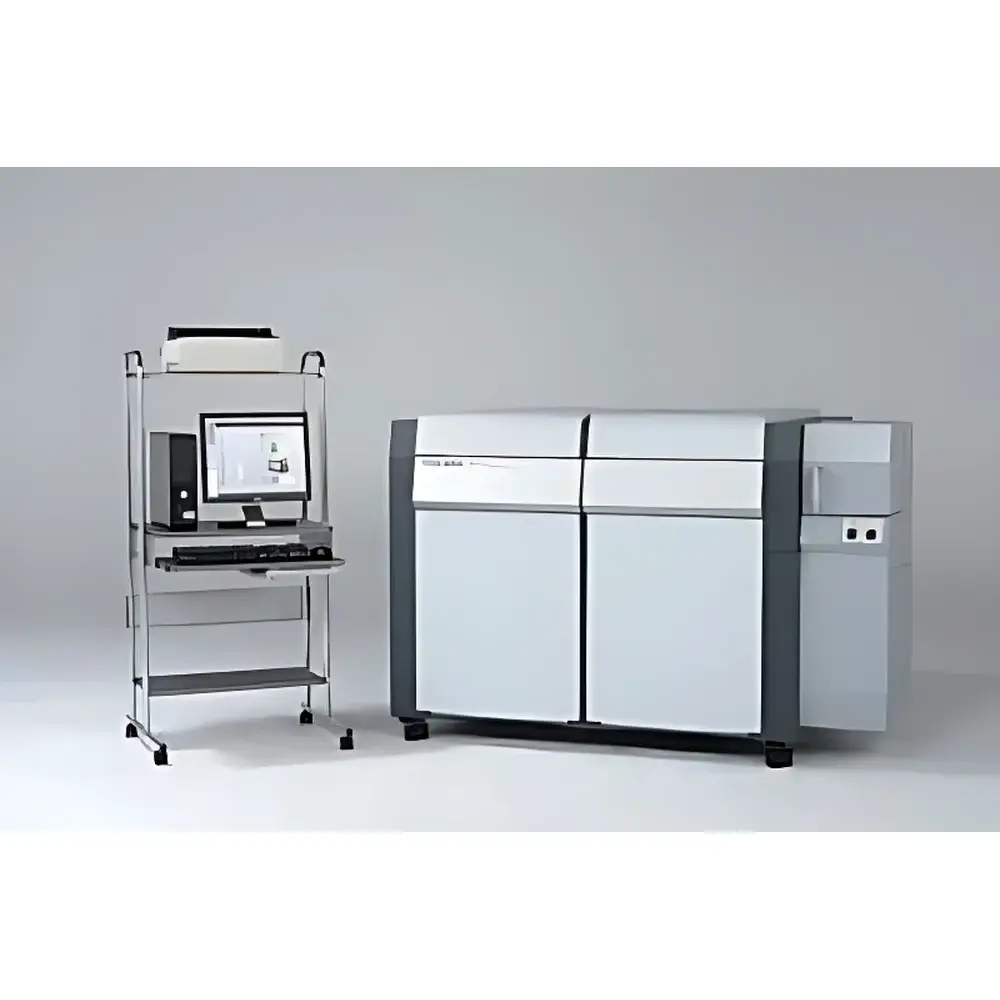
Shimadzu PDA-8000 Direct-Reading Optical Emission Spectrometer
| Brand | Shimadzu |
|---|---|
| Origin | Japan |
| Manufacturer Type | Original Equipment Manufacturer (OEM) |
| Import Status | Imported |
| Model | PDA-8000 |
| Configuration | Floor-standing |
| Excitation Source | Spark Discharge |
| Detector Type | Photomultiplier Tube (PMT) |
| Focal Length | 1000 mm |
| Wavelength Range | 120–800 nm |
| Maximum Channel Count | 64 |
Overview
The Shimadzu PDA-8000 is a high-performance floor-standing direct-reading optical emission spectrometer (OES) engineered for precise elemental analysis of metallic materials. Based on the principle of spark-induced atomic emission spectroscopy, the instrument excites solid metal samples using controlled high-voltage spark discharge, generating characteristic line spectra that are dispersed via a high-fidelity Czerny-Turner optical system and resolved by a 1000 mm focal length Paschen-Runge spectrometer. The resulting spectral lines are detected with high quantum efficiency using an array of photomultiplier tubes (PMTs), each dedicated to a specific analytical channel. Designed for laboratory environments requiring long-term operational stability and trace-level sensitivity—particularly in high-purity non-ferrous metals, low-alloy steels, and inclusion-related metallurgical research—the PDA-8000 integrates fundamental advances in plasma excitation control, spectral resolution enhancement, and real-time signal integrity monitoring.
Key Features
- High-Resolution 1-Meter Grating Spectrometer: Features a rigid, thermally stabilized Paschen-Runge mounting geometry with 1000 mm focal length, enabling superior peak separation and minimal inter-element spectral overlap—critical for accurate quantification of adjacent lines (e.g., Al I 396.15 nm and Fe I 396.27 nm).
- Multi-Order Spectral Analysis Capability: Supports second- and third-order diffraction for key ultraviolet elements including carbon (C I 165.69 nm), nitrogen (N I 174.27 nm), and phosphorus (P I 178.28 nm), improving effective resolution and detection limits without requiring vacuum purging.
- Real-Time Energy Monitoring (REM): Monitors instantaneous spark energy per pulse (adjustable from 0.02 J to 0.6 J in 0.02 J increments) and rejects spectra acquired during unstable discharges—such as those caused by surface contamination, poor electrode contact, or microstructural heterogeneity—ensuring only analytically valid pulses contribute to integration.
- Constant Current Spark (CRS) Mode: Implements regulated current maintenance at 10 A during the decay phase of spark discharge (up to 2 ms duration), significantly enhancing signal-to-noise ratio for trace elements (<10 ppm) in high-purity aluminum, copper, and titanium alloys.
- Dedicated PMT Detection Architecture: Up to 64 independent PMT channels with individually optimized high-voltage supplies and analog-to-digital conversion, supporting simultaneous multi-element analysis with sub-second integration times and high dynamic range (typically >10⁵).
Sample Compatibility & Compliance
The PDA-8000 accommodates standard metallic discs (Ø 32–40 mm, thickness ≥4 mm) and rods (Ø 10–20 mm) conforming to ISO 11577, ASTM E415, and JIS H 1301. Sample preparation follows standardized grinding and cleaning protocols to minimize oxide interference and ensure reproducible ablation. Instrument design complies with IEC 61000-6-3 (EMC) and IEC 61010-1 (safety). Data acquisition and reporting workflows support audit-ready documentation aligned with GLP and GMP requirements, including full electronic record retention, user access controls, and configurable audit trails per FDA 21 CFR Part 11 guidelines.
Software & Data Management
The PDA-8000 operates under Shimadzu’s proprietary PDA Control Suite—a Windows-based application offering bilingual (English/Japanese) interface, intuitive workflow navigation, and embedded diagnostics. Software modules include automated calibration verification, drift correction via internal reference lines, multi-point standardization with matrix-matched CRMs, and statistical process control (SPC) charting. All raw intensity values, integration parameters, spark history logs, and QC flag metadata are stored in a structured SQLite database with export capability to CSV, XML, or LIMS-compatible formats. Remote monitoring and preventive maintenance alerts are supported via Ethernet-connected status polling.
Applications
- Quantitative analysis of major, minor, and trace elements (e.g., C, S, P, N, B, Sn, Pb, As) in stainless steels, tool steels, and superalloys.
- Ultra-trace determination of acid-soluble aluminum (Als) and inclusion-forming elements (Ca, Mg, Ti, Zr) in high-purity aluminum and copper cathodes.
- Grade identification and positive material identification (PMI) in incoming raw material inspection per ASTM E2922.
- Research into inclusion morphology–composition correlation through sequential spark mapping and statistical clustering of emission intensities.
- Production line QC for foundry and rolling mill operations requiring <5 s cycle time and RSD <1.5% for certified reference materials.
FAQ
What sample forms are compatible with the PDA-8000?
Solid metallic specimens prepared as flat, polished discs or cylindrical rods meeting ISO 11577 dimensional tolerances.
Does the PDA-8000 require vacuum or inert gas purging for UV element analysis?
No—its sealed optical path and multi-order dispersion enable reliable C/N/P analysis down to 120 nm without vacuum pumping.
How does REM improve measurement reproducibility?
By discarding spectra acquired during sub-threshold spark events, REM eliminates outlier data points arising from arcing, pitting, or poor surface contact.
Can the PDA-8000 be integrated into an existing LIMS environment?
Yes—via configurable ODBC drivers and structured XML output, supporting bidirectional data exchange with major LIMS platforms.
Is CRS mode available for all elements or only specific applications?
CRS is selectable per analytical program and is recommended for trace analysis in non-ferrous matrices where thermal stability and signal continuity are critical.






