
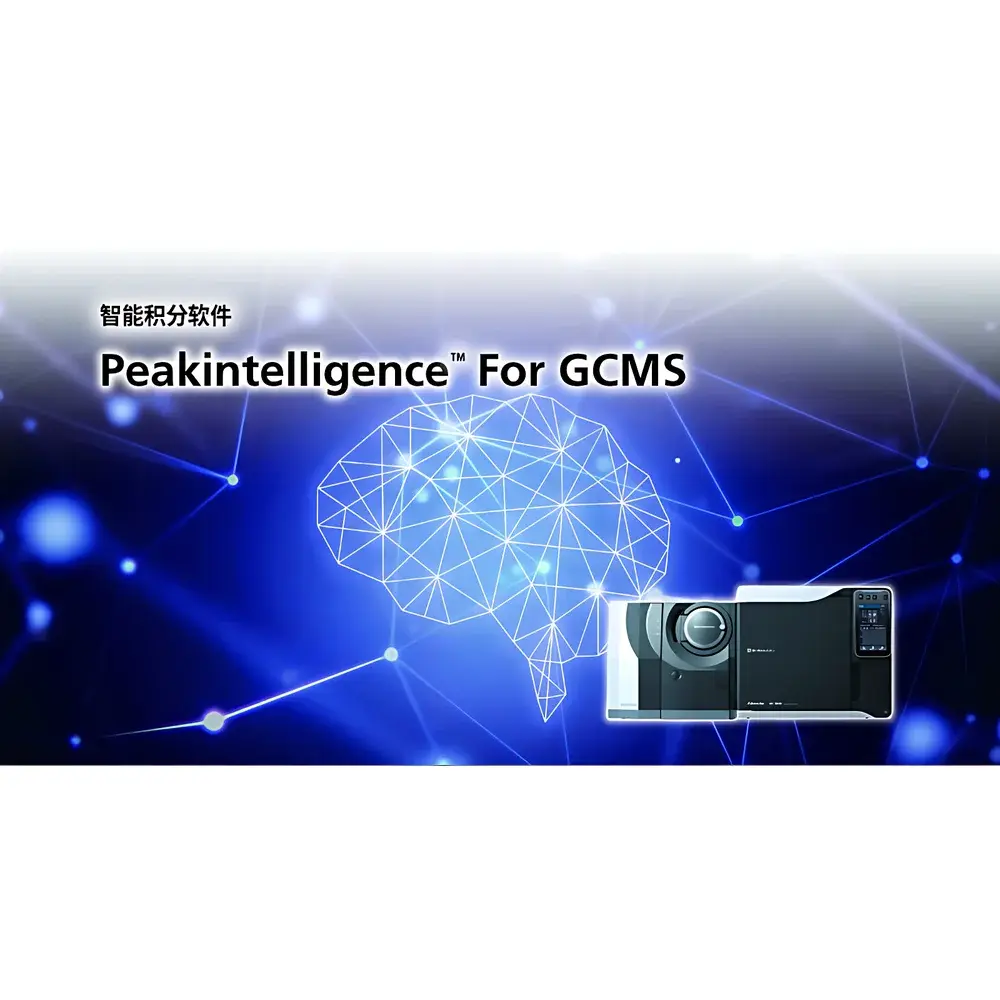
Shimadzu Peakintelligence AI-Powered GC-MS Data Processing Software
| Brand | Shimadzu |
|---|---|
| Origin | Japan |
| Manufacturer Type | Original Equipment Manufacturer (OEM) |
| Import Status | Imported |
| Model | Peakintelligence |
| Chromatography Type | Conventional Gas Chromatography–Mass Spectrometry (GC-MS) |
| Pricing | Available Upon Request |
Overview
Peakintelligence is a proprietary, AI-driven data processing software developed by Shimadzu Corporation for gas chromatography–mass spectrometry (GC-MS) systems. Unlike conventional post-acquisition software that relies on manually configured integration parameters—such as peak width, threshold, baseline slope, and noise tolerance—Peakintelligence employs a deep learning architecture trained on thousands of real-world GC-MS chromatograms annotated by expert analytical chemists. It implements unsupervised pattern recognition to distinguish true analyte peaks from baseline fluctuations, co-eluting interferences, and detector artifacts without requiring user-defined integration settings. The core algorithm operates on spectral continuity, retention time consistency, and mass spectral similarity across multi-component datasets, enabling robust peak detection and integration even in highly congested chromatographic regions typical of environmental, food safety, or forensic screening workflows.
Key Features
- Parameter-Free Peak Integration: Eliminates manual optimization of integration parameters; peak boundaries are determined autonomously based on learned chromatographic behavior.
- Expert-Level Pattern Recognition: Trained on curated datasets spanning diverse matrices (e.g., soil extracts, biological fluids, polymer leachates), ensuring high fidelity in low-S/N conditions and trace-level quantification.
- Automated Peak Identification & Grouping: Matches detected peaks with reference spectra from NIST or Shimadzu’s MS Library using retention index–adjusted matching, then clusters related fragments into compound-level entities.
- Quantitative Workflow Acceleration: Reduces total quantitative analysis time by up to 75% compared to manual review-based workflows—validated using a 475-compound benchmark mixture under ISO/IEC 17025-aligned validation protocols.
- Robust Baseline Estimation: Applies adaptive polynomial fitting combined with morphological filtering to reconstruct dynamic baselines in the presence of gradient drift or column bleed.
Sample Compatibility & Compliance
Peakintelligence is designed exclusively for Shimadzu GC-MS platforms, including the QP series (QP2010 Ultra, QP2020 NX) and GCMS-TQ series triple quadrupole systems. It supports standard data formats including .qgd, .lcd, and .cdf, and integrates natively with LabSolutions Insight and GCMS Postrun Analysis modules. The software complies with analytical data integrity requirements per FDA 21 CFR Part 11 when deployed in validated environments with appropriate system access controls, electronic signatures, and audit trail configuration. It supports GLP/GMP-aligned reporting structures—including full traceability of peak assignment logic, integration confidence scores, and version-controlled training dataset metadata.
Software & Data Management
Peakintelligence operates as a plug-in module within Shimadzu’s LabSolutions software suite. All processing steps—including peak detection, deconvolution, library search, and calibration curve generation—are logged with timestamped, immutable audit trails. Users can export processed results in CSV, PDF, or XML formats compliant with LIMS interfaces. Raw data remains unaltered; all AI-derived annotations are stored separately to preserve raw file integrity. Batch processing supports up to 500 samples per queue with configurable priority rules and error-handling policies. Training model updates are delivered via secure firmware patches certified under Shimadzu’s ISO 9001:2015 quality management system.
Applications
- High-throughput screening of semi-volatile organic compounds (SVOCs) in environmental monitoring (EPA Method 8270D, ISO 18856)
- Residue analysis in food and agricultural commodities (EU Regulation 2023/2058, AOAC Official Method 2017.16)
- Impurity profiling and stability-indicating assays in pharmaceutical development (ICH Q2(R2), USP <1225>)
- Forensic toxicology workflows involving complex biological matrices (SWGDAM Guidelines, ISO/IEC 17025:2017)
- Metabolomics studies requiring reproducible peak alignment across large cohort datasets
FAQ
Does Peakintelligence modify raw GC-MS data files?
No. All AI-generated annotations—including peak boundaries, identification scores, and integration results—are stored separately from the original .qgd or .lcd files.
Can Peakintelligence be validated for regulated laboratories?
Yes. Shimadzu provides IQ/OQ documentation packages, validation templates aligned with ASTM E2500 and EU Annex 11, and support for risk-based validation strategies.
Is retraining the AI model possible with in-house data?
No. The deep learning model is fixed at release and updated only through Shimadzu-certified software revisions to ensure analytical consistency and regulatory defensibility.
What level of IT infrastructure is required?
A Windows 10/11 64-bit system with ≥32 GB RAM, ≥1 TB SSD, and NVIDIA GPU (≥8 GB VRAM) is recommended for optimal inference speed on large batches.
How does Peakintelligence handle co-eluting isomers?
It leverages retention index–normalized spectral deconvolution and applies compound-specific mass spectral weighting to improve discrimination where library match factors alone are insufficient.
Related Products






