
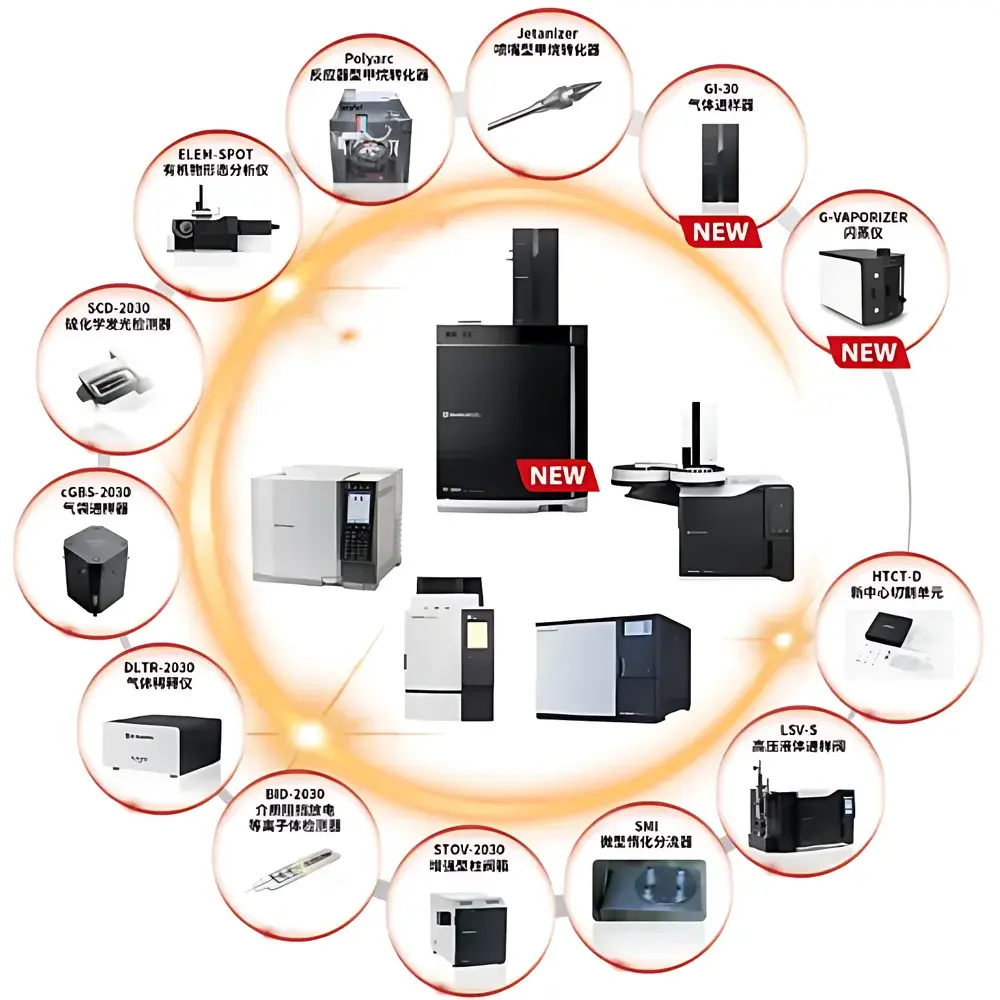
Shimadzu Petrochemical Accessories Kit for GC Systems
| Brand | Shimadzu |
|---|---|
| Origin | Jiangsu, China |
| Manufacturer Type | Original Equipment Manufacturer (OEM) |
| Product Category | Domestic |
| Model | Petrochemical Accessories Kit |
| Instrument Type | Laboratory Gas Chromatograph Accessories |
| Application Field | Petroleum & Petrochemical Industry |
| Key Components | G-VAPORIZER Flash Vaporizer |
| Compliance | Designed for ASTM D1319, D5769, D6730, ISO 6974, and USP <467> residual solvent methods |
Overview
The Shimadzu Petrochemical Accessories Kit is a purpose-engineered suite of modular GC peripherals designed to extend the analytical capability, robustness, and regulatory compliance of laboratory gas chromatography systems in petroleum refining, petrochemical production, and upstream/downstream quality control laboratories. These accessories collectively address critical methodological challenges inherent in hydrocarbon analysis—including volatile liquid handling, high-pressure phase transfer, multi-dimensional separation, thermal stability under extended temperature gradients, and trace-level calibration gas preparation. Each component adheres to Shimadzu’s system integration architecture, ensuring plug-and-play compatibility with GC-2010 Plus, GC-2030, and Nexis GC-2030 platforms. The kit operates on fundamental principles of controlled-phase transition (flash vaporization), pressure-regulated liquid sampling (liquid-phase injection into pressurized carrier streams), heart-cutting multidimensional GC (MDGC), thermally stabilized valve/column switching, and gravimetrically referenced dynamic dilution—enabling reproducible, traceable, and auditable workflows aligned with ISO/IEC 17025 and GLP requirements.
Key Features
- G-VAPORIZER Flash Vaporizer: Enables quantitative, composition-preserving vaporization of liquid hydrocarbons (e.g., gasoline, naphtha, LPG condensates) at temperatures up to 250 °C; features integrated flow control via mass flow controller (MFC) and real-time temperature monitoring with ±0.5 °C stability.
- LSV-S High-Pressure Liquid Sampling Valve (Side-Mount): Rated for operation up to 10 MPa; accommodates liquefied petroleum gas (LPG), light ends (C1–C5), and low-boiling refinery streams without phase separation or flash evaporation prior to injection; compatible with standard 10-port rotary valves and automated GC sequence control.
- HTCT-D High-Temperature Center-Cut Transfer Unit: Supports cryo- or hot-trap center-cutting between two orthogonal columns (e.g., non-polar + polar); operating range: −40 °C to 300 °C; enables retention time locking across complex hydrocarbon matrices per ASTM D5769 and D6730.
- STOV-2030 Enhanced Column/Valve Oven: Provides uniform thermal control (±0.1 °C) across dual columns, multiple switching valves (up to 4 × 10-port), and detector interfaces; includes independent zone heating, inert gas purge ports, and hardware-level interlock for valve timing synchronization.
- DLTR-2030 High-Precision Gas Dilution System: Delivers certified gas standards from 1 ppm to 100 % v/v with ≤1.5 % RSD repeatability; employs dual-stage MFCs calibrated against NIST-traceable reference gases; supports automated calibration curve generation and audit-ready log export per FDA 21 CFR Part 11.
Sample Compatibility & Compliance
The accessories are validated for use with liquid and gaseous hydrocarbon matrices including reformulated gasoline (RFG), jet fuel (Jet A-1), diesel distillates, cracked naphthas, polymer-grade ethylene/propylene, and refinery off-gas streams. All components meet material compatibility requirements for sulfur-containing compounds, olefins, aromatics, and oxygenates per ASTM D1319 (hydrocarbon type analysis), ISO 6974 (natural gas composition), and USP (residual solvents in pharmaceutical excipients). Electrical safety complies with IEC 61010-1; pressure-rated components conform to PED 2014/68/EU. Documentation packages include Factory Acceptance Test (FAT) reports, material certifications (3.1 EN 10204), and installation qualification (IQ) templates.
Software & Data Management
Full integration with GCsolution software (v2.8 or later) enables synchronized method programming across all accessories—e.g., timed valve actuation, oven ramp coordination, and dilution factor mapping within single acquisition methods. Audit trails record all parameter changes, valve events, and calibration logs with user ID, timestamp, and reason-for-change fields. Data export supports CSV, CDF, and XML formats compliant with LIMS interfaces; raw data files retain full metadata including accessory firmware versions and sensor calibration dates. Optional Shimadzu LabSolutions Connect module enables remote monitoring, predictive maintenance alerts, and electronic signature support for 21 CFR Part 11 compliance.
Applications
- Hydrocarbon group-type analysis (PIONA, DHA, TPH) in gasoline and naphtha per ASTM D1319 and D5769
- Light hydrocarbon speciation (C1–C5) in refinery gas and flare monitoring per ASTM D1945 and D1946
- Trace sulfur compound profiling (mercaptans, sulfides, thiophenes) using MDGC–SCD/PFPD configurations
- Residual solvent quantification in catalyst carriers and polymer feedstocks per USP and EP 2.4.24
- Calibration gas preparation for ambient air monitoring (EPA TO-15, ASTM D5504) and process analyzer validation
FAQ
Are these accessories compatible with non-Shimadzu GC systems?
Yes—mechanical and electrical interfaces follow industry-standard dimensions and signal protocols (e.g., 24 VDC TTL valve triggers, RS-232/USB for DLTR-2030), though full software integration and method automation require GCsolution or third-party drivers with Shimadzu SDK licensing.
What maintenance intervals are recommended for the LSV-S valve?
Shimadzu recommends quarterly inspection of sealing surfaces and annual replacement of PTFE/graphite composite seals when analyzing sulfur- or chloride-containing streams; detailed maintenance logs are auto-generated in GCsolution.
Does the HTCT-D unit support cryogenic trapping?
Yes—the HTCT-D accepts optional liquid nitrogen or CO₂ cooling modules (sold separately) enabling sub-ambient trapping down to −70 °C for enhanced volatility resolution in C2–C4 analysis.
Can the DLTR-2030 generate mixed gas standards with reactive components (e.g., H₂S, Cl₂)?
Only with inert carrier diluents (N₂, He, Ar) and stainless-steel wetted-path configuration; reactive gas blends require specialized corrosion-resistant options (e.g., Hastelloy C-276 tubing, passivated surfaces), available upon request with custom FAT.
Is IQ/OQ documentation provided with shipment?
Yes—each kit includes a complete qualification package: Installation Qualification (IQ) checklist, Operational Qualification (OQ) test protocols with acceptance criteria, and completed test records signed by Shimadzu QA; electronic copies are delivered via secure portal.
Related Products





