
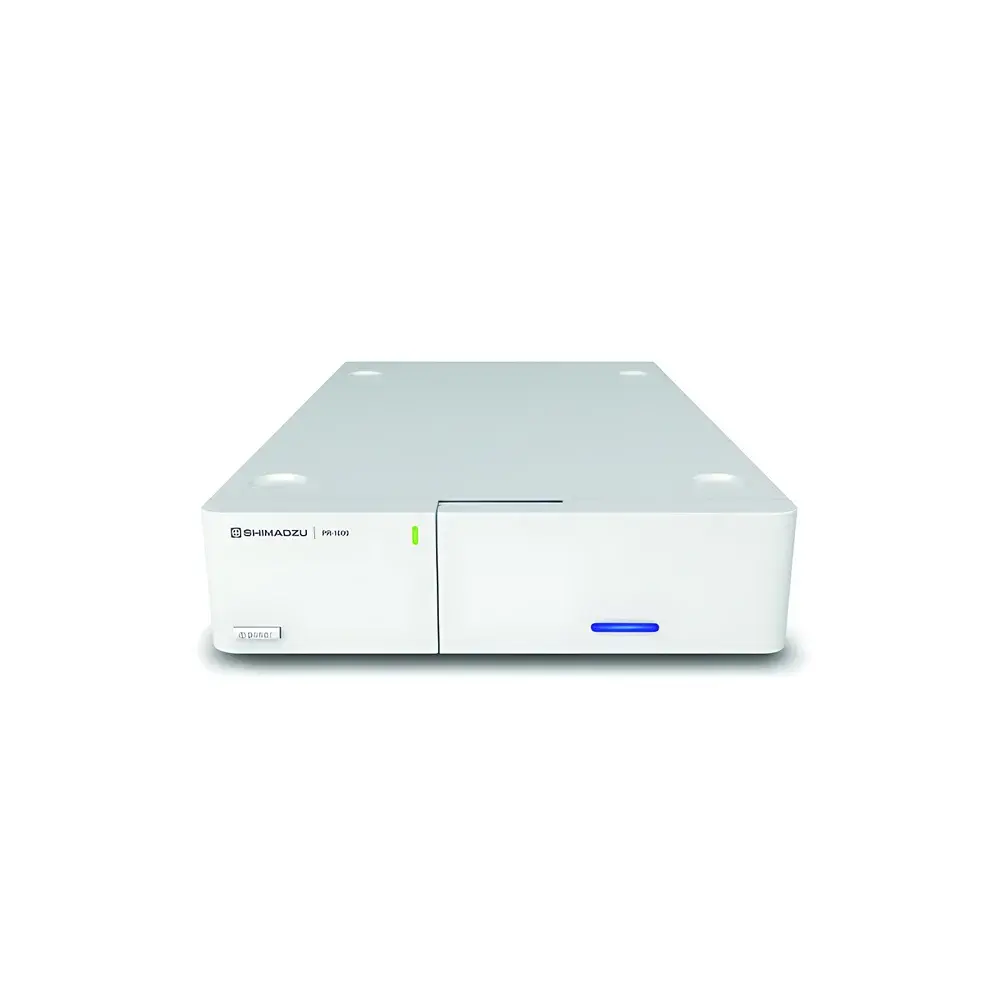
Shimadzu PR-1000 Post-Column Photochemical Derivatization System
| Brand | Shimadzu |
|---|---|
| Origin | Jiangsu, China |
| Manufacturer Type | OEM Manufacturer |
| Product Origin | Domestic (China) |
| Model | Shimadzu PR-1000 |
| Temperature Range | Ambient |
| Reaction Tubing Material | FEP (Fluorinated Ethylene Propylene) |
| UV Source Lifetime | 9,000 hours |
| Derivatization Flow Path | Passive (No Pump-Driven Reagent Delivery) |
| UV Leakage Protection | Integrated Shielding with UV-Blocking View Window |
| Delay Volume | Optimized for Minimal Extra-Column Dispersion |
Overview
The Shimadzu PR-1000 Post-Column Photochemical Derivatization System is a dedicated, pump-free ultraviolet (UV) irradiation module designed for integration into high-performance liquid chromatography (HPLC) workflows requiring photochemical enhancement of analyte detectability—particularly for mycotoxins such as aflatoxins B₁, B₂, G₁, and G₂. Unlike reagent-based post-column derivatization systems, the PR-1000 operates on the principle of controlled UV-C photolysis (typically at 254 nm), converting non-fluorescent or weakly fluorescent compounds into highly fluorescent derivatives immediately after column elution but prior to detection. This approach eliminates the need for chemical reagent pumps, mixing tees, reaction coils with variable residence time, or pH-sensitive derivatization chemistry—thereby improving method robustness, reducing maintenance burden, and minimizing baseline noise and carryover. The system is engineered for seamless coupling with Shimadzu RF-20A, RF-20AXS, or third-party fluorescence detectors, maintaining compatibility with standard 1/16″ OD stainless steel or PEEK capillary interconnects.
Key Features
- High-stability UV lamp with rated lifetime of 9,000 hours, ensuring long-term intensity consistency and reduced calibration frequency.
- FEP (fluorinated ethylene propylene) reaction tubing—chemically inert, UV-transparent, and thermally stable up to 200 °C—optimized for minimal peak dispersion and maximal photon flux transmission.
- Integrated thermal management system: passive heat-dissipating structure combined with airflow-guided cooling channels to stabilize tubing surface temperature under continuous operation, preventing thermal degradation of labile derivatives.
- Zero-reagent, zero-pump architecture: no external derivatization solvent delivery required; eliminates gradient incompatibility, backpressure fluctuations, and reagent purity dependencies.
- Engineered UV containment: fully shielded optical chamber with interlocked power cutoff and a front-panel fused quartz viewport incorporating UV-absorbing dopants (OD ≥ 4 at 254 nm), compliant with IEC 62471 Photobiological Safety standards for UV radiation equipment.
- Compact footprint (W × D × H: 180 × 320 × 120 mm) and modular mounting interface compatible with Shimadzu LC-20 series and Nexera platforms.
Sample Compatibility & Compliance
The PR-1000 is validated for use in regulatory-compliant analysis of aflatoxins in food and feed matrices per AOAC Official Method 2005.08, USDA-FSIS Directive 10,010.1, and EU Commission Regulation (EC) No. 401/2006. It supports mobile phases containing aqueous buffers (e.g., phosphate, acetate), acetonitrile, and methanol—provided UV-absorbing additives (e.g., iron chelators, certain ion-pair reagents) are avoided to prevent competitive absorption. The FEP tubing exhibits negligible extractables per USP , and system construction adheres to RoHS 2011/65/EU and CE marking requirements for laboratory instrumentation. No internal wetted parts require periodic replacement beyond routine lamp servicing.
Software & Data Management
As a hardware-only derivatization module, the PR-1000 does not include embedded firmware or network connectivity. It functions transparently within existing HPLC data systems (e.g., LabSolutions LCMS, Chromeleon, Empower). All timing-critical parameters—including dwell volume, detector acquisition rate, and gradient delay—are managed externally by the host chromatography data system (CDS). Audit trails, electronic signatures, and 21 CFR Part 11 compliance are maintained at the CDS level; the PR-1000 introduces no additional data handling or storage layer. Its passive design ensures full compatibility with GLP/GMP validation protocols, including IQ/OQ documentation templates provided by Shimadzu Technical Support.
Applications
- Quantitative determination of aflatoxin B₁, B₂, G₁, and G₂ in corn, peanuts, tree nuts, spices, and dairy products using HPLC-FLD.
- Enhancement of sensitivity for other UV-photolabile analytes including fumonisins (after hydrolysis), ochratoxin A (in specific solvent systems), and certain pharmaceutical impurities.
- Method transfer between laboratories where reagent-based derivatization poses reproducibility challenges due to pump variability or reagent stability issues.
- Support for multi-residue mycotoxin methods when coupled with switching valves and dual-detection configurations (e.g., UV + fluorescence).
FAQ
Does the PR-1000 require derivatization reagents or pumps?
No. It relies solely on UV irradiation and requires no chemical reagents, pumps, or auxiliary fluidic components.
What is the typical dwell volume introduced by the PR-1000?
The optimized FEP coil contributes ≤ 12 µL of extra-column volume, preserving chromatographic efficiency for sub-2 µm particle columns.
Can the PR-1000 be used with UHPLC systems operating above 600 bar?
Yes—its passive flow path imposes no pressure limitation; compatibility depends only on upstream/backpressure-rated tubing and detector inlet specifications.
Is lamp intensity monitoring available?
No real-time intensity feedback is built-in; however, output stability is verified during OQ via radiometric measurement using NIST-traceable UV photodiode sensors.
How often must the UV lamp be replaced?
Based on 8 h/day usage, replacement is recommended every 24–30 months to maintain >95% nominal irradiance output.




