
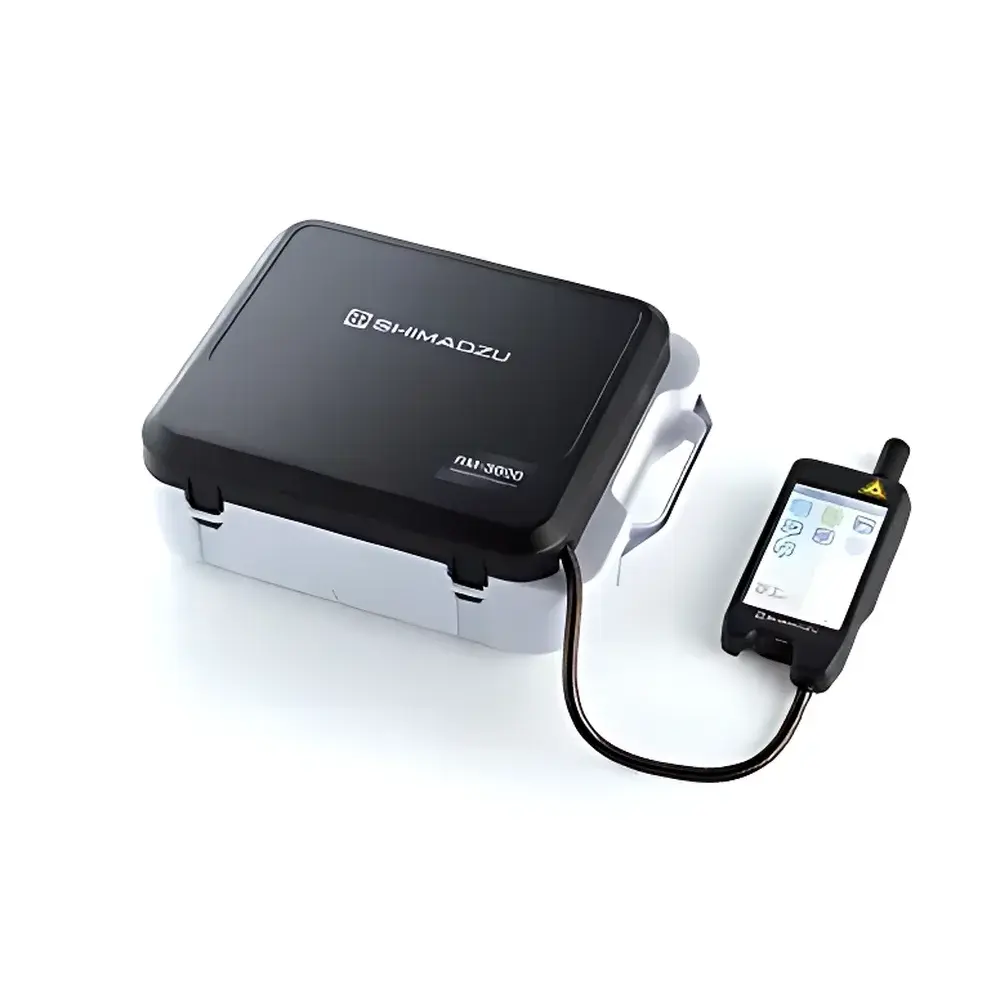
Shimadzu RM-3000 Portable Raman Spectrometer
| Brand | Shimadzu |
|---|---|
| Origin | Jiangsu, China |
| Manufacturer Type | Original Equipment Manufacturer (OEM) |
| Product Category | Domestic |
| Model | RM-3000 |
| Instrument Type | Handheld Portable Raman Spectrometer |
| Spectral Range | 200–3000 cm⁻¹ |
| Spectral Resolution | 4 cm⁻¹ |
| Spatial Resolution | 0.22 mm |
| Minimum Wavenumber | 200 cm⁻¹ |
| Spectral Repeatability | <1 cm⁻¹ |
Overview
The Shimadzu RM-3000 Portable Raman Spectrometer is an engineered solution for field-deployable molecular identification and qualitative/quantitative analysis based on inelastic light scattering (Raman effect). Designed around a stabilized 785 nm diode laser excitation source and a thermoelectrically cooled CCD detector, the RM-3000 delivers laboratory-grade spectral fidelity in a handheld form factor. Its optical architecture employs optimized notch filtering, aberration-corrected imaging optics, and real-time background subtraction algorithms to minimize fluorescence interference—particularly critical for pharmaceutical intermediates, polymers, and dyed or pigmented samples. Unlike benchtop systems requiring controlled environments, the RM-3000 maintains measurement integrity under variable ambient lighting and temperature conditions (10–40 °C operational range), making it suitable for GMP-aligned raw material verification, in-process checks, and finished product release testing at manufacturing sites, warehouses, and customs checkpoints.
Key Features
- Handheld ergonomic design with integrated touchscreen interface enabling single-handed operation and immediate spectral acquisition without external peripherals
- 785 nm excitation laser with adjustable power output (up to 500 mW) and automatic safety interlock compliant with IEC 60825-1 Class 3R requirements
- High quantum efficiency back-illuminated CCD detector with 2048-pixel linear array and >75% peak QE at 785 nm
- Real-time spectral calibration using built-in silicon reference peak (520.7 cm⁻¹) with auto-correction prior to each acquisition
- On-device spectral library search engine supporting user-defined libraries (e.g., USP Reference Standards, EP Monographs, in-house formulations) with customizable match thresholding (0.1–1.0 similarity score)
- Integrated GPS, barcode scanner, and digital camera for sample metadata tagging and chain-of-custody documentation
Sample Compatibility & Compliance
The RM-3000 accommodates diverse physical forms—including solids (tablets, crystals, films), liquids (solutions, suspensions), powders (APIs, excipients), and opaque containers (amber glass vials, HDPE bottles)—without sample preparation. Its fiber-optic coupled probe head features a working distance of 2–5 mm and a spot size of ~100 µm, enabling non-destructive analysis through packaging. The system complies with ISO/IEC 17025:2017 general requirements for competence of testing and calibration laboratories, supports audit-ready electronic records per FDA 21 CFR Part 11 (including electronic signatures, audit trails, and role-based access control), and aligns with ICH Q5A(R2) and USP guidelines for identity testing of pharmaceutical materials.
Software & Data Management
The RM-3000 operates with two-tier software architecture: the embedded Android-based SpectraTouch OS handles real-time acquisition, preprocessing (baseline correction, cosmic ray removal, Savitzky-Golay smoothing), and library matching; while the desktop SpectraManager Pro suite provides advanced chemometric tools (PCA, PLS-DA, hierarchical clustering), batch report generation, and LIMS integration via ASTM E1384-compliant data export (XML, CSV, JCAMP-DX). All data transactions are logged with immutable timestamps, operator IDs, instrument configuration snapshots, and spectral provenance metadata—ensuring full traceability for GLP/GMP audits.
Applications
- Pharmaceutical: Raw material identity verification (RMIV), counterfeit drug screening, blend uniformity assessment, and stability-indicating assays
- Chemical manufacturing: In-line catalyst characterization, solvent purity confirmation, and reaction endpoint detection
- Forensics: Illicit substance identification (e.g., fentanyl analogs, synthetic cannabinoids) in seized evidence bags
- Food safety: Adulterant detection (melamine, Sudan dyes), authenticity verification (olive oil, honey), and pesticide residue screening
- Materials science: Polymorph discrimination in APIs, carbon nanotube functionalization monitoring, and battery electrode composition mapping
FAQ
Does the RM-3000 require external calibration standards for routine use?
No—the system performs automatic internal calibration before every measurement using its onboard silicon reference, eliminating the need for daily standardization with external polystyrene or cyclohexane.
Can spectral data be exported in formats compatible with third-party chemometric platforms?
Yes—raw and processed spectra are exportable as JCAMP-DX (.jdx), ASCII text (.txt), or MATLAB-compatible .mat files, supporting seamless import into Unscrambler, Pirouette, or Python-based scikit-learn workflows.
Is the device certified for use in hazardous locations (e.g., Zone 1/21)?
The RM-3000 is not ATEX or IECEx certified; however, its intrinsically safe design (low-power laser, sealed electronics, no moving parts) permits use in non-classified industrial environments per NEC Article 500.
How is data security maintained during wireless transfer to enterprise networks?
All Wi-Fi and Bluetooth communications employ TLS 1.2 encryption; local storage uses AES-256 full-disk encryption, and remote access requires multi-factor authentication (MFA) via Shibboleth or SAML 2.0 federation.
Related Products





