
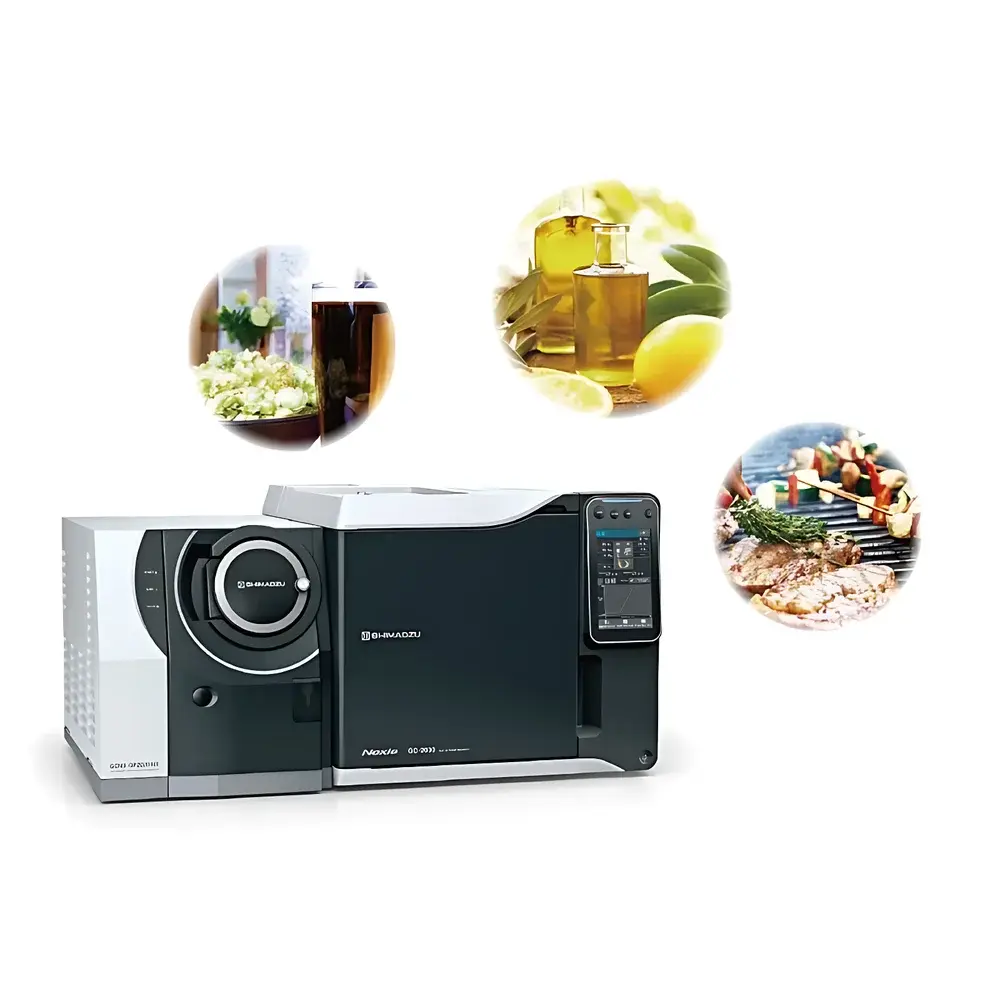
Shimadzu Smart Aroma Database for GC-MS/MS Systems
| Brand | Shimadzu |
|---|---|
| Origin | Japan |
| Manufacturer Type | Original Equipment Manufacturer (OEM) |
| Product Origin | Imported |
| Model | Smart Aroma Database |
| Chromatography Type | Conventional Gas Chromatography–Mass Spectrometry (GC-MS) |
| Compatible Platforms | GCMS-NX series, GCMS-QP2020, GCMS-TQ series, GCMS-QP2010 SE |
| Software Requirement | GCMSsolution Ver. 4.53 SP1 or later |
| Excel Compatibility | Microsoft Excel 2019 (32-/64-bit), Excel 2016 (32-bit) |
| Column Requirement | Shimadzu-recommended capillary columns with validated retention time and retention index protocols |
Overview
The Shimadzu Smart Aroma Database is a purpose-built, cheminformatics-enabled spectral and retention knowledge base designed exclusively for gas chromatography–mass spectrometry (GC-MS and GC-MS/MS) platforms. It supports rigorous identification and semi-quantitative assessment of volatile organic compounds (VOCs) responsible for characteristic odor profiles in complex matrices. Unlike generic mass spectral libraries (e.g., NIST or Wiley), this database integrates orthogonal identification criteria—retention time, linear retention index (LRI), diagnostic fragment ions, and organoleptic descriptors—within a unified analytical framework. Engineered for food science, fragrance development, cosmetic formulation, and quality control laboratories, it addresses the persistent challenge of low-abundance aroma-active compound detection amid high-background matrices. Its architecture aligns with ISO 11014 (safety data sheet preparation), ASTM E2895 (GC-MS method validation for flavor analysis), and supports traceability requirements under GLP-compliant workflows.
Key Features
- Multi-parameter compound identification: Combines retention time alignment, LRI matching, characteristic ion abundance ratios, and library spectrum similarity scoring (dot-product algorithm) to resolve co-eluting or structurally similar volatiles—such as enantiomeric terpenes or isomeric aldehydes—that conventional single-parameter methods fail to distinguish.
- Automatic Retention Time Adjustment (AART): Dynamically corrects retention time shifts across injections using n-alkane calibration standards and interpolated LRI values, ensuring robust peak alignment even under variable temperature ramp conditions or column aging.
- Semi-quantitative odor relevance scoring: Each of the 500+ registered aroma compounds includes experimentally determined odor threshold values (in air or water), sensory descriptors (e.g., “fruity,” “green leafy,” “spicy”), and relative sensitivity coefficients derived from response factor calibrations on Shimadzu GC-MS systems—enabling prioritized reporting of odor-impact compounds based on concentration × odor potency.
- Automated MRM/SIM method generation: Generates instrument-specific multiple reaction monitoring (MRM) or selected ion monitoring (SIM) methods directly from compound entries—including precursor→product transitions, dwell times, collision energies, and retention windows—without requiring reference standards during method setup.
- Integrated GC-O compatibility: Supports synchronized data import from gas chromatography–olfactometry (GC-O) systems, allowing direct correlation between chromatographic peaks and human panel sensory responses for key aroma active regions.
Sample Compatibility & Compliance
The database is validated for use with solid-phase microextraction (SPME), dynamic headspace (DHS), purge-and-trap (P&T), and thermal desorption (TD) sample introduction techniques. It complies with FDA 21 CFR Part 11 requirements when deployed within GCMSsolution’s audit-trail-enabled environment (with user authentication, electronic signatures, and immutable method/data logs). All retention indices are referenced to the Kováts scale using C8–C30 n-alkane standards per ISO 7931 and ASTM D5504. Compound registration adheres to IUPAC nomenclature and CAS Registry Number referencing.
Software & Data Management
Fully embedded within GCMSsolution Ver. 4.53 SP1 or later, the database operates as a native module—not a standalone application—ensuring seamless integration with raw data acquisition, peak detection, library search, and report generation. Search results include confidence scores, match quality flags, and cross-referenced sensory metadata exportable to Excel® (2016/2019) for downstream multivariate statistical analysis (PCA, OPLS-DA). Method files (.mth) and compound libraries (.lib) are digitally signed to prevent unauthorized modification, supporting laboratory accreditation under ISO/IEC 17025.
Applications
- Identification of off-flavors in dairy, fermented beverages, and plant-based alternatives
- Characterization of natural essential oils and synthetic fragrance blends
- Stability testing of cosmetics and personal care products under accelerated aging
- Authenticity verification of premium food ingredients (e.g., vanilla, saffron, truffle oil)
- Development of low-odor formulations in polymer and adhesive manufacturing
FAQ
Is the Smart Aroma Database compatible with third-party GC-MS instruments?
No—it is licensed exclusively for Shimadzu GC-MS platforms and requires GCMSsolution software; spectral matching algorithms and AART functionality depend on proprietary instrument control parameters.
Does the database include quantitative calibration curves?
No—semi-quantitation relies on pre-determined sensitivity coefficients and user-applied internal standard normalization; full quantification requires external calibration with certified reference materials.
Can retention indices be recalculated for non-Shimadzu columns?
LRI values are column- and temperature-program dependent; accurate application requires Shimadzu-recommended columns (e.g., SH-Rxi-5Sil MS) and the provided method templates.
How frequently is the database updated?
Shimadzu releases annual updates with newly characterized aroma compounds, expanded sensory annotations, and revised sensitivity coefficients based on inter-laboratory validation studies.
Is training included with license purchase?
Yes—Shimadzu provides application-specific workshops covering database navigation, AART optimization, MRM method deployment, and GC-O data fusion workflows.




