
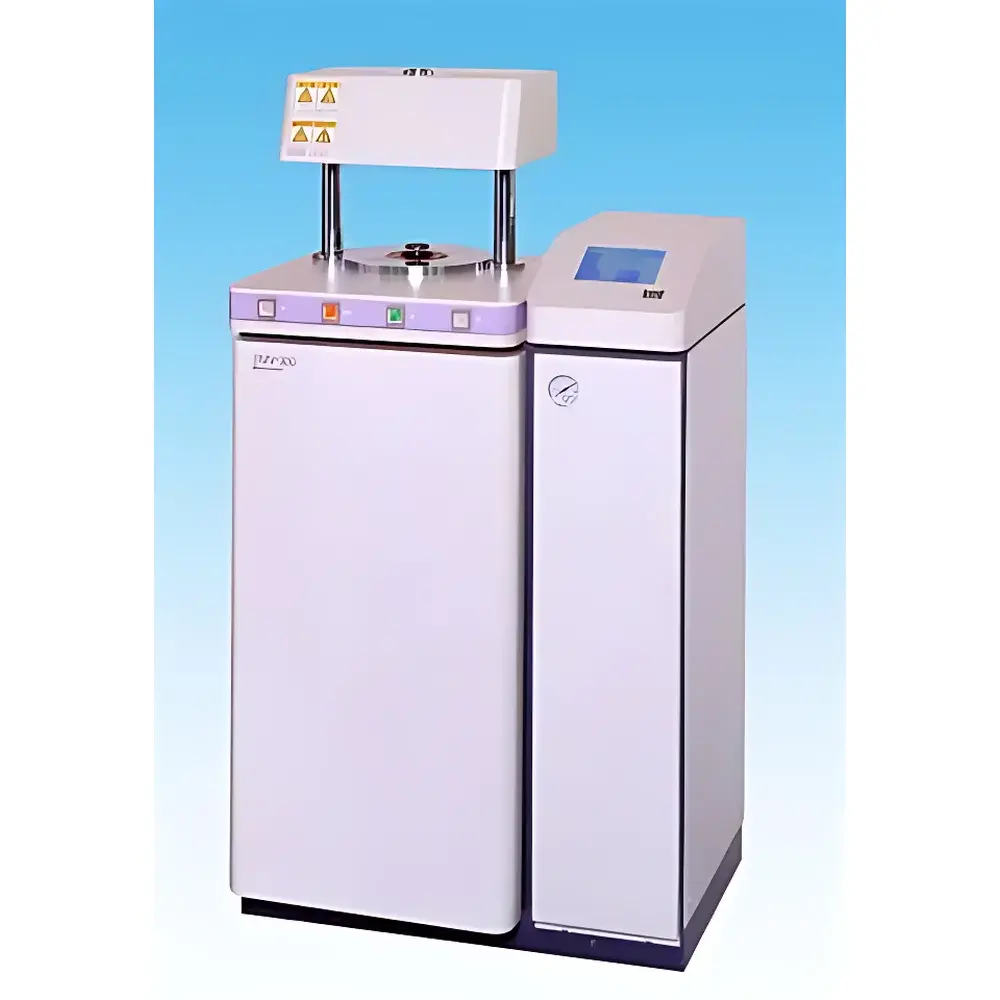
Shimadzu SMV-300/300RT Automatic Mooney Viscometer
| Brand | Shimadzu |
|---|---|
| Origin | Japan |
| Manufacturer Type | Original Equipment Manufacturer (OEM) |
| Product Origin | Imported |
| Model | SMV-300/300RT |
| Mooney Viscosity Range | 0–200 M (extendable to 400 M) |
| Test Temperature Range | Ambient to 200 °C |
| Temperature Accuracy | ±0.3 °C |
| Temperature Resolution | 0.1 °C |
| Rotor Speed (SMV-300RT only) | 0.5–5 rpm |
| Rotor Type | L-shaped |
| Sample Dimensions | Ø ≈ 50 mm × Thickness ≈ 6 mm |
| Heating Method | Thin-film heater with optimized PID control |
| Compression Method | Pneumatic cylinder actuation |
| Viscosity Measurement Duration | 0–99 min 59 sec (up to 10 time points programmable) |
| Scorch Point Setting Range | 0–99.9 M (up to 10 points programmable) |
| Data Logging & Statistical Analysis | Built-in |
Overview
The Shimadzu SMV-300/300RT Automatic Mooney Viscometer is a precision-engineered instrument designed for the standardized determination of Mooney viscosity and scorch behavior in raw and compounded elastomers. It operates on the principle of rotational viscometry under controlled temperature and shear conditions, where an L-shaped rotor rotates at a fixed speed (or variable speed in the RT variant) within a sealed, heated cavity containing a pre-conditioned rubber sample. The torque resistance exerted by the viscoelastic material is converted into Mooney units (M), providing a quantitative measure of polymer processability, molecular weight distribution, and crosslinking onset. Compliant with JIS K6300, ISO 289, ASTM D1646, and BS 1673, the system delivers high reproducibility for quality control laboratories in tire manufacturing, synthetic rubber synthesis, and compound development facilities.
Key Features
- Integrated LCD touch-panel interface enabling intuitive setup of test parameters—including temperature ramp profiles, rotor speed (0.5–5 rpm on SMV-300RT), measurement duration, and scorch point thresholds—without external software.
- Thin-film heating architecture with adaptive PID control ensures rapid thermal equilibration (< 3 min from ambient to 100 °C) and exceptional temperature stability (±0.3 °C), minimizing drift during extended cure monitoring.
- Electro-pneumatic compression system delivers consistent, repeatable sample confinement pressure via calibrated air cylinder actuation—critical for eliminating voids and ensuring uniform shear field geometry.
- SMV-300RT variant incorporates a servo-driven motorized drive train, enabling precise low-speed rotation for stress relaxation analysis and non-standard rheological profiling beyond conventional Mooney testing.
- Onboard data logging supports up to 10 user-defined time or viscosity checkpoints per test, with automatic calculation of ML1+4, MV100, t5, t35, and other industry-standard indices.
- Statistical processing functions include mean, standard deviation, coefficient of variation, and pass/fail flagging against configurable specification limits—facilitating GLP-compliant reporting.
Sample Compatibility & Compliance
The SMV-300/300RT accommodates standard disc-shaped specimens (Ø 50 mm × 6 mm) prepared per ISO 289 Annex A and ASTM D1646 Section 7. It supports natural rubber (NR), styrene-butadiene rubber (SBR), ethylene propylene diene monomer (EPDM), nitrile rubber (NBR), and thermoplastic elastomers (TPEs). All operational modes conform to the dimensional, thermal, and mechanical requirements defined in JIS K6300-1:2018, ISO 289-1:2021, ASTM D1646–23, and BS 1673:1975. The instrument’s calibration traceability follows Shimadzu’s internal metrology protocol aligned with ISO/IEC 17025 principles; optional NIST-traceable torque and temperature verification kits are available for audit readiness.
Software & Data Management
No external PC is required for routine operation—the embedded firmware handles real-time acquisition, display, and storage of torque vs. time curves, temperature logs, and derived indices. Data export is supported via USB 2.0 to CSV or PDF formats, preserving metadata such as operator ID, batch number, instrument serial number, and environmental timestamp. For enterprise integration, optional Shimadzu LabSolutions™ Link module enables secure, audit-trail-enabled transfer to LIMS or MES platforms, supporting FDA 21 CFR Part 11 electronic signature and record retention requirements. All stored test records retain full parameter history and raw sensor outputs for retrospective reanalysis.
Applications
- Quality release testing of incoming raw rubber lots against Mooney viscosity specifications (e.g., SBR 1502: ML1+4 @ 100 °C = 40 ± 5 M).
- Monitoring scorch safety during mixing and extrusion—identifying t5 (time to 5-unit rise) and t35 to prevent premature vulcanization.
- Formulation screening for accelerator systems, filler dispersion efficiency, and plasticizer compatibility.
- Stress relaxation profiling on SMV-300RT to assess network elasticity and bound rubber content in filled compounds.
- Supporting ISO 9001 and IATF 16949 process validation through documented repeatability (RSD < 1.2% for duplicate NR tests) and inter-laboratory comparability studies.
FAQ
What standards does the SMV-300/300RT comply with?
It fully satisfies JIS K6300, ISO 289, ASTM D1646, and BS 1673 for Mooney viscosity and scorch testing.
Can the instrument measure both viscosity and scorch in a single run?
Yes—each test sequence simultaneously captures viscosity evolution and identifies scorch onset using programmable threshold detection.
Is temperature calibration traceable to national standards?
Shimadzu provides optional factory calibration certificates traceable to JCSS (Japan) or NIST (USA); in-house verification uses certified PT100 reference probes.
Does the SMV-300RT support custom rotor speeds outside the standard 2 rpm?
Yes—0.5 to 5 rpm is continuously adjustable, enabling low-shear characterization and relaxation experiments.
How is data integrity ensured for regulatory submissions?
All measurements include immutable timestamps, operator IDs, and full audit trails; optional LabSolutions™ Link adds 21 CFR Part 11 compliance.
Related Products






