
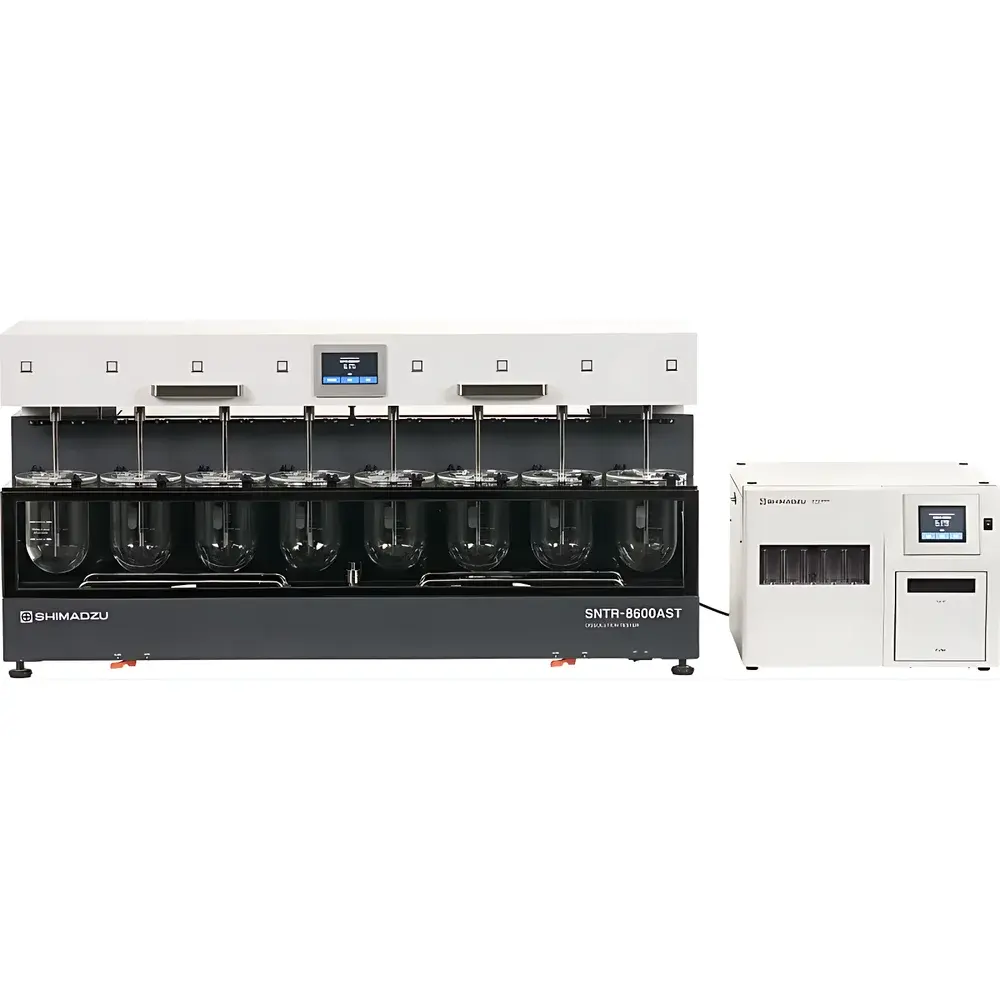
Shimadzu SNTR-8400AT Automated Online Dissolution Tester
| Brand | Shimadzu |
|---|---|
| Origin | Japan |
| Manufacturer | Shimadzu Corporation |
| Product Type | Imported Instrument |
| Model | SNTR-8400AT |
| Instrument Category | Online Dissolution Tester |
| Number of Vessels | 8 |
| Temperature Range | 20–60 °C |
| Temperature Accuracy | ±0.1 °C |
| Rotation Speed Range | 0–250 rpm |
| Paddle Wobble Amplitude | ≤0.5 mm |
| Basket Wobble Amplitude | ≤1.0 mm |
| Water Bath Temperature Control Range | Ambient +5 °C to 60 °C |
| Water Bath Temperature Resolution | 0.1 °C |
| Water Bath Volume | 17 L |
Overview
The Shimadzu SNTR-8400AT is an advanced, fully automated online dissolution testing system engineered for regulatory-compliant pharmaceutical development and quality control laboratories. It operates on the principle of USP Apparatus 1 (basket) and Apparatus 2 (paddle), with full support for small-volume vessel configurations per ChP (Chinese Pharmacopoeia) requirements. Designed to meet stringent mechanical calibration standards outlined in the *Guidance for Mechanical Verification of Dissolution Apparatus*, the SNTR-8400AT integrates real-time temperature monitoring within each dissolution vessel, precision rotational mechanics, and seamless analytical interfacing—enabling robust, reproducible, and auditable dissolution profiling under GMP/GLP conditions.
Key Features
- Centering Assurance Mechanism: A patented spherical elastic cup-mounting interface ensures repeatable alignment between dissolution vessels and rotating shafts—eliminating manual centering verification and maintaining positional accuracy across repeated setups.
- High-Fidelity Vessel Manufacturing: Each dissolution cup undergoes CNC machining followed by 3D optical scanning validation to guarantee dimensional consistency, surface finish, and geometric conformity to USP/ChP specifications.
- Low-Disturbance Head Assembly: Optimized head geometry minimizes air entrapment during basket immersion and reduces tablet impact; shortened shaft length suppresses wobble and improves rotational stability at all speeds (0–250 rpm).
- In-Vessel Real-Time Temperature Monitoring: Embedded thermistors integrated into each rotating shaft provide continuous, vessel-specific temperature feedback—enabling closed-loop control without disrupting hydrodynamic flow patterns.
- Integrated Dual-Media Delivery System: Two independent media replenishment channels allow concurrent dissolution testing under two distinct solvent conditions (e.g., pH-switched or surfactant-gradient protocols) within a single run.
- Ultra-Low-Vibration Water Bath: A monolithic, pump-free thermostatic bath design eliminates external circulation noise and mechanical coupling—critical for vibration-sensitive dissolution kinetics and long-duration release studies.
- Intelligent Auto-Sampling Architecture: High-precision syringe pumps operate in three configurable modes (delivery-only, preparation-only, or combined), supporting automatic dilution, reagent addition, and post-sampling line purging to prevent carryover between time points.
- Automated Filtration & Cleaning: Programmable secondary filtration supports standardized disc filters (13 mm, 25 mm); filter usage counters ensure traceable consumable lifecycle management. Full-system rinse cycles direct waste fluid to dedicated containment.
Sample Compatibility & Compliance
The SNTR-8400AT accommodates standard USP/ChP-compliant tablets, capsules, granules, and orally disintegrating formulations across all approved apparatus types. Its mechanical design satisfies ISO 19001-based verification criteria and aligns with ASTM E2503–22 for dissolution apparatus qualification. All firmware and software modules comply with FDA 21 CFR Part 11 requirements—including electronic signatures, audit trails, role-based access control, and immutable data archiving—ensuring readiness for regulatory inspections and submission-ready reporting.
Software & Data Management
Shimadzu’s dedicated dissolution software provides full lifecycle data governance: from method definition and instrument calibration logging to real-time curve generation, f₂ similarity factor calculation, and multivariate statistical analysis. Raw sensor data (temperature, rotation, sampling timestamps) are stored in encrypted binary format with SHA-256 hash integrity checks. Export options include CSV, PDF, and XML formats compatible with LIMS integration. Audit trail records capture user actions, parameter changes, and system events with timestamped, non-erasable entries—fully compliant with ALCOA+ principles.
Applications
The SNTR-8400AT serves critical roles in formulation development (e.g., assessing pH-dependent release, excipient effects, or extended-release matrix erosion), QC batch release testing, stability-indicating dissolution profiling, and bioequivalence study support. Its dual-media capability enables comparative dissolution under physiologically relevant conditions (e.g., gastric-to-intestinal transition simulations). Integration with UV-Vis or HPLC systems facilitates immediate quantification without offline handling—reducing analytical variability and accelerating decision-making in early-phase development.
FAQ
Does the SNTR-8400AT support small-volume dissolution methods per ChP?
Yes—it is validated for use with 100 mL and 200 mL vessels, including ChP-defined small-cup configurations.
Can temperature be monitored independently in each vessel?
Yes—each rotating shaft incorporates a calibrated thermistor, enabling per-vessel temperature acquisition and active feedback control.
Is mechanical verification documentation included?
Shimadzu provides a comprehensive mechanical verification kit, including traceable calibration tools, SOP templates, and a certified verification report aligned with ICH Q5C and USP <711>.
What level of data integrity does the software provide?
Full 21 CFR Part 11 compliance is implemented, including electronic signatures, automated audit trails, data encryption, and permission-tiered user access.
How is cross-contamination prevented during sequential sampling?
Post-sampling line purge functionality evacuates residual sample from all fluid paths before the next aspiration cycle—verified via pressure decay testing and dye-trace validation.





