
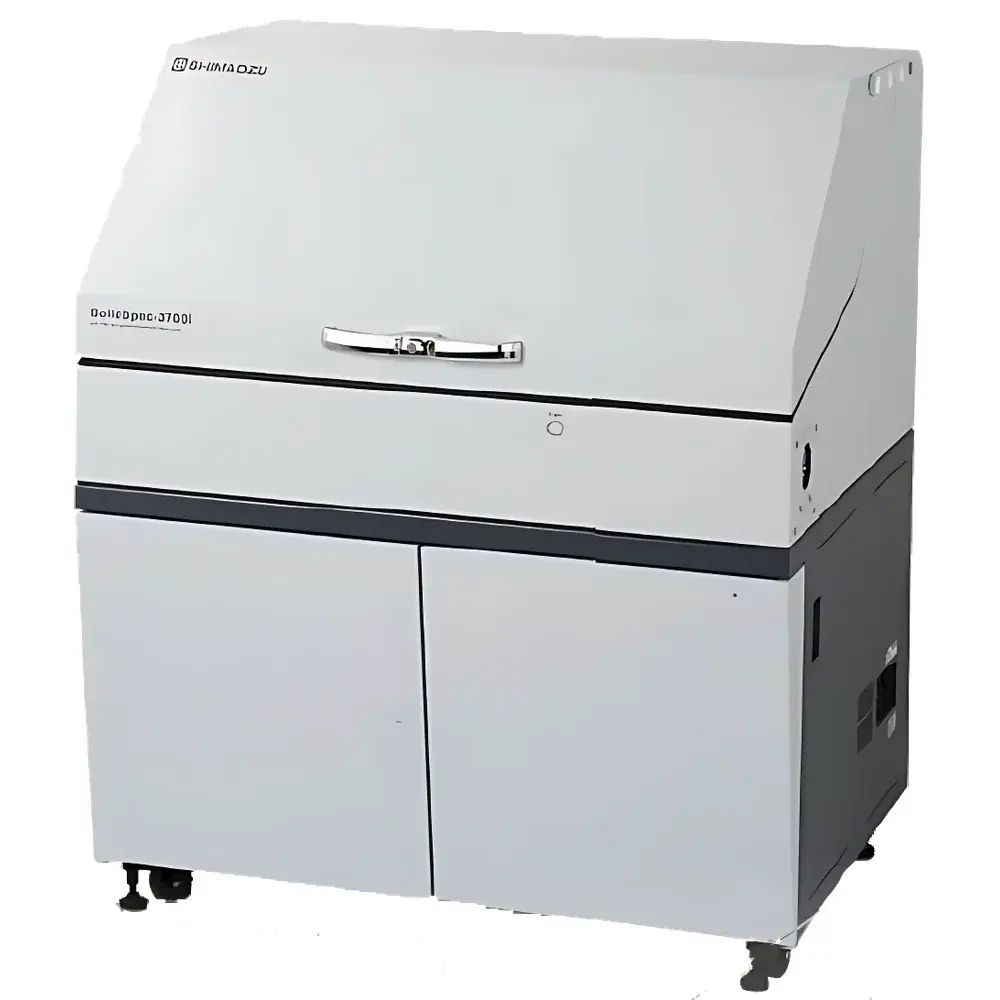
Shimadzu SolidSpec-3700i UV-Vis-NIR Spectrophotometer
| Brand | Shimadzu |
|---|---|
| Origin | Japan |
| Manufacturer Type | Original Equipment Manufacturer (OEM) |
| Product Origin | Imported |
| Model | SolidSpec-3700i |
| Optical Design | Double-beam |
| Detector | Photomultiplier Tube (PMT) / InGaAs / Cooled PbS |
| Wavelength Range | 165–3300 nm |
| Wavelength Accuracy | ±0.2 nm |
| Spectral Bandwidth | Variable |
| Stray Light | <0.00005% T (at 340 nm, NaNO₂) |
| Sample Compartment Internal Dimensions | 900 W × 700 D × 350 H mm |
| Max Sample Size | 700 W × 560 D × 40 H mm |
| Automation | Motorized wavelength scanning, optional XY automated sample stage |
| Software | LabSolutions UV-Vis |
Overview
The Shimadzu SolidSpec-3700i is a high-performance double-beam UV-Vis-NIR spectrophotometer engineered for extended spectral coverage and quantitative precision across the ultraviolet, visible, and near-infrared regions. It operates on classical Beer–Lambert absorption spectroscopy principles, utilizing simultaneous optical path referencing to compensate for source drift, detector instability, and environmental fluctuations—ensuring high reproducibility in both routine QC and advanced R&D applications. Its unique triple-detector architecture—integrating a high-sensitivity photomultiplier tube (PMT) for the UV-Vis range (165–900 nm), a thermoelectrically cooled InGaAs diode for the short-wave NIR (900–1700 nm), and a liquid-nitrogen-cooled PbS detector for the extended NIR (1700–3300 nm)—enables seamless, artifact-free spectral acquisition without manual detector switching or calibration interpolation. This design eliminates spectral discontinuities and baseline shifts commonly observed in dual-detector systems, supporting trace-level absorbance quantification and high-fidelity reflectance/transmittance mapping.
Key Features
- Triple-detector configuration (PMT / InGaAs / cooled PbS) as standard—no add-on modules required for full 165–3300 nm coverage
- Double-beam optical path with real-time reference beam correction, minimizing photometric noise and enhancing long-term stability
- Ultra-low stray light performance (<0.00005% T at 340 nm; <0.0005% T at 1420 nm), critical for high-dynamic-range measurements of highly absorbing or scattering samples
- Expanded sample compartment (900 × 700 × 350 mm internal volume) accommodating large-format solids, optical components, thin-film stacks, and irregularly shaped materials
- Integrated integrating sphere accessory (standard or optional, depending on configuration) enabling diffuse reflectance, total transmittance, and absolute reflectance measurements per ASTM E1331 and ISO 13468
- Motorized, software-controlled variable slit mechanism for adjustable spectral bandwidth (0.1–5.0 nm), optimizing resolution/sensitivity trade-offs per application requirement
- Optional motorized XY sample stage with programmable raster scanning, supporting spatially resolved spectral mapping of heterogeneous surfaces (e.g., coatings, pharmaceutical tablets, semiconductor wafers)
Sample Compatibility & Compliance
The SolidSpec-3700i supports solid, liquid, and powder samples via interchangeable accessories—including cuvette holders (1–100 mm pathlength), film clamps, specular reflectance stands, and fiber-optic probes. Its large sample chamber enables non-destructive analysis of oversized objects such as solar cell modules, architectural glass, polymer sheets, and cultural heritage artifacts. All optical measurements comply with internationally recognized standards: wavelength accuracy conforms to JIS K 0115 and ASTM E275; photometric linearity meets ISO 9001–certified instrument validation protocols; and stray light specifications align with USP requirements for UV-Vis method suitability in pharmaceutical analysis. The system architecture supports GLP/GMP environments through audit-trail-enabled software logging and electronic signature capability when deployed with LabSolutions UV-Vis under 21 CFR Part 11-compliant configuration.
Software & Data Management
LabSolutions UV-Vis is a modular, Windows-based application providing instrument control, spectral acquisition, kinetic profiling, quantitative analysis (including multi-component regression and Kubelka-Munk transformation), and report generation. Real-time data streaming enables synchronized acquisition from multiple detectors without latency or frame loss. Raw spectral data are stored in vendor-neutral ASCII and JCAMP-DX formats, ensuring compatibility with third-party chemometric platforms (e.g., MATLAB, Unscrambler, Python SciPy). The software includes built-in validation tools for IQ/OQ/PQ documentation, automatic wavelength and photometric calibration verification logs, and customizable templates compliant with ISO/IEC 17025 laboratory accreditation criteria. Data integrity safeguards include time-stamped operator authentication, immutable audit trails, and encrypted database backups.
Applications
- Pharmaceutical solid-state characterization: polymorph identification, excipient compatibility screening, and tablet coating uniformity assessment via NIR reflectance mapping
- Materials science: bandgap determination of semiconductors, optical constants extraction (n, k) of thin films using Kramers-Kronig analysis, and degradation kinetics of UV-stabilized polymers
- Environmental monitoring: quantification of dissolved organic carbon (DOC) and humic substances in water using UV254 and spectral slope analysis
- Food & agriculture: non-invasive quality grading of fruits and grains via Vis-NIR absorption signatures; moisture and protein content prediction in cereals
- Cultural heritage: pigment identification in historical paintings and manuscript inks without sampling, leveraging characteristic absorption features between 165–2500 nm
- Nanotechnology: size-dependent plasmonic resonance tracking in colloidal gold and silver nanoparticles across UV-Vis-NIR
FAQ
What is the maximum achievable spectral resolution with the SolidSpec-3700i?
The minimum spectral bandwidth is 0.1 nm (typical), adjustable via motorized slits. Actual resolution depends on grating selection, detector pixel density, and signal-to-noise ratio—typically ≤0.3 nm FWHM under optimal conditions.
Does the system support quantitative analysis of turbid suspensions?
Yes—when equipped with an integrating sphere and configured for diffuse transmittance mode, it enables accurate absorbance correction per ASTM D1003 and ISO 14782, mitigating scattering artifacts in colloidal or particulate systems.
Can LabSolutions UV-Vis be validated for regulated environments?
Yes—full 21 CFR Part 11 compliance is available with optional security packages, including role-based access control, electronic signatures, and tamper-evident audit trails meeting FDA and EMA expectations.
Is cryogenic cooling required for all detectors?
Only the PbS detector requires liquid nitrogen cooling for optimal SNR above 2500 nm; the PMT and InGaAs detectors operate at ambient and thermoelectrically stabilized temperatures, respectively.
How is wavelength accuracy verified during routine operation?
Built-in holmium oxide and didymium filters provide NIST-traceable reference peaks at 241.1, 279.4, 360.9, 418.5, 480.0, 536.2, and 637.5 nm; automated validation routines execute pre-run checks and generate calibration certificates.
Related Products




