
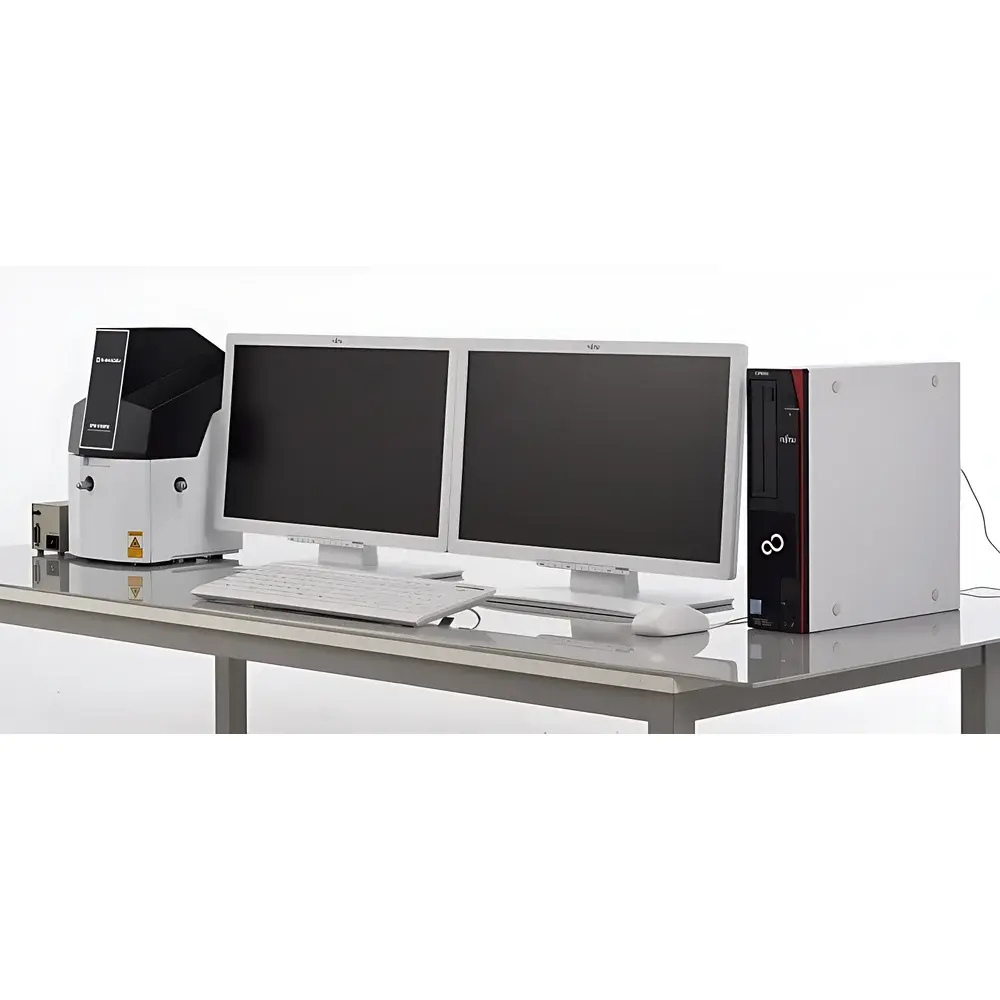
Shimadzu SPM-8100FM High-Resolution Frequency-Modulation Atomic Force Microscope
| Brand | Shimadzu |
|---|---|
| Origin | Japan |
| Manufacturer Type | Original Equipment Manufacturer (OEM) |
| Product Origin | Imported |
| Model | SPM-8100FM |
| Instrument Type | Atomic Force Microscope (AFM) |
| Lateral Positioning Noise | 0.1 nm |
| Vertical Positioning Noise | 0.03 nm |
| Sample Diameter × Thickness | Φ24 mm × 8 mm |
| Sample Stage Travel Range | ±5 mm |
Overview
The Shimadzu SPM-8100FM is a high-resolution frequency-modulation atomic force microscope engineered for quantitative nanoscale surface characterization under ambient and liquid environments. Unlike conventional amplitude-modulation AFMs, the SPM-8100FM employs frequency-modulation (FM) detection—a dynamic mode in which the cantilever’s resonant frequency shift (Δf) is tracked as a direct measure of tip–sample interaction forces. This principle enables sub-Angstrom vertical resolution and exceptional signal-to-noise performance without vacuum confinement. The instrument is uniquely capable of delivering vacuum-grade topographic fidelity in air and aqueous media, making it one of the first commercially available AFMs to bridge the resolution gap between ultra-high-vacuum scanning tunneling microscopy (UHV-STM) and practical lab-based operation. Its design targets fundamental investigations of interfacial phenomena—including hydration layers, solvation shells, and electrochemical double-layer structures—at solid–liquid interfaces with true three-dimensional force mapping capability.
Key Features
- Frequency-modulation (FM) detection architecture optimized for ultra-low-noise force sensing, achieving vertical positioning noise of 0.03 nm and lateral noise of 0.1 nm—performance previously attainable only in UHV systems.
- Advanced optical beam deflection system with enhanced photodetector quantum efficiency and active laser noise suppression, reducing photothermal and optical interference by a factor of 20 compared to prior-generation FM-AFMs.
- Dedicated liquid-cell compatibility with sealed flow chambers and inert gas purging options, enabling stable imaging and force spectroscopy in buffered aqueous solutions, organic solvents, and electrolytes.
- Three-axis piezoelectric scanner with ±5 mm travel range and integrated closed-loop position feedback, supporting large-area survey scans and high-precision region-of-interest navigation.
- Modular head design with quick-release cantilever holder and motorized probe exchange stage, minimizing downtime during tip replacement or mode switching (e.g., FM to AM or current-sensing modes).
- High-speed scanning capability up to 5 Hz at full 1024 × 1024 pixel resolution, facilitating time-resolved studies of dynamic interfacial processes such as ion adsorption/desorption or polymer chain rearrangement.
Sample Compatibility & Compliance
The SPM-8100FM accommodates samples up to Φ24 mm in diameter and 8 mm in thickness, compatible with standard silicon wafers, TEM grids, conductive substrates (e.g., HOPG, Au(111)), and soft biological specimens (e.g., lipid bilayers, protein monolayers). Its environmental flexibility supports ASTM E2539-22 (Standard Guide for AFM Measurements in Liquid Environments) and ISO/IEC 17025-compliant workflows when paired with traceable calibration standards (e.g., NIST SRM 2461). Data acquisition and metadata logging conform to GLP/GMP documentation requirements, including user authentication, audit trails, and electronic signature support per FDA 21 CFR Part 11 when operated with Shimadzu’s certified SPM Control Suite v4.x software.
Software & Data Management
The instrument is controlled via Shimadzu’s SPM Control Suite—a modular, Windows-based platform supporting real-time FFT analysis, multi-channel force–distance curve acquisition, and automated tip optimization routines. All raw data are stored in vendor-neutral HDF5 format with embedded metadata (scan parameters, environmental conditions, calibration constants). The software includes built-in modules for hydration layer thickness quantification, solvation shell radial distribution function (RDF) extraction, and 3D interfacial force volume reconstruction. Export options include CSV, TIFF, and MSA-compatible formats for third-party analysis in Igor Pro, Gwyddion, or MATLAB. Remote monitoring and scheduled batch acquisition are supported through secure SSH/TLS protocols.
Applications
- Electrochemical interface science: In situ mapping of solid–electrolyte interphase (SEI) evolution on Li-ion battery anodes/cathodes during cycling.
- Nanoscale biophysics: Quantitative imaging of membrane protein mobility, lipid phase separation, and ligand-binding-induced conformational changes in physiological buffers.
- Catalysis research: Visualization of solvent reorganization around catalytic nanoparticles under operando conditions.
- Functional polymer characterization: Nanomechanical mapping of block copolymer microphase separation and hydration-dependent modulus gradients.
- 2D materials science: Sub-molecular resolution imaging of graphene oxide defect dynamics and intercalation-induced lattice strain in aqueous dispersions.
FAQ
Does the SPM-8100FM require ultra-high vacuum to achieve atomic resolution?
No. It delivers sub-nanometer resolution in ambient air and liquid environments using frequency-modulation detection, eliminating the need for vacuum chambers.
Can it perform simultaneous topography and nanomechanical property mapping?
Yes. The system supports concurrent acquisition of topography, frequency shift (Δf), excitation amplitude, and phase lag—enabling quantitative elasticity and adhesion mapping via force-volume or PeakForce Tapping-derived parameters.
Is the software compliant with FDA 21 CFR Part 11 for regulated laboratories?
When deployed with validated SPM Control Suite v4.x and configured with role-based access control and electronic signatures, it meets core Part 11 requirements for audit trail integrity and data authenticity.
What sample preparation methods are recommended for biological specimens in liquid mode?
Standard protocols include spin-coating on mica, Langmuir–Blodgett transfer, or chemical functionalization of gold substrates; no metal coating is required due to the non-contact FM operating principle.
How is thermal drift compensated during long-duration liquid-phase experiments?
The system integrates real-time drift correction using fiducial markers and closed-loop scanner feedback, with typical thermal drift rates below 0.05 nm/min over 60-minute acquisitions at 25 °C.





