
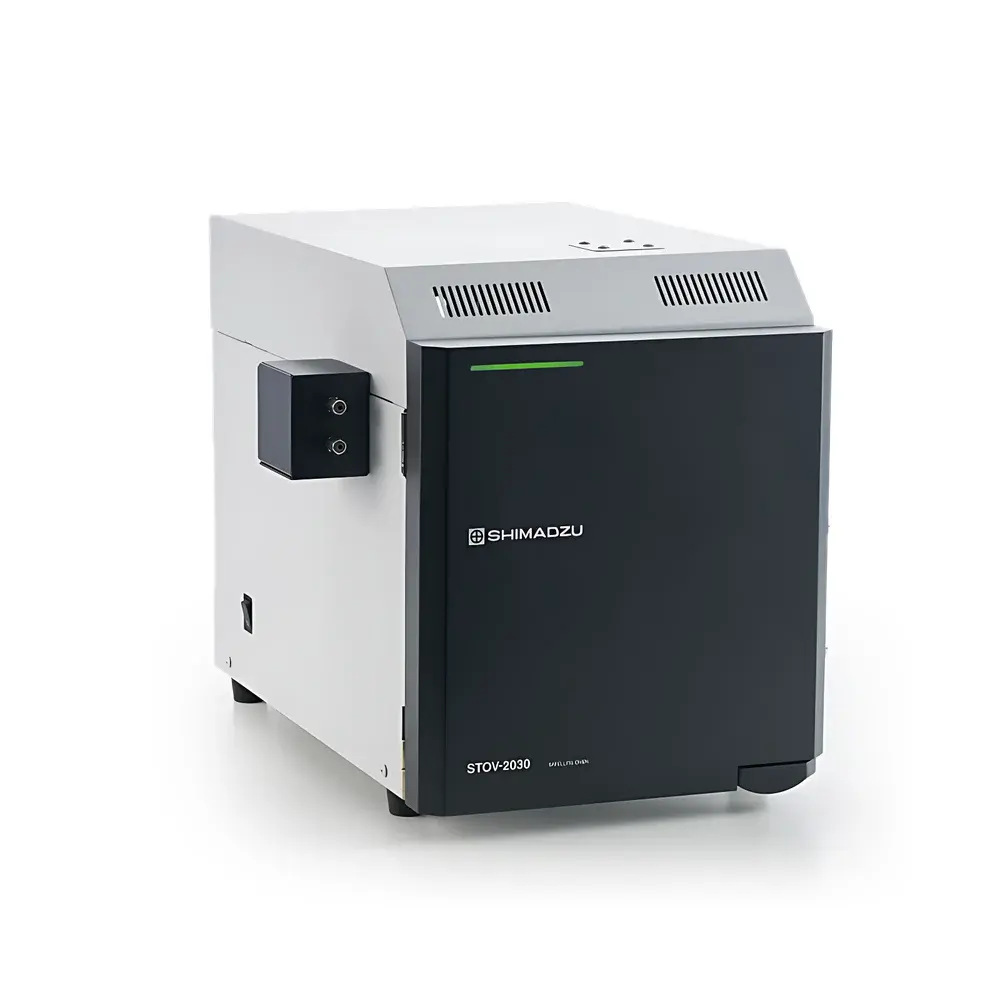
Shimadzu STOV-2030 Enhanced Column and Valve Oven
| Brand | Shimadzu |
|---|---|
| Model | STOV-2030 |
| Origin | Jiangsu, China |
| Manufacturer Type | Original Equipment Manufacturer (OEM) |
| Product Category | Domestic |
| External Dimensions | 17.8 L (volume) |
| Compatibility | Nexis GC-2030 Gas Chromatograph |
| Control Interface | GC instrument front panel & LabSolutions software |
| Temperature Control | Independent, programmable, integrated with GC sequence timing |
Overview
The Shimadzu STOV-2030 Enhanced Column and Valve Oven is an engineered thermal management module designed specifically for high-complexity gas chromatography (GC) configurations requiring simultaneous control of multiple analytical columns and switching valves. Unlike standard column ovens, the STOV-2030 implements a fully independent, spatially uniform heating architecture—eliminating thermal gradients across valve manifolds, transfer lines, and column bundles. Its operation is grounded in precision resistive heating combined with PID-controlled air circulation, ensuring stable thermal environments within ±0.1 °C over time. The oven is mechanically and electronically optimized for seamless integration with the Shimadzu Nexis GC-2030 platform, enabling synchronized temperature ramping, valve actuation, and injection timing—all governed by a single acquisition sequence. This architecture supports advanced multidimensional GC (MDGC), heart-cutting, and comprehensive two-dimensional GC (GC×GC) workflows where thermal consistency directly impacts retention time reproducibility, peak shape fidelity, and method robustness.
Key Features
- Independent thermal control system with no cold spots—uniform heating across all internal components including valve heads, stainless-steel tubing, and up to four 30-m capillary columns (or equivalent packed column configurations)
- Large internal volume (17.8 L) accommodating complex valve manifolds (e.g., 6-port, 10-port switching valves), auxiliary pressure regulators, and multi-column arrangements without compromising airflow dynamics
- Direct digital communication with Nexis GC-2030 via RS-232/USB; temperature setpoints and ramps are programmable through both the GC front panel and LabSolutions GC software
- Temperature parameters embeddable into GC pre-run sequences—enabling precise alignment of oven equilibration, valve switching events, and split/splitless injection timing
- Thermally insulated double-wall construction with low-thermal-mass ceramic heater elements and redundant safety cutoffs compliant with IEC 61010-1
- Front-access service design: removable side panels and modular mounting rails simplify valve replacement, column reconfiguration, and leak-check procedures without disassembling the GC chassis
Sample Compatibility & Compliance
The STOV-2030 is validated for use with standard fused-silica capillary columns (0.1–0.53 mm ID), packed stainless-steel or glass columns, and high-pressure pneumatic or electrically actuated switching valves (up to 100 psi operating pressure). It meets mechanical and electrical safety requirements per ISO/IEC 17025 laboratory infrastructure guidelines when installed in accredited testing facilities. While not a standalone analytical instrument, its thermal stability contributes to method compliance with ASTM D3606 (benzene/toluene in gasoline), ASTM D5186 (aromatics in diesel), and USP chromatographic system suitability criteria. All firmware and LabSolutions-integrated control logic support audit trail generation and electronic signature capability per FDA 21 CFR Part 11 when deployed in regulated GLP/GMP environments.
Software & Data Management
Temperature programming is fully integrated into Shimadzu LabSolutions GC software (v5.9 or later). Users define oven profiles—including hold times, ramp rates, and event-triggered setpoint changes—as part of the method file. The STOV-2030 reports real-time internal temperature, heater status, and fault codes to the GC data system; these values are logged alongside chromatograms and stored in the native .lcd format. Sequence-based control allows temperature transitions to be synchronized with valve actuation commands (e.g., “Valve A switch at 2.4 min, followed by column oven ramp to 180 °C at 2.6 min”). All temperature-related events are timestamped and included in the raw data audit trail, supporting traceability during regulatory inspections.
Applications
- Petrochemical analysis: Simultaneous quantification of C3–C12 hydrocarbons, oxygenates, and sulfur compounds using backflush, heart-cut MDGC, or column-switching methods
- Environmental testing: Automated analysis of EPA Method 8260C target volatiles with on-column cryo-focusing and timed valve release
- Pharmaceutical impurity profiling: Orthogonal column switching between polar and non-polar phases for co-elution resolution without manual intervention
- Food and flavor chemistry: High-resolution separation of terpenes, aldehydes, and esters across temperature-programmed dual-column systems
- Method development labs: Rapid prototyping of valve timing, column combinations, and thermal gradients under reproducible ambient conditions
FAQ
Is the STOV-2030 compatible with GC systems other than Nexis GC-2030?
The STOV-2030 is designed and tested exclusively for Shimadzu Nexis GC-2030 integration. While analog temperature monitoring may be possible via external thermocouple inputs, full bidirectional control—including sequence-synchronized valve timing and LabSolutions method embedding—is only supported on the native platform.
What is the maximum operating temperature range?
The STOV-2030 supports programmable temperature control from ambient +5 °C to 250 °C, with stabilization accuracy of ±0.1 °C at steady state and ramp rates adjustable from 0.1 to 60 °C/min.
Does it support passive cooling or forced-air cooling options?
No. The STOV-2030 is a convection-heated oven without active cooling; cooldown occurs passively following heater deactivation. For applications requiring rapid temperature cycling, users must account for natural cooldown kinetics in method development.
Can multiple STOV-2030 units be daisy-chained or networked?
Each unit operates as an independent peripheral controlled by a single GC host. Daisy-chaining or shared controller configurations are not supported; multi-oven setups require separate GC channels or external PLC coordination.
Is calibration documentation provided with shipment?
Yes. Each unit ships with a factory calibration certificate traceable to NIM (National Institute of Metrology, China), verifying thermal uniformity across five internal reference points at 50 °C, 150 °C, and 220 °C.




